

Yes, UK contractors can secure a mortgage using contract or day rates rather than payslips or tax accounts. Many lenders, including a growing number of specialist underwriters, will assess your gross contract rate as the primary income measure. The fastest route to an offer is to annualize your day rate, gather evidence of contract continuity, and engage a specialist contractor mortgage adviser before approaching any lender directly.
Here is what to do immediately:
- Annualize your day rate using the standard formula: daily rate × 5 days × 46 weeks.
- Estimate your borrowing range by applying a common multiple to that annualized figure.
- Gather your current contract, any renewal letters, and three to six months of bank statements.
- Check your credit file and confirm your deposit is at least 10% of the purchase price.
- Contact a specialist adviser who works with contractor-based underwriting before submitting any application.
Pro Tip: Do not approach a high-street lender directly before speaking with a specialist. Many mainstream lenders default to payslip or SA302 assessment, which can significantly understate a contractor's actual income and reduce borrowing capacity.
Table of Contents
- What is a contractor mortgage and how does it differ from a standard mortgage?
- How do lenders calculate affordability for contractors?
- How much can contractors typically borrow?
- Which mortgage products do contractors commonly use?
- What does the contractor mortgage application process involve?
- How do you pick the right contractor mortgage specialist?
- How Havenmarkadvisers approaches contractor mortgage cases
- Key Takeaways
- What contractors consistently get wrong about specialist advice
- Havenmarkadvisers: structured advice for contractor mortgage cases
- Useful sources
What is a contractor mortgage and how does it differ from a standard mortgage?
A "contractor mortgage" is not a separate product. It refers to a bespoke underwriting approach in which a lender assesses income based on your gross contract or day rate rather than requiring payslips, P60s, or two to three years of self-employed accounts. The distinction matters because standard mortgage underwriting is built around salaried employment: lenders look at payslips or, for the self-employed, SA302 tax calculations and business accounts. For contractors, those figures often understate real earning capacity, particularly when a limited company director draws a low salary and retains profit in the business.
Contract-based underwriting treats the gross contract rate as the income measure, which can allow contractors to borrow significantly more than traditional underwriting would permit.
Three contracting structures are typically considered by lenders using this approach:
- Limited company contractors — operating outside IR35, assessed on day rate or annualized contract value.
A contractor earning £500 per day assessed under standard underwriting might show a limited company salary of £12,570 and dividends of £30,000, giving a lender income of roughly £42,570. Under contract-based underwriting, the same contractor's annualized rate is £500 × 5 × 46 = £115,000 — a figure that changes the mortgage conversation entirely.
The practical difference is not marginal. It can determine whether a contractor qualifies for the property they want or is forced to settle for less.

How do lenders calculate affordability for contractors?
The day-rate annualization formula
The industry-standard formula is: daily rate × 5 days × 46 weeks. The 46-week multiplier accounts for holidays, bank holidays, and typical gaps between contracts. A contractor billing £600 per day produces an annualized income of £138,000 under this method. Lenders then apply an income multiple to that figure to determine the maximum loan.
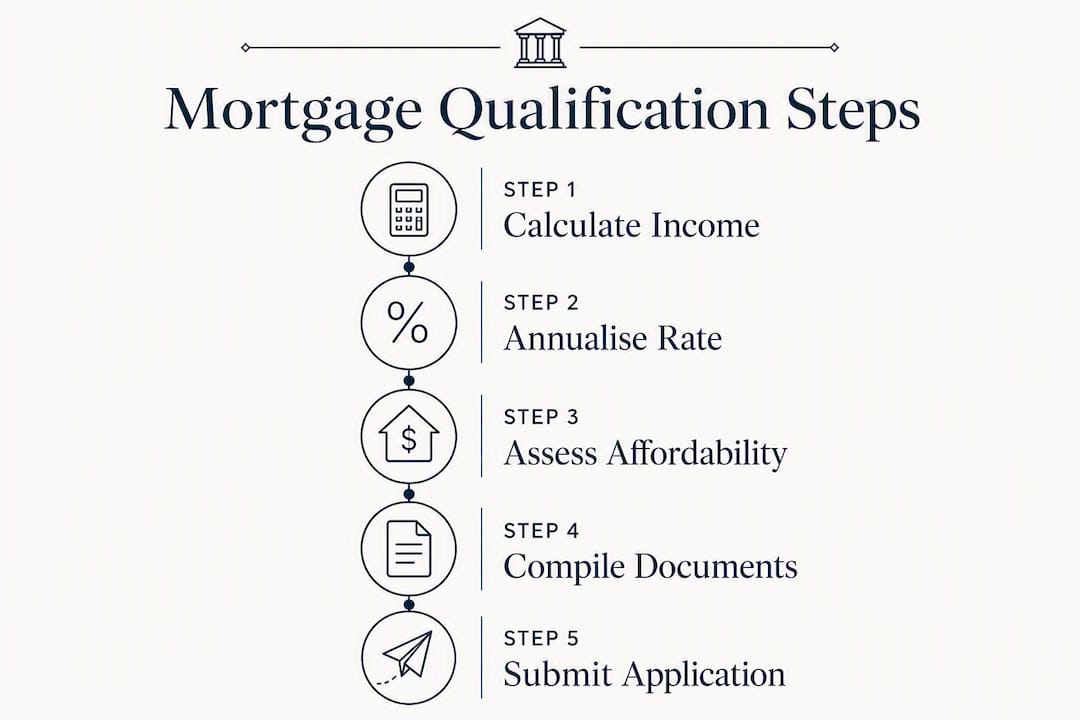
Income assessment methods lenders use
Not every lender applies the same method. The most common approaches are:
- Day rate × 5 × 46 — the standard annualization formula, used by most specialist lenders and a growing number of mainstream ones.
- Payslips and SA302 — used by lenders who treat contractors as self-employed or PAYE, requiring two to three years of accounts or tax calculations.
- Umbrella payslips and P60: for umbrella workers, lenders typically use payslips and P60s as the primary income evidence, though some will still apply a day-rate calculation where the contract specifies one.
Umbrella/PAYE versus limited company contractors
Umbrella company workers are treated as PAYE employees for mortgage purposes. That simplifies documentation — payslips and a P60 are straightforward evidence — but it can reduce the income figure a lender accepts. Umbrella deductions (employer's National Insurance, the umbrella margin, and employee deductions) reduce gross pay before it appears on a payslip. A contractor grossing £500 per day through an umbrella may see a net payslip figure considerably lower than the £115,000 annualized rate a limited company contractor would present.
Limited company contractors outside IR35 generally benefit most from day-rate underwriting. Those inside IR35 are treated more like employees, and some lenders will assess them on the deemed employment income rather than the gross contract rate.
IR35 and its impact on affordability
IR35 status directly affects which income figure a lender will accept. Outside IR35, most specialist lenders will use the full day-rate annualization. Inside IR35, the deemed employment income is lower after deductions, and some lenders revert to payslip-based assessment. Switching IR35 status mid-application is one of the most common mistakes contractors make — lenders treat it as a material change and may withdraw an offer.
Documents lenders commonly request
Many lenders ask for a combination of the following, depending on structure:
- Current signed contract and any renewal letters
- Assignment confirmations or schedule of contracts for the past 12–24 months
- Three to six months of personal and business bank statements
- Most recent P60 (for umbrella or PAYE contractors)
- SA302 and tax year overviews (where accounts-based assessment applies)
- Payslips (last three months for umbrella/PAYE applicants)
- Proof of identity and address
Specialist lenders tend to be more flexible with contract history length. Some will accept a single contract with three months remaining, where a high-street lender might require 12 months of continuous contracting.
How much can contractors typically borrow?
Most contractor-friendly lenders apply income multiples in the range of 4.0× to 4.5× annualized contract income. Specialist contractor brokers commonly cite 4.5× as a practical market average for estimating borrowing capacity.

| Daily Rate | Annualized Income (× 5 × 46) | At 4.0× | At 4.5× |
|---|---|---|---|
| £600 | £138,000 | £552,000 | £621,000 |
These figures are illustrative. Actual maximum loan amounts depend on deposit size, outstanding credit commitments, loan term, and the specific lender's criteria. A contractor with a £50,000 car finance balance or significant credit card debt will see those figures reduced.
Deposit size also affects which products and multiples are available. A minimum deposit advised is around 10%, with better rates typically available at lower loan-to-value ratios. Contractors with larger deposits often access both better rates and higher income multiples.
Pro Tip: Use the 4.0× figure for conservative planning and the 4.5× figure as your target. If a lender offers 5.0×, treat it as a ceiling — not a starting point — and factor in your full monthly outgoings before committing to the maximum.
You can model your own figures using contractor mortgage calculators that apply day-rate inputs directly.
Which mortgage products do contractors commonly use?
Contractors have access to the same product types as any other borrower, though lender availability varies by underwriting approach.
- Fixed-rate mortgages are the most common choice for contractors. A fixed rate provides payment certainty for two, three, or five years, which suits contractors whose income can fluctuate between contracts. Budgeting is straightforward when the monthly payment does not change.
- Tracker and variable-rate mortgages follow the Bank of England base rate or a lender's standard variable rate. They can offer lower initial payments but introduce payment risk during rate-rising cycles. Contractors with strong cash reserves and predictable contract pipelines sometimes prefer trackers for the flexibility they offer, particularly where early repayment charges are lower.
- Repayment mortgages reduce the outstanding balance each month and are the standard choice for residential purchases. Most lenders require repayment for contractor applicants, particularly at higher loan-to-value ratios.
- Interest-only mortgages are available to contractors in some circumstances, typically at lower LTV ratios and where a credible repayment vehicle exists. Lender criteria for interest-only are stricter, and availability through contractor-specialist underwriting is more limited.
- Buy-to-let mortgages for contractors are assessed differently again. Most buy-to-let lenders focus on rental income coverage rather than personal income, but some still require evidence of personal income above a minimum threshold. Contractors pursuing buy-to-let should confirm whether the lender applies contractor-specific underwriting or defaults to accounts-based assessment.
One practical consideration: some lenders that offer contractor-friendly underwriting on residential products do not extend the same flexibility to their buy-to-let range. The lender panel for contractor buy-to-let cases is narrower, and a specialist adviser is particularly valuable in that context.
What does the contractor mortgage application process involve?
Typical costs
| Cost Item | Approximate Range |
|---|---|
| Adviser/broker fee | £500 (paid on completion) |
| Lender arrangement fee | £0–£2,000 (some lenders add to loan) |
| Conveyancing/legal fees | £1,000–£2,000 |
| Stamp duty land tax | Varies by purchase price; see official SDLT rates |
Stamp duty is calculated on the purchase price and varies by buyer status (first-time buyer, home mover, additional property). Budget for it separately from mortgage costs.
Specialist contractor applications that are well-prepared — correct documents, clear contract history, no mid-application status changes — typically reach mortgage offer within four to eight weeks. Poorly prepared cases, or those submitted to lenders whose criteria do not match the applicant's structure, can take considerably longer or result in a declined application that affects the credit file.
A specialist adviser reduces timescales by matching lender criteria before submission and preparing the document pack to the lender's exact requirements. That upfront preparation is where most of the time saving occurs.
How do you pick the right contractor mortgage specialist?
Not every mortgage adviser has experience with contract-based underwriting. The difference between a generalist broker and a specialist can determine whether you access the right lender panel and whether your income is presented accurately.
What to look for
- Experience specifically with day-rate and contract-based underwriting, not just general self-employed cases.
- A lender panel that includes specialist contractor-friendly underwriters, not only high-street names.
- Demonstrated track record with umbrella, limited company, and IR35 cases.
- A transparent, fixed fee structure with no hidden charges.
Questions to ask before engaging
- How do you evidence contract income to lenders, and which lenders do you use for short contract histories?
- What is your typical turnaround from application to offer for contractor cases?
- How do you handle IR35 status changes or mixed income structures?
- What is your fee, when is it payable, and what does it cover?
Red flags to avoid
An adviser who cannot name specific lenders they use for contractor cases, promises guaranteed approval, or is vague about their fee structure before engagement is not operating with the transparency a contractor mortgage application requires. Guaranteed approval is not a legitimate offer — it is a warning sign.
Specialist advisers can often match contractors to lenders who accept short contract histories or specific contract types, which speeds up approval and improves borrowing outcomes. Ask for references or case examples (anonymized) and confirm the adviser is authorized and regulated by the Financial Conduct Authority.
A quick check on the FCA Register confirms whether an adviser or firm holds the correct permissions for mortgage advice. That verification takes two minutes and is worth doing before sharing any financial documents.
How Havenmarkadvisers approaches contractor mortgage cases
Havenmarkadvisers assigns a single dedicated adviser to each contractor mortgage case from initial assessment through to completion. There is no handoff between teams, no repeated explanation of your contract structure, and no ambiguity about who is managing your application.
The firm's approach to day-rate contractor mortgages includes:
- Lender-matching: with over 10 years of experience and access to a broad panel of UK lenders, Havenmarkadvisers identifies lenders whose criteria align with your specific contracting structure, whether limited company, umbrella, CIS, or self-employed business owner.
Fees are charged on a completion basis for purchase and remortgage cases, with the structure explained transparently at the outset. The firm may also receive commission from lenders. Contractors working in finance, law, or other professional sectors will find that Havenmarkadvisers has specific experience with the income structures common in those fields.
Key Takeaways
UK contractors can secure mortgages using day-rate annualization, with specialist lenders applying a 4.0× to 4.5× multiple to the annualized contract income figure.
| Point | Details |
|---|---|
| Contract-based underwriting | Lenders use day rate × 5 × 46 weeks as annualized income, not payslips or accounts. |
| Typical borrowing multiple | Specialist lenders commonly apply 4.5× annualized income; 4.0× is a conservative planning figure. |
| Deposit and credit | A minimum 10% deposit is advised; better rates and multiples apply above 25% LTV. |
| IR35 and structure | Avoid changing IR35 status or working structure during an active application. |
| Havenmarkadvisers | Assigns one dedicated adviser per case, with lender access and over 10 years of contractor mortgage experience. |
What contractors consistently get wrong about specialist advice
The most common mistake contractors make is treating a mortgage application as a documentation exercise rather than a positioning exercise. Lenders do not simply process numbers — they assess risk. A contractor who submits a well-organized contract history, a clear annualized income calculation, and a clean credit file is presenting a low-risk profile. A contractor who submits the same financial position but with gaps, inconsistent bank statements, and no explanation of IR35 status is presenting an uncertain one.
The second mistake is assuming that a generalist broker who handles self-employed cases will understand contractor underwriting. Self-employed mortgage advice and contractor mortgage advice overlap but are not the same thing. A broker who defaults to SA302 assessment for a limited company contractor outside IR35 is leaving significant borrowing capacity on the table.
Specialist preparation is not a luxury for complex cases. It is the standard that produces reliable outcomes. Contractors who engage a specialist adviser early, before property searches begin, consistently reach offer faster and with fewer complications than those who approach lenders directly or use generalist brokers.
Havenmarkadvisers: structured advice for contractor mortgage cases
Contractors with non-standard income structures need an adviser who understands how lenders assess contract rates, not one who defaults to the payslip model. Havenmarkadvisers provides structured mortgage advice specifically for contractors, with a single dedicated adviser managing every stage of the process.

The firm's fee model is transparent: a completion fee for purchase or remortgage cases, explained clearly before engagement begins. There are no hidden charges and no ambiguity about what the service covers. With access to a broad panel of UK lenders and over 10 years of experience with contractor income structures, Havenmarkadvisers matches each case to the lender most likely to approve it at the best available rate.
To start, request an eligibility check or book a call through the day-rate contractor mortgage page. Bring your current contract, a summary of your recent contract history, and your deposit figure. The initial assessment is the fastest way to confirm your borrowing position before you begin a property search.
This article provides general information only and does not constitute regulated mortgage advice. Mortgage eligibility, rates, and lender criteria change regularly. Confirm current terms with a qualified adviser or the relevant lender before making any financial decision.
Useful sources
| Resource | Purpose |
|---|---|
| Contractor Mortgages: advice, information and quotation | Day-rate annualization formula, lender expectations, and document guidance |
| Contractor Mortgages based on your contract rate | Borrowing multiples, specialist broker guidance, and worked examples |
| Mortgages for contractors | Lender flexibility overview and document requirements |
| Umbrella Company Mortgage guidance | How umbrella/PAYE workers are assessed and how P60s are used |
| Contractor mortgage calculators | Day-rate borrowing calculators and scenario modeling |
| gov.uk: P60 guidance | Official P60 documentation reference for PAYE and umbrella applicants |
| gov.uk: Stamp Duty Land Tax rates | Official SDLT rates for purchase cost budgeting |