

Contractors can remortgage. The process is more document-intensive than a standard employed application, but it is entirely achievable when you approach the right lenders with the right evidence. Many lenders and specialist products are available to contractors, and success depends primarily on how your income is structured and how clearly you can document it.
Quick eligibility checklist:
- Income evidence: At least two years of SA302 tax calculations, company accounts, or a current contract with annualised day-rate evidence (lender-dependent)
- Affordability range: Lenders typically lend around 4.5 times income, though specialist lenders using gross contract value may reach higher multiples in illustrative calculations
- Offer window: Once a mortgage offer is issued, you generally have up to six months to complete — plan your application timing accordingly
The immediate next step: gather your key documents and contact a specialist adviser for lender-matching before your current deal expires.
Pro Tip: Start the process four to six months before your fixed rate ends. Leaving it later risks a lapse onto your lender's standard variable rate, which is almost always higher.
Key Takeaways
Contractors can remortgage successfully when they approach the right lenders with complete, well-structured documentation and allow sufficient lead time before their current deal expires.
| Point | Details |
|---|---|
| Remortgaging is achievable | Contractors can remortgage; success depends on income model, documentation quality, and lender selection. |
| Lender criteria vary by type | Day-rate, limited company, umbrella, and sole trader contractors each require different income evidence and lender matching. |
| Start four to six months early | Beginning the process four to six months before your fixed rate ends avoids lapsing onto the standard variable rate. |
| Six-month offer window | Once issued, a mortgage offer is typically valid for six months — align your contract renewal and completion date accordingly. |
| Havenmarkadvisers | Provides dedicated, single-adviser remortgage support for contractors, with broad lender panel access and a fee-on-completion model. |
Table of Contents
- What does remortgaging mean for contractors, and when does it make sense?
- Can contractors remortgage, and how does eligibility differ by income type?
- How do UK lenders assess a contractor remortgage application?
- What paperwork do you need, and how long does a contractor remortgage take?
- Step-by-step: how to prepare your remortgage application now
- What does a contractor remortgage cost?
- Why a specialist adviser matters for contractor remortgage cases
- What to do this week if you want to remortgage
- What contractors often underestimate about the remortgage process
- Havenmarkadvisers' remortgage service for contractors
- Sources
What does remortgaging mean for contractors, and when does it make sense?
Remortgaging means switching your existing residential mortgage to a new product, either with your current lender or a different one, without moving home. For contractors, the motivation is usually one of four things: securing a lower interest rate as a fixed term ends, releasing equity from a property that has risen in value, consolidating higher-rate debt into the mortgage, or moving to a lender that assesses income on contract terms rather than salary alone.
Timing is the critical variable. Most fixed-rate products carry early repayment charges (ERCs) during the fixed period, typically calculated as a percentage of the outstanding balance. Remortgaging before the ERC window closes can cost more than staying put, so the first calculation is always whether the saving on the new rate outweighs the exit cost. For contractors whose income has grown since the original mortgage was arranged, remortgaging can also unlock better loan-to-value bands and lower rates.
A product transfer with your existing lender is a simpler alternative when the rate is competitive and your income documentation has become more complex since the original application. It avoids a full underwriting review. The trade-off is that you are limited to that lender's product range.
Can contractors remortgage, and how does eligibility differ by income type?
Eligibility is real and broadly available, but the criteria vary significantly depending on how you operate. Remortgages for contractors and self-employed applicants are available and often hinge on whether you can demonstrate historical income through accounts or future income through contract evidence.
Day-rate contractors are often assessed using annualised gross contract value. A lender takes the day rate, multiplies it by the number of working days per year (commonly 46 to 48 weeks), and uses that figure as the income basis. Some specialist lenders use this method to produce borrowing examples of a higher multiple of gross annualised contract value in illustrative calculations for IT contractors. The key requirement is a current contract with at least four to six weeks remaining, plus a track record of continuous contracting.
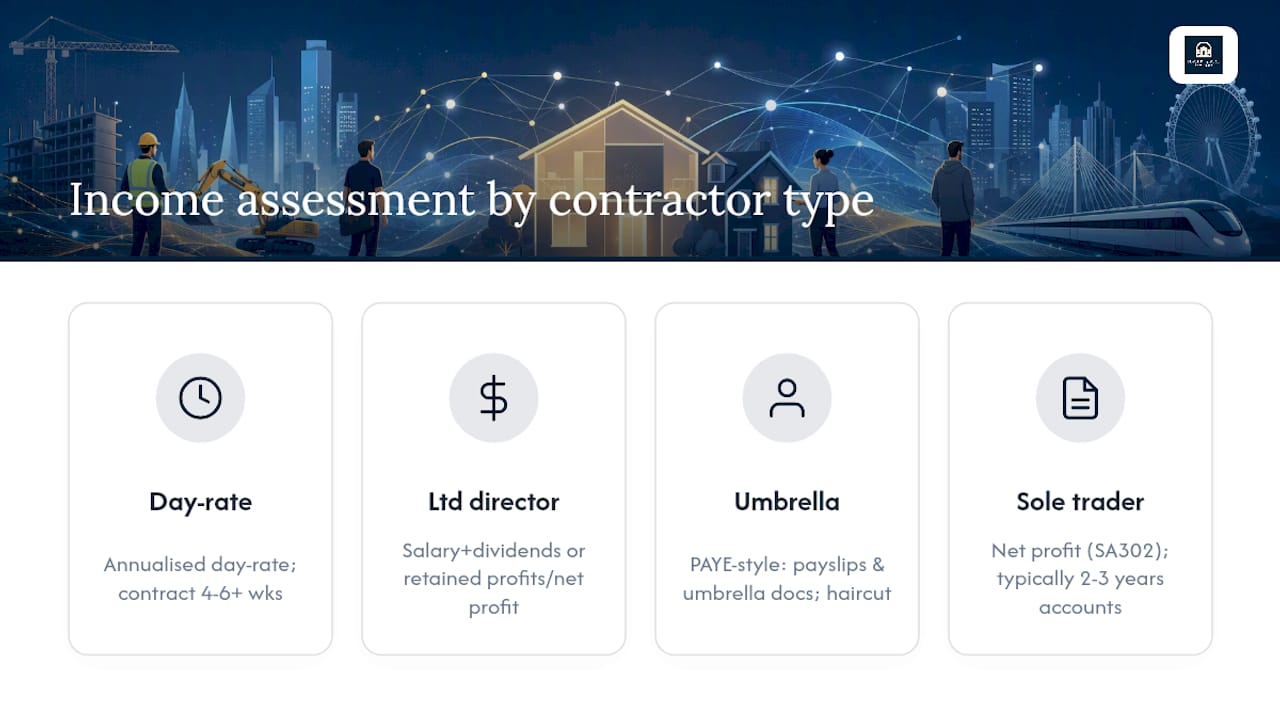
Limited company directors face a more varied assessment. Some lenders use salary plus dividends declared on the tax return. Others will consider retained profits within the company, which benefits directors who reinvest rather than extract income. A third route uses the company's net profit. The approach that produces the highest assessable income depends on how the company accounts are structured, which is why an adviser familiar with limited company director mortgages is worth engaging early.
Umbrella company contractors are generally treated similarly to PAYE employees. Lenders look at payslips and the umbrella's employment documentation. The income assessment is more straightforward, though some lenders apply a haircut to umbrella pay to account for the variable nature of assignments.
Sole traders are assessed on net profit as declared on the SA302 and tax return. Two to three years of accounts is the standard expectation, though some lenders will consider one year where the income trend is strong and the sector is stable.
Gaps between contracts affect all types. A gap of more than four to eight weeks within the past 12 months can prompt additional questions. Lenders want to see that contracting is a deliberate career structure, not a period of instability. Being inside IR35 does not automatically disqualify an application, but it changes how income is assessed and which lenders are appropriate.
How do UK lenders assess a contractor remortgage application?
Lenders underwriting a contractor remortgage review several factors simultaneously. Understanding the full picture helps you anticipate queries before they slow the process.
Core lender criteria:
- Proof of income: Current contract, SA302s, company accounts, or payslips depending on contractor type
- Contract length remaining: Most lenders want at least four weeks left on the current contract at application; some require more
- Trading history: Typically two years, though some lenders accept one year with strong evidence
- Loan-to-value (LTV): Lower LTV generally unlocks better rates; 75% LTV or below is the threshold where the best products tend to appear
- Credit history: Defaults, missed payments, or County Court Judgments within the past three to six years will limit lender options
- Outgoings and commitments: Student loans, car finance, and credit card balances all reduce the assessable income figure
- Sector and client stability: Lenders in some cases consider the stability of the contractor's sector and the size of the end client
Specialist lenders assess contractor income through day-rate annualisation, salary plus dividends, or company net profits, and the route that produces the most favorable outcome depends on your specific structure. High-street lenders often default to the most conservative method, which is why the lender panel matters.
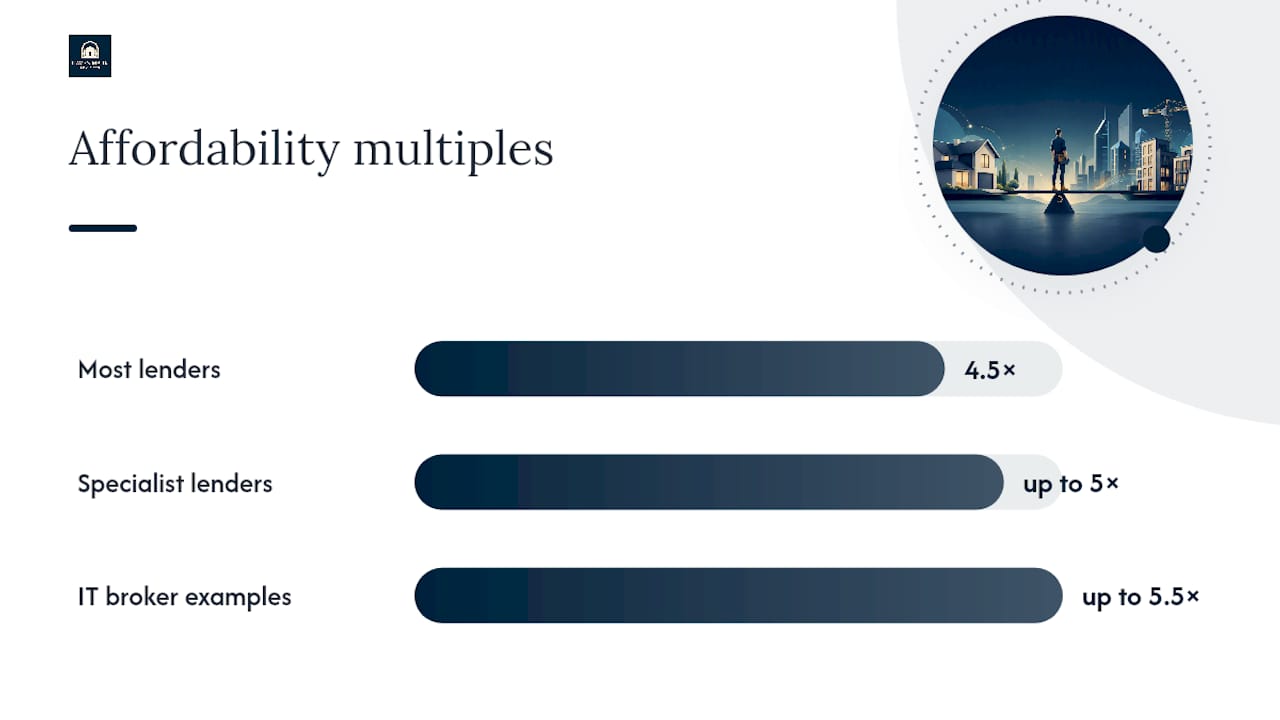
On affordability, the standard market guidance is around 4.5 times income for most lenders, though illustrative examples from IT contractor-focused brokers show specialist lenders sometimes offer up to 5 or 5.5 times for applicants with annualised contract evidence. Deposit size and income consistency materially affect available products and rates, and preparing accounts alongside forward projections can strengthen an application where income has been variable.
For day-rate contractors, the annualisation method can produce a materially higher assessable income than two years of averaged accounts, particularly where recent contract rates have increased. Choosing the right lender for your income model is the single most consequential decision in the process.
What paperwork do you need, and how long does a contractor remortgage take?
Document checklist:
- Valid photo ID (passport or driving license)
- Proof of current address (utility bill or bank statement, dated within three months)
- Last two to three years of SA302 tax calculations and tax year overviews (generally obtained from HMRC)
- Company accounts for the last two to three years (limited company directors)
- Current contract or letter of engagement, showing start date, end date, and day rate or fee
- Last three months of personal bank statements
- Last three months of business bank statements (limited company)
- Recent payslips (umbrella contractors, typically last three months)
- Accountant's certificate confirming income (some lenders require this)
- Proof of existing mortgage account details and outstanding balance
Lenders commonly request SA302s, company accounts, and accountant's certificates as standard for contractor applications. Where historical accounts are limited, lenders may also require proof of future income or signed contract evidence.
Typical timeline:
A straightforward contractor remortgage takes four to eight weeks from application to completion. More complex cases, such as a recent transition from employment to contracting, overseas income, or a short-term contract with limited history, can extend to ten to twelve weeks. The stages and approximate durations:
- Adviser instruction and lender research: One to two weeks
- Application submission: Two to five working days once documents are complete
- Valuation or desktop survey: Three to seven working days
- Underwriting and queries: One to three weeks (longer for complex income)
- Mortgage offer issued: Offer is typically valid for six months from issue date
- Legal work and completion: Two to four weeks
The six-month offer window is particularly relevant for contractors whose contract renewal falls close to the completion date. If your contract expires before completion, some lenders will require a new contract before proceeding.
Step-by-step: how to prepare your remortgage application now
- Check your fixed-rate end date and ERC schedule. Log into your lender's portal or call them directly. Note the exact date your ERC drops to zero and calculate the cost of exiting early versus waiting.
- Pull your credit report. Use a free service such as Experian, Equifax, or TransUnion. Resolve any errors, register on the electoral roll if you have not already, and clear any small outstanding balances that appear as defaults.
- Gather your income documents. Request SA302s through your accountant or the HMRC online service. Confirm your company accounts are filed and up to date. Obtain a signed accountant's certificate if your lender is likely to require one.
- Secure written contract evidence. If your current contract is due to renew, get the renewal in writing before applying. Some lenders will not proceed without at least four weeks remaining on the contract.
- Review your outgoings. Reduce or close unused credit facilities. Avoid taking on new credit in the three months before application.
- Assess your LTV position. Get an indicative property valuation to understand your current equity position. Moving from 80% LTV to 75% LTV, for example, can open a materially different product tier.
- Contact a specialist adviser. Provide your income structure, current mortgage details, and target completion date. A specialist can identify the lenders most likely to accept your income model before you submit a formal application.
Pro Tip: If your most recent year of accounts shows significantly higher income than the prior year, waiting until that year's SA302 is available can increase the assessable income figure and improve your borrowing options. Discuss the timing with your accountant and adviser together.
What does a contractor remortgage cost?
Remortgaging carries several fees, and the total cost determines whether switching is financially worthwhile.
Common fees to budget for:
- Early repayment charge: Typically 1%–5% of the outstanding balance if you exit during a fixed period
- Arrangement or product fee: Charged by the new lender, commonly £999–£1,999, sometimes higher for specialist products; can often be added to the loan
- Valuation fee: Ranges from £150 to £1,500 depending on property value and survey type; some lenders offer free valuations as part of the product
- Solicitor or conveyancing fees: £300–£800 for a standard remortgage; some lenders offer a free legal service
- Lender exit fee: A small administrative charge from your current lender, typically £50–£300
- Adviser fee: Varies by firm; some charge on completion, others on application; confirm the model before instructing
The break-even calculation is straightforward in principle. Add up all the costs of switching. Divide that total by the monthly saving the new rate produces. The result is the number of months before you are in profit from the switch. If you plan to remortgage again or sell before that point, the switch may not be worthwhile.
Pro Tip: Fee-free products carry a higher interest rate. A product with a £1,500 arrangement fee but a lower rate often costs less over a two-year fixed term on a mortgage above £200,000. Run both scenarios before deciding.
Practical cost-reduction options include requesting a product transfer with your existing lender (no legal fees, no valuation in most cases), choosing a lender that offers a free valuation and free legal service as part of the remortgage product, and confirming that any adviser fee is charged on completion rather than upfront.
Why a specialist adviser matters for contractor remortgage cases
Remortgaging can be more challenging for contractors because of additional paperwork and lender sensitivity to non-standard income. A specialist adviser reduces that friction in several concrete ways.
What a specialist adviser does:
- Identifies lenders whose criteria match your specific income model before application, avoiding rejections that can affect your credit file
- Prepares and reviews your document pack to catch gaps before submission
- Manages lender queries directly, reducing delays during underwriting
- Provides a single point of contact throughout the case, so nothing falls between advisers
- Advises on timing: when to lock a rate, whether to wait for a stronger year of accounts, and how to handle a contract gap
A contractor-friendly lender is one that acknowledges the unique income structure of self-employment, and identifying those lenders requires knowledge of underwriting policies that are not always published publicly. High-street channels often default to the most conservative income assessment, which can understate borrowing capacity significantly.
Havenmarkadvisers brings over 10 years of experience in structured mortgage advice for contractors and self-employed professionals. Each client is assigned a single dedicated adviser from initial enquiry through to completion, with access to a broad panel of UK lenders including those that accept day-rate annualisation and contract-based income. Fees are charged on completion, not upfront.
For self-employed borrowers and business owners, the adviser's role extends to coordinating with accountants, structuring the document pack for the target lender's specific requirements, and managing the timeline around contract renewals.
Pro Tip: When you first contact an adviser, have your current mortgage statement, most recent contract, and last SA302 to hand. That information alone allows an experienced adviser to identify the most suitable lender tier and give you a realistic borrowing estimate within the first conversation.
What to do this week if you want to remortgage
- Check your fixed-rate end date and ERC. Log this date and calculate the earliest cost-free exit point.
- Pull your credit report from Experian, Equifax, or TransUnion and resolve any errors immediately.
- Gather your core documents: current contract, last two SA302s, and most recent company accounts or payslips.
- Contact a specialist adviser with your income structure and target completion date. If your fixed term ends within six months, do this today.
If your fixed term ends in more than six months, use the time to strengthen your position: file accounts, renew contracts in writing, and reduce credit commitments. If it ends within three months, prioritize adviser contact above everything else on this list.
What contractors often underestimate about the remortgage process
The paperwork volume surprises most contractors the first time they remortgage. What surprises them more is discovering that the lender they originally used may no longer offer the best terms for their current income structure, particularly if their contracting income has grown or their operating model has changed.
The assumption that a product transfer with the existing lender is always the simpler route is worth examining carefully. A product transfer avoids underwriting, which is convenient. But it also means the lender assesses affordability on the same basis as the original application, which may now understate income if day rates have increased or if a limited company structure has matured. A full remortgage to a specialist lender can unlock a materially higher loan or a lower rate, even accounting for the additional process steps.
The other underestimated factor is the interaction between contract timing and mortgage offer validity. A contractor whose contract expires during the underwriting period may find the lender pauses the application pending a renewal. Planning the remortgage application to align with a confirmed contract renewal, rather than a contract that is about to lapse, removes one of the most common causes of delay.
Early planning is not just a procedural nicety. For contractors, it is the difference between a controlled process and a reactive one.
Havenmarkadvisers' remortgage service for contractors
Contractors with complex income structures need more than a rate comparison. They need a structured process, a lender panel that includes specialist options, and an adviser who understands how day-rate annualisation, limited company accounts, and umbrella payslips translate into a mortgage application.

Havenmarkadvisers provides dedicated remortgage advice for contractors and self-employed professionals across England. Each client works with one adviser from the initial consultation through to completion. That adviser handles lender-matching, document review, underwriting queries, and timeline management. Fees are charged on completion. There are no upfront advisory charges.
In an initial consultation, the adviser reviews your income structure, current mortgage terms, and target outcome, then identifies the lenders most likely to accept your application on favorable terms. For contractors with variable income, recent transitions to self-employment, or complex company structures, this lender-matching step is where the most significant value is created.
To get started, visit the Havenmarkadvisers remortgage page and request a consultation. Bring your current mortgage statement, most recent contract, and last two SA302s to the first conversation.
Sources
- Contractor Mortgages - based on your contract rate 2026 - IT Contracting
- Mortgages for contractors | MoneySuperMarket
- Remortgaging: 6 Month Rule - Ferro Financial
This article provides general information about contractor remortgages in England and does not constitute regulated financial advice. Mortgage products, lender criteria, and tax rules change regularly. Confirm current terms with a qualified mortgage adviser and verify tax-related figures directly with HMRC or a qualified accountant before making decisions.
This article is general information, not a substitute for advice from a qualified financial advisor. Consult a qualified financial professional about your own circumstances before acting on anything here.