

A Decision in Principle (also called an Agreement in Principle or AIP) is a lender's written indication of how much they would likely lend you. It is not a mortgage offer. According to Nationwide, an AIP helps you set a realistic budget and demonstrates to sellers that you are a serious buyer, but the figure is provisional and subject to full underwriting, income verification, and property valuation.
Two trust signals matter before you apply. First, validity: most AIPs remain valid for a period typically lasting between one and three months, depending on the lender. Second, credit impact: some lenders run a soft search (no score effect, visible only to you), while others run a hard search (recorded on your file, visible to other lenders). A regulated mortgage adviser can coordinate soft-search approaches across multiple lenders, reducing risk to your credit file while you compare options.
Table of Contents
- How to obtain a Decision in Principle in the UK
- What information you will need to provide
- Does a Decision in Principle affect your credit score?
- How long a Decision in Principle lasts and what to do next
- Why having a Decision in Principle strengthens your position when buying
- How a regulated mortgage adviser adds value at the AIP stage
- Key Takeaways
- When a Decision in Principle is worth the effort — and when it is not
- Havenmarkadvisers can manage your AIP and full mortgage application
- Useful sources
How to obtain a Decision in Principle in the UK
Experian notes that a typical online AIP takes around 15 minutes to complete. Three routes are available:
- Apply directly with a lender online. Most major UK lenders offer an online AIP portal. You fill in a form covering income, outgoings, deposit, and basic personal details. The lender runs a credit check and returns a decision, often immediately or within a few hours.
- Apply via a lender branch or phone channel. The same process, handled by a lender's adviser. Useful if you prefer guided input or have questions about how to present your income. Response times vary from same-day to 24 hours.
- Apply through a regulated mortgage adviser or broker. The adviser completes the AIP on your behalf, selecting lenders whose criteria match your income profile. This route is preferable for contractors, self-employed buyers, foreign nationals, and professionals with complex income structures. A good adviser will confirm the search type before submitting and can often access lenders not available on the high street.
Pro Tip: Always confirm whether the lender uses a soft or hard credit search before submitting. If you are comparing multiple lenders, a broker can run soft searches across several simultaneously, protecting your credit file.

What information you will need to provide
Lenders ask for a consistent set of details at AIP stage. Nationwide's AIP guidance lists the standard requirements:
- Personal details: Full name, date of birth, contact information.
- Address history: Three years of residential addresses.
- Income: Salary, bonuses, benefits, pension income, rental income.
- Outgoings and existing debts: Monthly commitments including loans, credit cards, and maintenance payments.
- Deposit amount: Source and size of your deposit.
- National Insurance number.
- Basic ID: Passport or driving license details (full ID verification typically happens at full application stage).
Self-employed buyers should prepare two years of accounts or SA302 tax calculations. Contractors presenting day-rate income will often need to show their current contract and annualized day-rate calculation. A limited company director may need to show both salary and dividend history, since many lenders assess these differently.
Pro Tip: Gather your last three months of payslips and your most recent P60 before starting. Having these ready reduces the risk of submitting inaccurate figures, which can cause discrepancies at full application.

Does a Decision in Principle affect your credit score?
The answer depends entirely on the search type the lender uses.
A soft search is visible only to you on your credit file. It does not affect your credit score and cannot be seen by other lenders. Most lenders now use soft searches for AIP purposes, but not all.
A hard search is recorded on your credit file and is visible to any lender who checks it. As the Consumer Financial Protection Bureau explains, hard inquiries can affect credit-scoring models. In a UK mortgage context, Which? warns that multiple hard searches in a short period can act as a red flag to lenders, suggesting financial stress or repeated rejections.
Practical steps to protect your credit file:
- Confirm the search type before submitting any AIP application.
- Use a single broker to coordinate multiple lender checks under one soft-search approach.
- Space out applications if hard searches are unavoidable; do not apply to five lenders in a week.
- Review your credit file on Experian, Equifax, or TransUnion before applying and correct any errors.
- Avoid taking on new credit (car finance, credit cards) in the months before applying.
Pro Tip: Request a copy of your credit report before starting the AIP process. Errors on your file — a wrong address, an incorrectly recorded default — can cause a decline that has nothing to do with your actual financial position.
How long a Decision in Principle lasts and what to do next
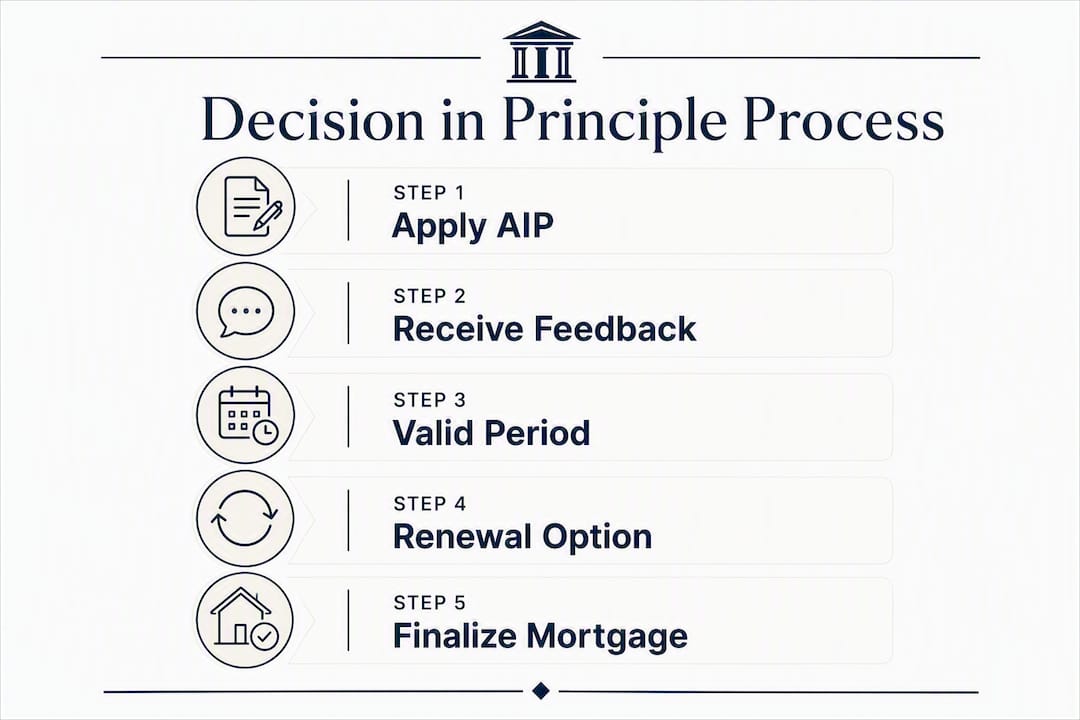
Experian's guidance confirms that validity commonly ranges from 30 to 90 days, with the exact period set by the individual lender. Nationwide, for example, issues AIPs valid for 90 days.
Validity window: 30–90 days, depending on the lender. Nationwide's AIP is valid for 90 days.
Once you have your AIP, the practical next steps are straightforward:
- Begin viewing properties within the borrowing range confirmed by the AIP.
- Present the AIP to estate agents when registering your interest or placing an offer.
- Avoid significant financial changes: do not change jobs, take on new debt, or make large purchases before the full application.
- Keep the AIP document accessible; agents and sellers may ask to see it.
If your AIP expires before you find a property, you can renew it with the same lender or obtain a fresh one. Renewal typically involves a new credit check. Whether that check is soft or hard depends on the lender's policy, so confirm before renewing. MoneyHelper is clear that even after renewal, a full mortgage application remains required once an offer is accepted.
Why having a Decision in Principle strengthens your position when buying
TSB's consumer guidance notes that an AIP helps estate agents and sellers feel confident you are a serious buyer, and that it supports house-hunting within a realistic budget. In practice, this translates to several concrete advantages:
- Budget discipline for first-time buyers — Knowing your confirmed borrowing ceiling prevents wasted viewings on properties outside your range.
Pro Tip: Offer to show your AIP to the estate agent at the viewing stage, not just when placing an offer. Agents who know you are mortgage-ready are more likely to call you first when a property matches your criteria.
For first-time buyers in particular, the Haven Mark Advisers first-time buyer guide sets out how an AIP fits into the broader purchase timeline and what to prepare before approaching lenders.
How a regulated mortgage adviser adds value at the AIP stage
A regulated adviser does more than fill in a form. At AIP stage, the adviser's role covers four distinct functions:
- Lender matching. Advisers assess which lenders are most likely to accept your income profile before any credit search is run. For contractors, day-rate contractors, foreign nationals, and professionals with variable income, this pre-selection prevents unnecessary hard searches.
Havenmarkadvisers assigns one dedicated adviser to each client from AIP through to completion. For professionals with complex income — lawyers, finance workers, self-employed business owners, and foreign nationals — this continuity matters. The adviser who understands your income structure at AIP stage is the same person presenting it to the underwriter at full application.
Pro Tip: Before your first call with any adviser, prepare a one-page summary of your income sources, employment type, and deposit origin. This allows the adviser to identify the right lender panel immediately, rather than spending the first session gathering basics.
Key Takeaways
A Decision in Principle is a provisional borrowing indication, not a mortgage offer, and its value depends entirely on how you use it and how carefully you protect your credit file during the process.
| Point | Details |
|---|---|
| Definition and scope | A DIP/AIP is a lender's provisional borrowing indication; it is not binding and can change after full underwriting. |
| Check the search type | Confirm soft vs. hard search before every AIP submission; multiple hard searches can be a red flag to lenders. |
| Gather documents first | Prepare three years of address history, income evidence, and deposit details before starting any AIP application. |
| Validity window | Most AIPs are valid for 30–90 days; Nationwide's is 90 days. Renew before expiry if your search continues. |
| Use an adviser for complexity | Havenmarkadvisers assigns one dedicated adviser to coordinate soft searches, match lenders, and manage the full application for professionals and buyers with nonstandard income. |
When a Decision in Principle is worth the effort — and when it is not
Most buyers should get an AIP before they start viewing seriously. The argument against getting one early is thin: the process takes a short time online, and the credibility it provides with estate agents is immediate. The stronger question is not whether to get one, but how to get one without damaging your credit file in the process.
For buyers in competitive markets, particularly in London and the South East, an AIP is close to mandatory. Sellers in those markets routinely instruct agents to qualify buyers before accepting viewings. Arriving without one puts you behind buyers who have prepared.
First-time buyers with limited credit history benefit most from the AIP process itself. Running through the affordability calculation with a lender or adviser before viewing properties prevents the common trap of falling in love with a property that is £50,000 above what any lender will offer.
Professionals with variable income — contractors, partners in law firms, finance professionals with bonus-heavy packages — should not apply direct with a high-street lender for an AIP. The standard online form is built for salaried employees. A specialist adviser who understands how lenders assess complex income will produce a more accurate AIP figure and select lenders whose criteria actually fit the applicant's profile. Getting an AIP from a lender that would never approve the full application is not useful preparation.
Havenmarkadvisers can manage your AIP and full mortgage application
For buyers who want a single point of contact from AIP to completion, Havenmarkadvisers offers structured mortgage advice with one dedicated adviser throughout. The firm's panel covers a broader range of UK lenders than standard high-street access, with particular depth for professionals, contractors, and buyers with nonstandard income.

The practical difference: your adviser confirms the right lender before any credit search is run, coordinates soft searches where available, and prepares your income evidence in the format each lender requires. For residential mortgage clients, this means fewer delays, fewer surprises at full application, and a clear fee structure with no hidden costs.
To start the process, contact Havenmarkadvisers directly. Your adviser will review your income profile, identify suitable lenders, and initiate the AIP on your behalf. Visit havenmarkadvisers.co.uk/mortgages to book an initial consultation.
This article provides general information only and does not constitute regulated financial or mortgage advice. Confirm current lender criteria and eligibility with a qualified mortgage adviser or the relevant lender before making any application.
Useful sources
- Decision in Principle | Mortgage in Principle | Nationwide
- Mortgage in principle | How to get an agreement in principle | Experian
- Getting a mortgage: mortgage agreements in principle (AIPs) | Which?
- What Is A Decision In Principle? | Mortgage In Principle — HSBC UK
- What is an agreement in principle? | Money Confidence Articles | TSB Bank
- What happens when I get a mortgage in principle? | MoneyHelper
- What is a credit inquiry? | Consumer Financial Protection Bureau