

IMPORTANT: YOUR HOME MAY BE REPOSSESSED IF YOU DO NOT KEEP UP REPAYMENTS ON YOUR MORTGAGE.
Yes, you can get a mortgage on a fixed term contract. Most mainstream and specialist lenders will consider your application, though acceptance depends on how much time remains on your current contract, your track record in the role, and how you present your evidence. Lender criteria vary, but a common benchmark is 3 to 6 months remaining on your contract, backed by a steady work history, according to Beverley Building Society's contracting factsheet. Gov sets out the legal definition of a fixed-term contract and your employment rights within one, which underpins how lenders treat continuity.
Your next step is simple: start collecting your contract, payslips, and bank statements now, or speak to an adviser at Haven Mark Advisers for a suitability check before you approach a lender directly.
- Contract remaining: most lenders want 3 to 6 months left on your current contract.
- Track record: 12 months in the same line of work is a common minimum; some lenders ask for 24 months.
- Evidence: payslips, bank statements, and a renewal letter or proof of pipeline work if your contract is close to ending.
Quick fact: Barclays requires evidence covering 12 months of contracts, sometimes across two separate agreements, and treats rolling placements in professions such as teaching or medicine as salaried employment rather than temporary work, according to its intermediary criteria guide.
Key Takeaways
Fixed-term contract holders can secure a UK mortgage when they present at least 3 to 6 months' remaining contract time, a consistent work history, and complete evidence packaged for the right lender.
| Point | Details |
|---|---|
| Remaining contract length | Most lenders want 3 to 6 months left; some, like Danske Bank, look for six months for PAYE applicants. |
| Track record counts | A 12 to 24 month history in the same line of work widens your lender options considerably. |
| Prepare documents early | Gather your contract, payslips, bank statements, P60, and any renewal letter before applying. |
| Short contract remedies | A specific renewal letter, evidence of pipeline work, or a bigger deposit can offset a thin history. |
| Specialist support helps | Haven Mark Advisers assigns one dedicated adviser to match your case to the right lender and package your evidence. |
Table of Contents
- How do you apply for a mortgage on a fixed term contract?
- What do lenders look for from fixed term contract applicants?
- How much can you borrow on a fixed term contract?
- What documents do lenders want from you?
- What if your contract is short or about to end?
- Should you consider a guarantor, bigger deposit, or remortgage instead?
- How does a specialist adviser improve your chances?
- What is the typical timeline and cost?
- What does 'fixed-term contract' actually mean under UK law?
- Get tailored help with your fixed-term mortgage application
- Frequently asked questions
- Sources
How do you apply for a mortgage on a fixed term contract?
The process follows a similar shape to any mortgage application, but the order in which you gather evidence matters more when your income doesn't come from a permanent PAYE role.
- Check your position first. Work out how many months remain on your current contract and how long you've worked in the same industry or role. This single fact shapes which lenders will even consider your case.
- Gather your paperwork early. Pull together your current contract, payslips, bank statements, and P60 before you speak to anyone. Lenders and advisers move faster when the file is complete on day one.
- Choose the right lender, not just any lender. High street banks, building societies, and specialist lenders all treat fixed-term income differently. Some want 24 months' history in the same field; others accept 12 months plus a renewal letter.
- Submit a packaged application. This means your income evidence is presented clearly, with context attached, rather than a raw stack of documents left for an underwriter to interpret.
- Respond quickly if asked for more evidence. Underwriters on temporary or agency income cases often come back for a renewal letter, an agency confirmation, or clarification on a pay gap. Delay here is the most common reason applications stall.
Before you call an adviser, have your current contract, your last 3 to 6 months of payslips, 3 months of bank statements, your P60, and any renewal letter or confirmation of extension ready. A complete file at the first conversation saves weeks later.
Pro Tip: If your contract has less than six months left, secure a renewal letter or written confirmation of extended work before you apply. This one document does more to reassure underwriters than any amount of explanation.

Specialist advice earns its keep here — for example, you can get free mortgage broker consultation to understand how adviser's guidance improves your mortgage application success. An adviser who knows which lenders accept 12 months' history rather than 24, and which ones treat agency income more leniently, can save you a rejected application and a hard credit search that dents your file before you've even found the right lender.
What do lenders look for from fixed term contract applicants?
Lenders assess three things above all else: how much time is left on your contract, how long you've worked in your field, and how consistent your pay has been.
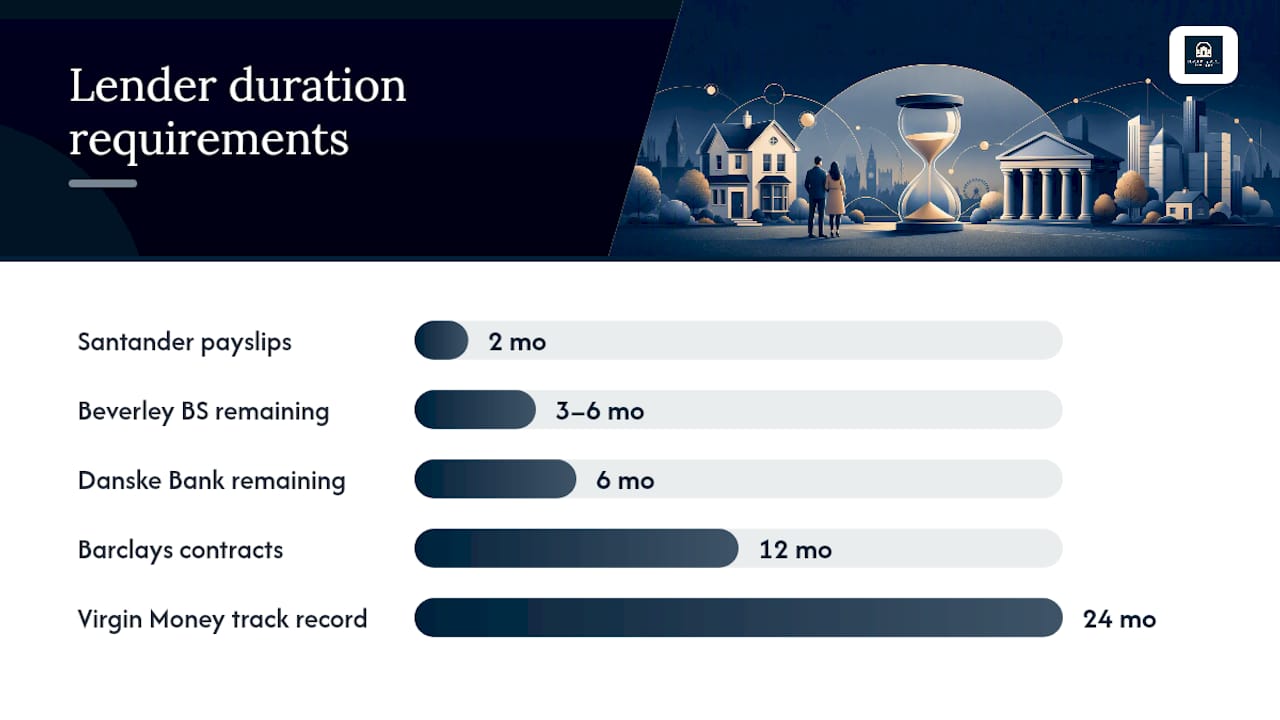
- Remaining contract length: Beverley Building Society expects 3 to 6 months remaining; below that, lenders typically want written confirmation of renewal. Danske Bank's published criteria for PAYE fixed-term applicants sets the bar slightly higher, usually looking for six months remaining alongside a current contract and recent payslip, according to its employment and income criteria.
- Track record: Virgin Money accepts agency, fixed-term, and zero-hours income where the applicant has two years in the same line of work. If you've been in your current role less than a year, expect the lender to ask whether your income matches what you earned before.
- Contract type matters: PAYE fixed-term staff are usually assessed on payslips and P60s. Limited company contractors are often reclassified as self-employed, which brings SA302s and company accounts into the picture, and typically lengthens the checking process.
- Verification: Santander for Intermediaries states that monthly payslips should be no older than two months, and that continuous employment evidence or an agency confirmation letter is used to support fixed-term cases.
If you're paid through an umbrella company or agency, present your pay as a consistent monthly figure rather than itemised day rates. Averaging your last three to six months and showing it against a steady pattern reduces the appearance of volatility that underwriters flag first.
Quick fact: Barclays asks for evidence covering 12 months of contracts, sometimes two agreements stitched together, and treats rolling placements in professions like junior doctors as salaried roles rather than temporary work, per its criteria and packaging guide.
How much can you borrow on a fixed term contract?
Lenders convert your fixed-term income into an annual figure much the same way they would for a permanent employee, once your track record is established. They typically average your payslips over three to twelve months, cross-check against your P60, and treat the resulting figure as your gross annual income for affordability purposes.
Two examples show how the maths plays out differently depending on your history.
- Stable history, short time left. An applicant with 12 months in the same NHS trust role, earning £42,000 a year, but only 4 months remaining on their contract, is likely to be accepted by most lenders provided they supply a renewal letter or evidence their contract is due to be extended. Vantage Mortgages notes that once 12 months' history and 3 months remaining are established, affordability is usually calculated much as it would be for permanent staff.
- Recent move, thinner history. An applicant who moved to a fixed-term role eight months ago, on a similar salary but with no prior track record in that field, faces a narrower pool of lenders. Expect either a larger deposit requirement or a request for two years' history in the same line of work before a mainstream lender proceeds.
An online mortgage calculator gives you a starting estimate, nothing more. Final lending decisions depend on the specific lender's policy, your full financial position, and how your application is packaged.
What documents do lenders want from you?
A prepared file moves faster than a reactive one. Gather these before your first conversation with a lender or adviser.
- Current employment contract, showing start date, end date or renewal terms, and salary.
- Latest 3 to 6 months' payslips, no older than two months for monthly pay, per Santander's evidence requirements.
- Recent personal bank statements, usually the last 3 months, showing salary credits and normal spending.
- P60 or proof of the previous year's earnings, to confirm your income history.
- Renewal letter or agency confirmation, if your current contract is close to ending.
- Evidence of pipeline work, such as an email or letter confirming your next placement.
- SA302 tax calculations, obtained via Gov, if you're self-employed or work through a limited company.
- Company accounts, if you're a limited company director, since most lenders assess this income differently from PAYE earnings.
If you're borrowing at a high loan-to-value, expect closer scrutiny of your bank statements and possibly a longer run of payslips than the standard three to six months. Lenders offering 90% or 95% mortgages tend to want more certainty precisely because their exposure is greater.
What if your contract is short or about to end?
A contract ending in a matter of weeks doesn't rule you out. It changes which lenders will look at your case and what you need to hand over.
- Get a renewal letter. The strongest single document you can produce confirms your role is continuing, states the likely duration or pipeline of work, and confirms your pay arrangement. A vague note from HR rarely satisfies an underwriter; specifics do.
- Show a pipeline of work. If you're moving between fixed-term roles rather than renewing one, evidence of your next placement carries similar weight to a renewal letter.
- Increase your deposit. A larger deposit reduces the lender's exposure and can offset a thinner contract history, particularly with specialist lenders.
- Consider a guarantor. This widens your options but comes with real obligations for the person backing you, covered in more detail below.
- Ask about remortgaging with your existing lender. If you already have a mortgage and your circumstances have shifted, your current lender may apply less scrutiny than a new one would.
Most lenders will tolerate a short gap between contracts, often a few weeks, if your overall 12 to 24 month history is consistent. Others treat any recent gap as a concern regardless of context, which is exactly where a specialist adviser earns their fee by steering you toward the right lender rather than the wrong one.
Pro Tip: A renewal letter should name the role, confirm the likely duration or existence of further work, and state the pay arrangement. Anything less specific tends to trigger further underwriter queries rather than resolve them.
Should you consider a guarantor, bigger deposit, or remortgage instead?
When your standard application looks marginal, a handful of alternative routes can still get you to completion.
- Guarantor mortgages: widen affordability and can offset a short contract history, but the guarantor becomes legally responsible for the debt if you can't pay, which is a serious and lasting commitment for them.
- Bigger deposit: reduces the lender's risk and often opens up lenders that would otherwise decline a thinner contract history, though it ties up more of your savings upfront.
- Specialist contractor lenders: built around temporary and agency income, often more flexible on remaining contract length, but sometimes with less competitive rates than mainstream high street deals.
- Remortgaging with your current lender: can involve a lighter affordability review than switching to a new lender, useful if your contract situation has recently become less straightforward.
Each option suits a different set of circumstances. A guarantor arrangement makes sense when your income is genuinely solid but your history is short; a bigger deposit suits those with savings but a patchier work pattern.
How does a specialist adviser improve your chances?
Matching the right applicant to the right lender is most of the job. One case handled through the contractor mortgage space involved an applicant eight months into a fixed-term NHS role with no prior track record in healthcare. A mainstream high street lender had already declined the case on the grounds of insufficient history. A specialist adviser repackaged the application around a lender whose policy explicitly recognised NHS rolling placements as salaried income, and the case completed within the lender's standard timeline.
The lender's perception of income predictability matters more than contract permanence. Packaging the evidence to demonstrate a stable line of work, rather than simply restating contract dates, is what changes an underwriter's decision.
What a dedicated adviser typically does for you:
- Identifies which lenders' policies fit your specific contract length and work history.
- Packages your income evidence with context, not just raw documents.
- Checks your file for gaps before submission, catching issues an underwriter would otherwise flag.
- Negotiates conditions on your behalf if a lender comes back with queries.
- Manages your case proactively through to offer, rather than leaving you to chase updates.
Pro Tip: Ask any adviser three things: how many fixed-term contract cases they've placed, which lenders they'd approach first for your specific situation, and how they charge. The answers tell you more than any marketing page will.
Haven Mark Advisers assigns one dedicated adviser to your case from first call to completion, which matters most precisely when your income situation needs context rather than a standard form. Their work with day-rate contractors and other non-permanent professionals feeds directly into how they package fixed-term applications for lenders.
What is the typical timeline and cost?
Expect the process to run in four stages, each with its own rough duration:
- Initial adviser call: same day to a few days, depending on availability.
- Document gathering: typically 1 to 2 weeks, faster if you've prepared your paperwork in advance.
- Lender submission and underwriting: usually 2 to 4 weeks, longer if further evidence is requested.
- Offer to completion: commonly 4 to 8 weeks, depending on the conveyancing chain.
On cost, advisers commonly charge a fixed fee payable at completion rather than an hourly rate, and Haven Mark Advisers publishes how its fees work rather than leaving clients guessing. Beyond adviser fees, expect a lender product fee and a valuation fee, both of which vary by lender and property.
Quick fact: timelines and total costs shift significantly depending on how complex your income evidence is, so treat any figure quoted before your documents are reviewed as an estimate rather than a promise.
What does 'fixed-term contract' actually mean under UK law?
A fixed-term contract is an employment agreement with a defined end date or a specific event that ends it, such as covering maternity leave or completing a project, as set out in GOV.UK's guidance on fixed-term contracts. Employees on fixed-term contracts hold broadly the same statutory rights as permanent staff, including protection from unfair dismissal after a qualifying period.
- Rolling placements in some professions, such as teaching or medicine, are sometimes treated by lenders as salaried rather than temporary, per Barclays' criteria.
- Continuity of service matters more to lenders than the contract label itself; a string of consecutive fixed-term roles in the same field often reads better than one long contract with a recent gap.
- This is general information, not legal advice; for the full detail on your rights, consult GOV.UK directly.
Three quick tips from an adviser's perspective
Pack your evidence early, before a lender asks for it. A file that's ready on day one moves faster than one assembled under pressure. Be upfront about any gaps between contracts rather than hoping they go unnoticed; underwriters find them regardless, and an honest explanation lands better than a discovered one. If you work through a limited company, get specialist advice early, because reclassification as self-employed changes almost everything about what you'll need to provide.
Get tailored help with your fixed-term mortgage application
Haven Mark Advisers works with contractors, agency staff, and professionals on fixed-term contracts across banking, law, and business ownership, and gives every client one dedicated adviser from the first call through to completion rather than passing you between departments.

That single point of contact matters most when your income needs explaining rather than simply ticking a box. Your adviser handles lender matching, document packaging, and proactive case management, drawing on access to a wide range of UK lenders including those with more flexible criteria for fixed-term and agency income. Fees are charged as a set amount at completion, detailed transparently on the fees page, so there are no surprises partway through. If you'd like a clear view of what your fixed-term contract mortgage could look like, the preparation service walks you through exactly what to gather before you apply, or you can go straight to the residential mortgages page to book an initial call.
IMPORTANT: YOUR HOME MAY BE REPOSSESSED IF YOU DO NOT KEEP UP REPAYMENTS ON YOUR MORTGAGE.
Frequently asked questions
Can I get a mortgage with a fixed-term contract in England? Yes. Most lenders assess fixed-term applicants on remaining contract length, work history, and evidence of continuity, rather than ruling out temporary employment outright.
How many months must be left on my contract to qualify? Commonly 3 to 6 months, though some lenders, such as Danske Bank, ask for six months for PAYE applicants, according to its employment and income criteria.
What if I've only just started my fixed-term role? Lenders typically want to see that your income matches your previous employment level if you've been in your current role less than 12 months, per Virgin Money's criteria.
Do I need a bigger deposit on a fixed-term contract? Not necessarily, but a larger deposit can help if your contract history is short or your remaining contract time is limited, particularly with mainstream lenders.
Is a mortgage on a fixed-term contract different from a self-employed mortgage? Yes. PAYE fixed-term applicants are usually assessed on payslips and a P60, while limited company contractors are often reclassified as self-employed and asked for SA302s and company accounts, which typically extends the process.
This article is general information, not a substitute for advice from a qualified financial advisor. Consult a qualified financial professional about your own circumstances before acting on anything here.
Sources
- Contracting offering factsheet (Beverley Building Society)
- Santander for Intermediaries (document and evidence guidance)
- Criteria and packaging guide (Barclays intermediaries)
- Income lending criteria (Virgin Money intermediaries)
- Gov