

IMPORTANT: YOUR HOME MAY BE REPOSSESSED IF YOU DO NOT KEEP UP REPAYMENTS ON YOUR MORTGAGE.
If your budget cannot absorb a payment rise, a fixed-rate mortgage is the sensible starting point. If you have spare income each month and a shorter time horizon, a tracker mortgage can work out cheaper, though it moves with the Bank of England Bank Rate, currently held at 3.75%. Either way, stress-test your finances and start reviewing your options three to six months before your current deal ends.
TL;DR:
- Fixed-rate mortgages offer payment certainty, making them suitable for borrowers with tight budgets or upcoming financial commitments.
- Tracker mortgages usually start cheaper but expose borrowers to rate increases, as payments follow the Bank of England base rate plus a set margin.
- Early repayment charges are generally higher on fixed deals, and fixed products may include more incentives like cashback or fee contributions.
- When a deal ends, borrowers typically move to the lender's standard variable rate, which is often significantly more expensive, unless they arrange a new deal in advance.
- Borrowers should stress-test their finances against a two-percentage-point rate rise and compare total costs, exit penalties, and product features before choosing between fixed and tracker options.
Table of Contents
- Fixed vs tracker mortgage: the key differences at a glance
- How does a fixed-rate mortgage work?
- How does a tracker mortgage work?
- Fixed vs tracker mortgage in 2026: cost and flexibility compared
- Which borrower profile suits fixed or tracker?
- What happens when your mortgage deal ends?
- How to decide between fixed and tracker: a quick checklist
- Haven Mark Advisers' view on choosing between fixed and tracker
- Fixed vs tracker: real payment scenarios at different rates
- How ERCs change the real cost of switching early
- Why mortgage term length changes the fixed vs tracker calculation
- Total interest paid over the life of a fixed vs tracker deal
- How lender incentives differ between fixed and tracker deals
- Are there tax implications for choosing fixed or tracker?
- Get help choosing between fixed and tracker
- Sources
- FAQ
Fixed vs tracker mortgage: the key differences at a glance
A fixed-rate mortgage locks your interest rate, and therefore your monthly payment, for an agreed period, typically two to five years in the UK. A tracker mortgage moves in line with the Bank of England base rate plus a set margin, so your payment can go up or down each time the Bank changes its rate. Some trackers run for two years; others extend to five years or track for the life of the loan with no fixed end date.
At current pricing, with Bank Rate currently held steady, the choice boils down to a handful of practical trade-offs:
- Certainty: fixed deals guarantee your payment; trackers do not.
- Starting cost: trackers have often priced cheaper than equivalent fixes in 2026, though the gap narrows and widens with market sentiment.
- Early repayment charges: fixed deals usually carry stiffer ERCs than trackers, which frequently charge little or nothing to exit.
- Flexibility: trackers suit shorter horizons or plans to move; fixes suit those who want to set a budget and forget it.
How does a fixed-rate mortgage work?
A fixed-rate mortgage fixes your interest rate for a set term, most commonly two, three, or five years in the UK market, though some lenders offer ten-year fixes. Your monthly payment stays identical throughout that period regardless of what happens to Bank Rate or swap rates in the wider market. Once the fixed term ends, you revert to your lender's standard variable rate (SVR) unless you arrange a new deal, and SVRs are almost always considerably more expensive than any fixed or tracker product on the market.
Fixed deals typically come with early repayment charges that apply if you remortgage, overpay beyond an allowance, or repay the mortgage in full before the term ends. Product fees, whether a flat charge or added to the loan, also vary between deals and affect the true cost, something worth checking against the fee structure your broker discloses.
Fixing makes most sense when your budget is tight, when you have a major expense coming up such as school fees or a career break, or when you simply cannot tolerate payment volatility. It removes one variable from your finances at a point when you may already be juggling several.
How does a tracker mortgage work?
A tracker mortgage follows the Bank of England base rate, or occasionally another published benchmark, plus a fixed margin set by the lender. If Bank Rate sits at 3.75% and your tracker margin is 0.75%, you pay 4.5%. When the Bank moves rates up or down, usually following its scheduled Monetary Policy Committee meetings, your payment adjusts automatically within a billing cycle or two.

Read the contract wording carefully. Some products marketed loosely as "tracker" deals actually reference a lender's own internal rate rather than an independent published benchmark, which removes the transparency that makes genuine trackers attractive. Always confirm the exact base rate referenced and the precise margin before signing.
Trackers have often started cheaper than fixed equivalents through 2026, and market reporting shows they are increasingly used as a short-term bridge by borrowers who expect to move house, expect rates to fall, or simply want lower exit penalties while they decide their longer-term plan. The trade-off is obvious: your payment rises if Bank Rate rises, with no ceiling built in unless the product includes a collar or cap.
Fixed vs tracker mortgage in 2026: cost and flexibility compared
With Bank Rate currently steady, average two-year tracker pricing has, at points in 2026, undercut comparable fixed deals, though BBC's market analysis notes the majority of borrowers still choose fixed products despite the headline saving on offer elsewhere. The numbers matter more than the label.
On a typical mortgage, a small difference in percentage points between a fixed rate and a tracker rate can amount to a noticeable monthly and annual amount, and this gap changes with Bank Rate decisions.
Bank Rate has been held steady since mid-2026, with inflation easing to lower levels in June, though the Bank flags that risks to that trajectory remain. That figure is the benchmark every tracker mortgage in the country is currently priced against.
Three practical distinctions decide which product suits you better:
- Payment security: fixed deals guarantee the figure leaving your account each month; trackers do not, however comfortable the current margin looks.
- Exit cost: trackers frequently carry lower or no ERCs, useful if you expect to move house or remortgage early; fixed deals usually penalise early exit more heavily.
- Overpayment flexibility: both product types typically allow a standard overpayment allowance, often 10% a year, but check the specific terms before relying on it.
Which borrower profile suits fixed or tracker?
Matching the product to your circumstances matters more than chasing the headline rate. A household with little spare income each month, or one budgeting around parental leave or a new baby, generally does better fixing, because a payment increase of even £100 a month could break the budget. A first-time buyer stretching to the top of their affordability is in a similar position and usually benefits from the certainty a fix provides.
Self-employed professionals and contractors sit in a different category. Income can be lumpy, but many also carry higher savings buffers, and an adviser who understands how lenders assess irregular income can widen the pool of products available, fixed or tracker. Someone remortgaging with six months left on a fixed deal should start comparing options immediately rather than waiting for the renewal letter to land.
Run a simple stress test before deciding: take your current tracker or prospective tracker rate, add two percentage points, and check whether your monthly budget still works. If it does not, fix.
- Tight monthly budget or single income: lean towards fixing.
- Comfortable savings buffer and shorter time horizon: a tracker is worth considering.
- Self-employed or contractor income: get advice on which lenders suit your income pattern before choosing either product.
- Remortgage due within six months: start the comparison now, not later.
Pro Tip: Run your stress test against a two percentage point rise, not just today's rate. If your finances still work at that higher figure, a tracker becomes a genuinely comfortable option rather than a gamble.
What happens when your mortgage deal ends?
When a fixed or tracker deal expires, you automatically move onto your lender's standard variable rate unless you arrange something else first. SVRs sit well above most fixed and tracker pricing, sometimes by several percentage points, so drifting onto one by accident is one of the most avoidable costs in UK mortgage lending.
The FCA advises borrowers to review their options well before an incentivised deal ends, and firms are permitted to offer certain internal product switches without running a full affordability test in many cases, which can make transferring to a new deal with your existing lender faster than a full remortgage. Your alternatives at this point are a product transfer with your current lender, a full remortgage to a different lender for potentially better terms, or, in rarer cases, staying on the SVR deliberately for a short, planned period.
Begin comparing offers three to six months before your deal ends. Lenders typically let you lock in a new rate up to six months ahead, which protects you if pricing moves against you in the interim.
How to decide between fixed and tracker: a quick checklist
Work through three steps before committing to either product:
- Check your affordability buffer. Stress-test your monthly budget against a Bank Rate rise of two percentage points. If the numbers still work comfortably, a tracker is worth exploring further.
- Compare the current market. Look at both two-year and five-year fixed pricing alongside tracker rates for your loan-to-value band, since the gap between them shifts month to month.
- Weigh the exit costs. If you expect to move, overpay heavily, or remortgage early, factor the ERC schedule into your decision, not just the headline rate.
Bring these exact questions to any lender or adviser conversation: What margin does this tracker add to Bank Rate? What is the ERC schedule for this fixed deal, and does it step down annually? Is the product portable if I move house during the term? What are the total fees, including any product fee, valuation fee, and legal costs? Some borrowers split the difference deliberately, taking a tracker as a short-term bridge while house-hunting, then fixing once they have settled on a property and a longer time horizon.
Haven Mark Advisers' view on choosing between fixed and tracker
Haven Mark Advisers assigns each client a single dedicated adviser who assesses affordability, runs the stress tests described above, and, where income is complex, gathers the documentation lenders need to assess it properly. That single point of contact matters most for professionals and business owners with non-standard income, where the right lender match can be the difference between a straightforward application and a stalled one.
No adviser can guarantee acceptance, a specific rate, or a particular lending outcome, and every case depends on individual circumstances and lender criteria at the time of application.
Fixed vs tracker: real payment scenarios at different rates
Numbers make the trade-off concrete. Take a £300,000 mortgage over 25 years, and compare how monthly payments shift across a few plausible rate environments.
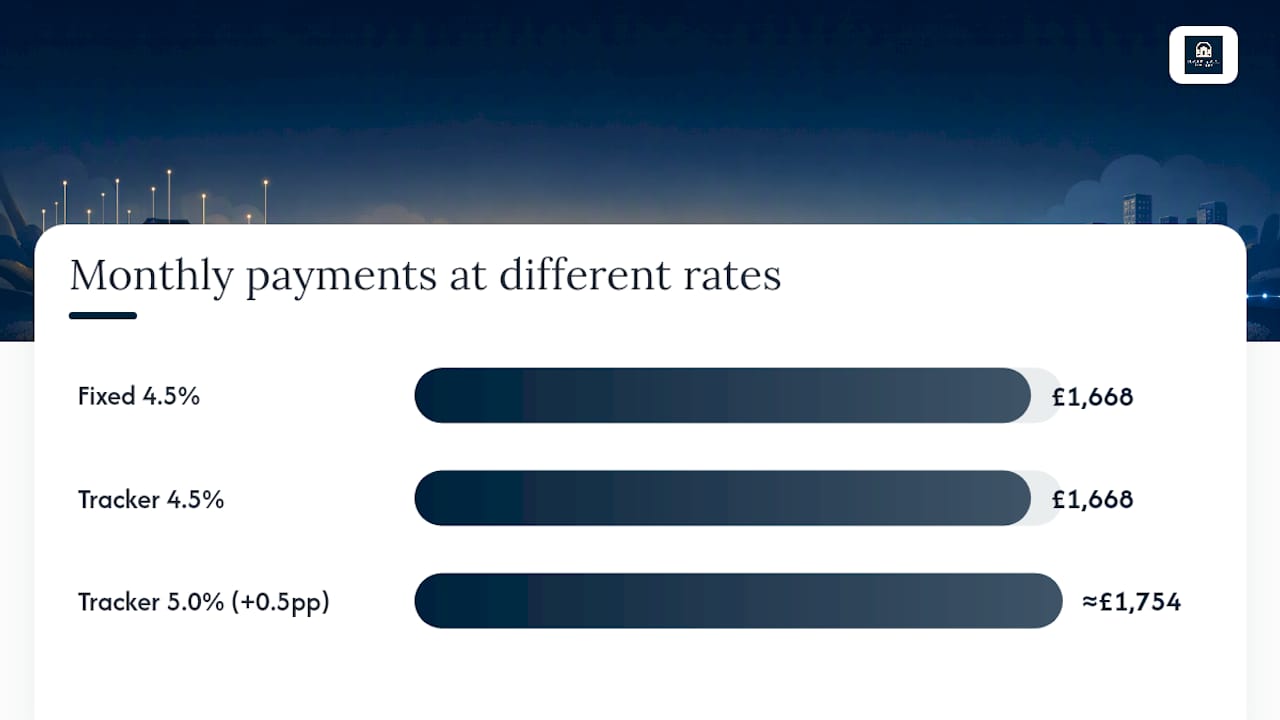
A fixed deal at 4.5% locks you into £1,668 a month for the whole term, whatever happens to Bank Rate. A tracker priced at Bank Rate plus 0.75%, starting at 4.5% when Bank Rate is 3.75%, gives you the identical starting payment, but that figure moves the moment the Bank changes its rate. If Bank Rate rose by 0.5 percentage points, your tracker payment would climb to roughly the 5.0% row, around £86 more a month.
That is the entire trade-off in one table: the fixed borrower pays £1,668 every month for years, rain or shine; the tracker borrower's payment breathes with the base rate, for better or worse. Neither is objectively right. It depends on whether an £86 monthly swing would trouble your budget or barely register against it.
How ERCs change the real cost of switching early
Early repayment charges rarely feature in headline rate comparisons, yet they can outweigh the saving from choosing the cheaper product in the first place. On a £250,000 balance, exiting in year one could cost £12,500; exiting in year four might cost £2,500.
Tracker mortgages frequently carry lower ERCs, and many two-year trackers charge nothing at all to exit early, which is precisely why borrowers using trackers as a deliberate bridge strategy favour them while they wait for life circumstances, such as a house move or a return to steadier income, to settle.
The practical rule: never choose a product purely on headline rate without checking the ERC schedule against your realistic plans. If there is a meaningful chance you will move house, inherit a lump sum, or want to remortgage within the term, the ERC could cost more than any rate saving delivers. Ask your lender for the exact percentage and the exact years it applies, in writing, before signing anything. A broker fee structure that is transparent from the outset helps you see the full cost picture, ERCs included, rather than just the advertised rate.
Why mortgage term length changes the fixed vs tracker calculation
The length of the deal you choose interacts directly with how much risk you are taking on. A two-year fix gives you certainty for a short window, then exposes you to whatever the market looks like at renewal, potentially higher rates, tighter lending criteria, or both. A five-year fix trades a typically slightly higher rate for four extra years of protection from Bank Rate movements, which suits anyone who values stability over the medium term or expects their circumstances, income, or family situation, to shift.
Trackers complicate this further because the term length determines how much base-rate risk you are actually exposed to. A two-year tracker limits your exposure to whatever the Bank does over roughly eight Monetary Policy Committee meetings. An evergreen or long-term tracker with no fixed end could expose you to several full rate cycles, both up and down.
If you expect to move house, change jobs, or otherwise disrupt your finances within two to three years, a shorter fix or a flexible tracker with low ERCs usually suits better than locking into five years. If your plans are settled and you want to remove interest-rate risk from the equation entirely, a longer fix does more of the heavy lifting. There is no universally "better" term length. It is a function of how confident you are about your circumstances over that specific window.
Total interest paid over the life of a fixed vs tracker deal
Total interest paid depends on the path rates take over the full term, not just the starting rate, which is where fixed and tracker mortgages diverge most sharply in outcome. On a fixed deal, the interest cost is entirely predictable from day one: multiply the fixed rate by the outstanding balance each year, and you know the total before you sign.
On a tracker, total interest is essentially unknowable in advance, because it depends on however many Bank Rate changes occur across the term. A tracker that starts cheaper than an equivalent fix could still cost more in total interest if Bank Rate rises significantly and stays elevated; equally, it could cost considerably less if rates fall.
This is why comparing "average" tracker and fixed rates in isolation, as much reporting on 2026 pricing does, only tells part of the story. The comparison that matters is between the fixed rate on offer today and your own reasonable expectation of where Bank Rate is heading over your specific term, informed by Bank of England guidance rather than guesswork. Borrowers who fixed early in previous rate cycles when Bank Rate was low locked in years of cheap borrowing that trackers of the same era could not match once rates climbed; the reverse has also been true in falling-rate periods. Neither product has a permanent advantage on total interest. It is entirely path-dependent.
How lender incentives differ between fixed and tracker deals
Lenders price and promote fixed and tracker products differently, and the incentives attached often say as much about a lender's strategy as the headline rate does. Fixed deals frequently come bundled with cashback offers, free valuations, or contributions towards legal fees, particularly on higher loan-to-value products where lenders compete hardest for volume. These incentives can meaningfully offset the product fee on a fixed deal, sometimes by £250 to £500 or more depending on the lender.
Tracker deals are marketed differently. Because their headline rate already does the competing, for example pricing that has undercut fixed equivalents through parts of 2026, lenders attach fewer cashback sweeteners and instead differentiate on the margin above Bank Rate and the absence of exit penalties.
Compare products on the combination of rate, fee, and incentive together, never on any single element in isolation. A broker with access to a wider panel of lenders can also surface incentive structures that do not appear on comparison sites, since some lenders reserve their most competitive terms for adviser-introduced business rather than direct applications.
Are there tax implications for choosing fixed or tracker?
For a residential mortgage on your own home, the choice between fixed and tracker carries no direct tax consequence. Mortgage interest on a main residence is not tax-deductible in the UK regardless of product type, so neither option offers a tax advantage over the other for owner-occupiers.
The position differs for buy-to-let borrowers, where mortgage interest relief operates under separate rules restricting relief to a basic-rate tax credit rather than full deduction against rental income. That restriction applies identically whether the underlying mortgage is fixed or tracker; the tax treatment depends on the property's use and the borrower's tax position, not on which interest-rate product was chosen. Landlords weighing buy-to-let options should factor tax treatment into overall return calculations, but it should not drive the fixed-versus-tracker decision itself.
Where the choice does have an indirect financial planning dimension is cash flow. A tracker's variable payment can complicate budgeting for anyone managing tax liabilities alongside mortgage costs, particularly the self-employed managing quarterly or annual tax bills, since an unexpected Bank Rate rise adds one more variable to plan around. That is a cash-flow consideration rather than a tax one, but it is worth weighing if your income and tax obligations are already unpredictable. For collateral and borrowing-capacity considerations more broadly, Aria's analysis of what lenders actually weigh is a useful complementary read.
Get help choosing between fixed and tracker
Weighing a fixed rate against a tracker gets harder when your income does not fit a standard payslip, and that is precisely where Haven Mark Advisers is built to help. Every client works with one dedicated adviser from first enquiry through to completion, rather than being passed between different case handlers, which matters most when you are self-employed, contracting, or working in law or finance with variable pay structures that need proper explanation to a lender's underwriter.
That adviser will stress-test your affordability against both a fixed and a tracker scenario, explain the ERC and margin terms in plain language, and draw on access to a broader panel of UK lenders to find products suited to your specific income pattern. If you are weighing your first purchase or approaching the end of a current deal, speak to Haven Mark Advisers about your residential mortgage options and get a clear recommendation before you need to decide. As with all mortgage advice, no outcome, rate, or lending decision can be guaranteed, and your home may be repossessed if you do not keep up repayments on your mortgage.
This article is general information, not a substitute for advice from a qualified financial advisor. Consult a qualified financial professional about your own circumstances before acting on anything here.
Sources
- Monetary Policy Report — Bank of England (July 2026)
- FCA consumer guidance: support for mortgages and interest rates
- ‘Tracker mortgages are back’ – The Guardian (May 2026)
- What's happening to UK interest rates and mortgage deals? — BBC
FAQ
Is a tracker mortgage a good idea in 2026?
It can be, if your budget has room to absorb a Bank Rate rise and you have a shorter time horizon or plan to move or remortgage soon; market reporting shows trackers have priced competitively through 2026, but they still carry the risk of payments rising if Bank Rate climbs from its current 3.75%.
What are the disadvantages of a tracker mortgage?
The main disadvantage is unpredictability: your monthly payment can rise every time the Bank of England raises Bank Rate, with no cap unless the product specifically includes one, which makes budgeting harder than with a fixed deal.
What is a tracker rate mortgage in the UK?
A tracker rate mortgage charges interest at the Bank of England base rate plus a fixed margin set by the lender, so your rate and payment move automatically whenever the Bank changes Bank Rate.
What happens after a two-year tracker mortgage ends?
Unless you arrange a new deal beforehand, you move onto your lender's standard variable rate, which is typically more expensive than either a new fixed or tracker product; the FCA recommends reviewing your options three to six months before expiry to avoid drifting onto it.
Recommended
- Mortgages for Day-Rate Contractors
- Residential Mortgages
- Mortgages for the Self-Employed & Business Owners
This article provides general information only and does not constitute personalised mortgage advice. Mortgage availability, affordability and lender criteria depend on individual circumstances and may change. Please seek advice tailored to your circumstances before acting on this information.