

IMPORTANT: YOUR HOME MAY BE REPOSSESSED IF YOU DO NOT KEEP UP REPAYMENTS ON YOUR MORTGAGE.
Foreign nationals can get a UK mortgage. The process involves specialist underwriting, a larger deposit than the standard residential minimum, and a more demanding documentation pack than most UK applicants face. The fastest reliable route is to engage an FCA-regulated mortgage adviser before approaching any lender directly.
Three things to expect from the outset:
-
Eligibility triggers: Lenders assess residency status, visa category, nationality, and UK credit history separately. Each factor can open or close specific products.
-
Deposit requirements: Non-resident applicants typically face a minimum deposit starting at a quarter of the property’s value, and some lenders set that floor higher depending on visa type and income source.
-
Product types: Residential owner-occupier mortgages, buy-to-let products, and specialist non-resident mortgages are all available, but not every lender offers all three to foreign nationals.
The practical next step is a pre-qualification check with a regulated adviser who can match your residency status and income profile to the lenders currently active in this space.
Table of Contents
-
How does the application process work, and how long does it take?
-
Havenmarkadvisers: structured support for your UK mortgage application
Who do lenders actually consider eligible?
Lenders draw a clear line between applicants who are UK-resident and those who are not. Where you fall on that line determines which products are available, what deposit is required, and how your income is assessed.
Residency and visa status
Most lenders treat applicants as UK-resident if they live and work in the UK under a valid visa with at least two to three years remaining. Skilled Worker visa holders, those with Indefinite Leave to Remain (ILR), and individuals with EU Settled Status are generally the most straightforward to place. A mortgage without ILR is possible, but the lender pool narrows and the deposit requirement typically rises.
Applicants with Limited Leave to Remain face more scrutiny. Lenders want to see that the remaining visa term covers a meaningful portion of the mortgage term, or at least demonstrates a credible path to ILR or Settled Status. A mortgage with limited leave to remain is not a blanket refusal, but it requires careful lender selection.
Non-UK residents buying from abroad, including returning expats and international investors, are treated as a separate category. Some lenders, including HSBC UK, publish explicit eligibility country lists and minimum income thresholds for this group. Skipton International and The Nottingham also serve non-resident applicants, each with their own residency and nationality criteria.
Nationality and approved-country lists
Nationality matters at some lenders. Certain mainstream banks publish lists of approved countries from which non-resident applicants may apply. If your nationality is not on that list, the lender will decline regardless of income or deposit size. A specialist adviser can identify which lenders have no nationality restriction before you submit a formal application.
Credit history
A thin or absent UK credit file is one of the most common barriers. Lenders generally prefer a UK credit report, but alternatives exist: international credit reports, bank reference letters from your home country, and evidence of a sustained payment history on overseas accounts. Some lenders will accept a combination of these as a substitute for a full UK credit file.
Pro Tip: If you have been in the UK for less than 12 months, open a UK current account, register on the electoral roll if eligible, and take out a small credit product immediately. Even three to six months of UK credit history can improve your LTV outcome and shorten underwriting time.
What mortgage products are available to foreign nationals?
The product type a foreign national can access depends primarily on residency status and the intended use of the property.
Residential (owner-occupier) mortgages
These are available to foreign nationals who are UK-resident under a qualifying visa. Lenders treat this category similarly to a standard residential application, with adjustments for visa term, income source, and credit history. The deposit floor is usually higher than the 5–10% available to UK citizens, but residential products remain accessible to a wide range of visa holders.
Buy-to-let mortgages
Non-resident applicants are frequently steered toward buy-to-let products rather than residential ones, as Wise notes in its guidance on UK mortgages for foreign nationals. BTL products assess affordability primarily on projected rental income rather than personal earnings, which can work in favor of applicants whose overseas income is difficult to verify through standard payslip evidence. Deposit requirements for BTL are typically 25% or higher.

Non-resident specialist mortgages
A small number of lenders, including Skipton International and The Nottingham, offer products specifically designed for non-UK residents. These products carry their own eligibility criteria, often including minimum income thresholds, restrictions on property type, and requirements for a UK-based solicitor.
Bridging and specialist finance
Short-term bridging loans are used by some foreign buyers to complete a purchase quickly while a longer-term mortgage is arranged. These are typically more expensive and carry higher arrangement fees, but they allow completion at auction or in competitive markets where a standard mortgage timeline is too slow.
Key considerations by product type:
-
Residential products require UK residency under a qualifying visa; deposit floors are typically higher than for UK nationals.
-
BTL products are accessible to non-residents but are assessed on rental yield, not personal income.
-
Non-resident specialist products have narrow eligibility but are purpose-built for international buyers.
-
Bridging finance is short-term and expensive; it is a completion tool, not a long-term solution.
What paperwork do lenders require?
A complete documentation pack submitted at the outset is the single most effective way to avoid underwriting delays. Lenders handling foreign-national cases apply Anti-Money Laundering (AML) checks that are more detailed than those for standard applications.
Identity
-
Valid passport (original or certified copy).
-
A second form of government-issued photo ID if the passport is from a country outside the lender’s approved list.
-
Certified translations of any document not in English.
Immigration and residency proof
The gov.uk View and prove your immigration status service generates a shareable code that gives lenders direct access to your visa or settled-status record. This is the most efficient way to satisfy residency checks. For ILR holders, the ILR vignette or biometric residence permit is also accepted.
Income evidence
-
Last three months’ payslips and a current employment letter on company letterhead, confirming salary, contract type, and start date.
-
Last two years’ tax returns (P60 or overseas equivalent) for salaried applicants.
-
Last two to three years’ accounts and SA302 forms for self-employed applicants; see the limited company director mortgage guide for how lenders treat director income specifically.
-
Foreign bank statements covering at least three months, with certified translations where required.
Deposit and source of funds
-
Bank statements covering at least three to six months showing the deposit accumulating or already held.
-
Gifted deposit letter and the donor’s bank statements if any portion of the deposit is a gift.
-
AML seasoning: most lenders want to see funds held in a UK or internationally recognized bank account for at least three months before application. Funds transferred in a lump sum immediately before application will trigger additional scrutiny.
Property documents
-
Memorandum of sale or sales contract for purchase cases.
-
Rental projections or a letting agent’s assessment for BTL applications.
Pro Tip: Commission certified translations from a translator registered with the Chartered Institute of Linguists or the Institute of Translation and Interpreting. Lenders recognize these credentials and are less likely to request re-translation, which can add two to three weeks to a case.
What deposits, rates, and fees should you budget for?
Deposit requirements for foreign-national cases are higher than the standard residential minimum. The table below summarizes typical ranges based on published lender guidance and market norms.
| Applicant type | Typical minimum deposit | Max LTV | Notes |
|---|---|---|---|
| UK-resident visa holder (residential) | 25% | 75% | Some lenders go to higher LTV with strong UK credit history |
| Non-resident (residential) deposits usually range from a quarter to approximately two fifths of the property value; HSBC UK publishes explicit LTV caps for non-residents |
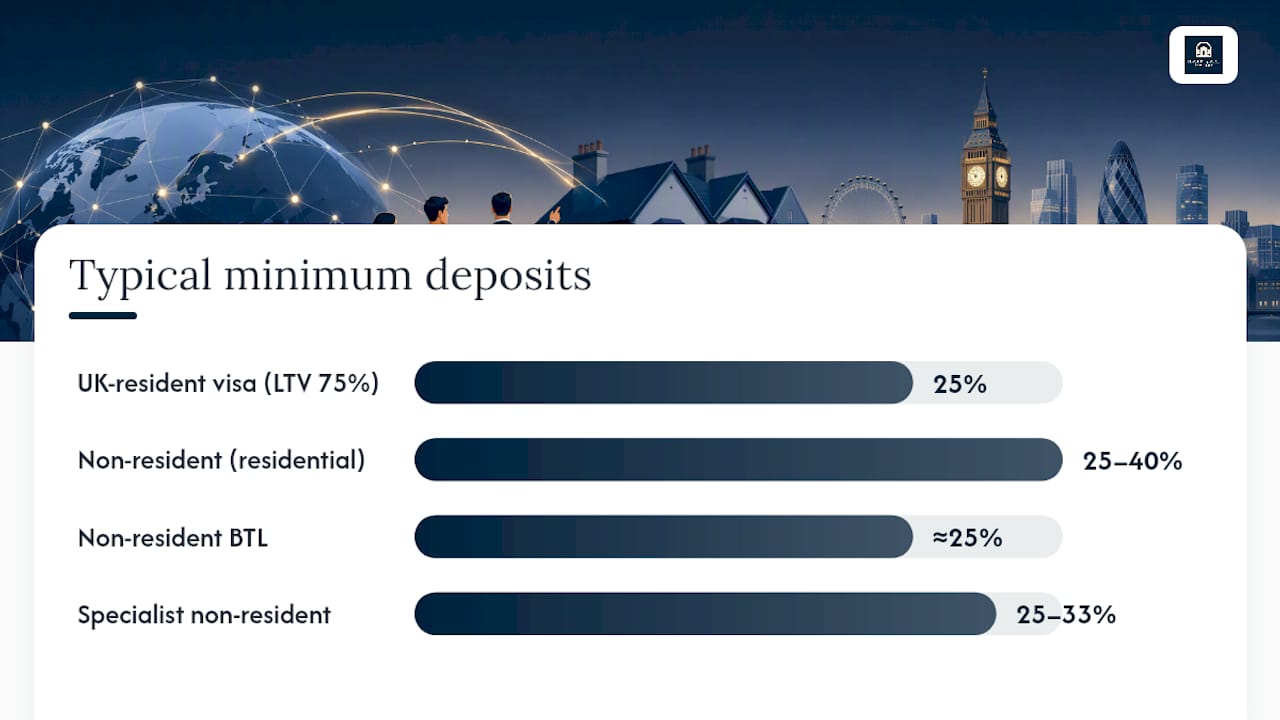
| Non-resident (buy-to-let) deposits typically start at around a quarter of the property value; rental yield must meet lender’s stress-test threshold | | Specialist non-resident product deposits generally fall between a quarter and a third of the property value; Skipton International and The Nottingham operate in this space |
For context, Defy Mortgage’s guide to foreign-national loans documents that foreign-national programs in the US typically require deposits of 25–40%, with alternative credit evidence accepted in place of a domestic credit file. The UK pattern is broadly consistent with this global norm.
Rates and fees
Foreign-national cases attract a rate premium over standard residential products. The premium reflects the additional underwriting complexity and the lender’s assessment of cross-border risk. Arrangement fees, valuation fees, and legal fees apply in the same way as standard UK mortgages, but some specialist lenders charge higher arrangement fees for non-resident products.
Stamp Duty Land Tax
Non-UK residents pay an additional SDLT surcharge on top of the standard rates. The gov.uk SDLT guidance provides the official calculator, and the non-resident SDLT surcharge page sets out the applicable rates. Budget for this cost before exchange of contracts, not after.
Currency transfer warning: Moving a large deposit from an overseas account to a UK account introduces exchange-rate risk. A 2–3% adverse movement on a £100,000 deposit transfer is a material sum. Consider using a specialist currency transfer service and locking in a forward contract once your offer is accepted.
How does the application process work, and how long does it take?
The application sequence for a foreign-national mortgage follows the same broad stages as a standard UK mortgage, but each stage takes longer and requires more documentation.
-
Initial affordability and lender match. An FCA-regulated adviser reviews your residency status, income, deposit, and credit position and identifies lenders whose published criteria your case meets. This stage typically takes two to five working days.
-
Documentation pack assembly. You gather and submit all required documents: ID, immigration proof, income evidence, and source-of-funds paperwork. Allow one to two weeks, longer if certified translations are needed.
-
Decision in principle (DIP). The lender issues a DIP based on the information provided. For foreign-national cases, some lenders require a full document review before issuing a DIP rather than relying on a credit-score-only check.
-
Full mortgage application and underwriting. The lender’s underwriter reviews the complete file. Cross-border cases involve additional AML checks and may require the underwriter to consult a specialist team. Allow two to four weeks at this stage.
-
Formal mortgage offer. Once underwriting is complete and the valuation is satisfactory, the lender issues a formal offer. The offer is typically valid for three to six months.
-
Legal completion. Your solicitor handles exchange of contracts and completion. Foreign-national buyers must instruct a UK-qualified solicitor. Completion typically follows exchange by two to four weeks.
Total timeline: A straightforward case with a complete documentation pack can move from initial enquiry to offer in four to eight weeks. Complex cross-border cases, particularly those involving multiple income currencies or thin UK credit files, can take ten to sixteen weeks.
NatWest International explicitly notes that complex cross-border mortgage applications are often processed through FCA-regulated intermediaries. For some lenders, using a regulated intermediary is not optional; it is a precondition for the application to be accepted at all.
Pre-application checklist:
-
Confirm your visa type and remaining term.
-
Obtain your immigration status share code from gov.uk.
-
Gather three to six months of bank statements (UK and overseas).
-
Obtain employer letter and last two years’ tax returns.
-
Confirm deposit source and ensure funds are seasoned for at least three months.
-
Check your UK credit file and address any errors.
-
Instruct an FCA-regulated mortgage adviser before approaching any lender directly.
Common problems that slow or block applications
Most foreign-national mortgage applications that stall do so for predictable, avoidable reasons.
Unseasoned deposit funds
Funds transferred into a UK account shortly before application trigger AML scrutiny. Lenders want to see a clear, documented trail showing where the money came from and how long it has been held. Move funds early and keep a paper trail.
Missing or unacceptable translations
A document translated by a family member or an uncertified online service will be rejected. Use a translator with recognized professional credentials (see the pro tip in the documents section above).
Unclear source of funds
Lenders are required by law to satisfy themselves that deposit funds are not the proceeds of crime. Vague explanations (“savings over time”) without supporting bank statements are a red flag. Prepare a written source-of-funds narrative supported by statements going back as far as the lender requests.
Thin credit references
No UK credit file, or a file with fewer than two to three active accounts, limits lender choice. International credit reports and bank reference letters can substitute, but not at every lender.
Occupation or immigration status mismatch
Declaring a visa type that does not match the lender’s eligibility criteria, or failing to disclose a recent change in immigration status, will cause the application to be declined or withdrawn. Disclose your full immigration history accurately.
Things to avoid:
-
Submitting an application to a lender whose country list excludes your nationality.
-
Providing rental income projections for a BTL application without a formal letting agent’s assessment.
-
Allowing your visa to lapse or enter a renewal period during the application process without notifying your adviser.
-
Submitting documents in batches rather than as a complete pack, which restarts the underwriting clock.
If any of these red flags apply to your case, an experienced adviser can usually resolve them before submission. The key is early engagement, not last-minute remediation.
How Haven Mark Advisers handles foreign-national cases
Haven Mark Advisers assigns a single dedicated adviser to each foreign-national case from the initial pre-qualification check through to legal completion. That adviser manages the documentation pack, liaises with the lender’s underwriting team, coordinates with the client’s solicitor, and handles any queries that arise during the process. There is no handoff between advisers at different stages.
For foreign-national applicants, the practical value of this model is in the detail. Haven Mark Advisers guides clients through certified-translation requirements, prepares source-of-funds narratives that satisfy AML checks, and identifies lenders whose published criteria match the client’s specific visa, nationality, and income profile before a formal application is submitted. The firm accesses a broad panel of UK lenders, including specialist non-resident products that are not available directly to applicants.
Havenmarkadvisers operates on a fee-based model. A set fee is charged upon completion for purchase or remortgage cases, and the firm may also receive commission from lenders. Full details of the fee structure are disclosed before instruction. To request a confidential pre-qualification, visit the foreign nationals and visa holders page or the who we help page.
This article provides general information only and does not constitute regulated mortgage advice. Confirm current lender criteria, tax rates, and immigration rules with the relevant primary sources or a qualified professional before making any financial decision.
Key Takeaways
Foreign nationals can secure a UK mortgage, but the outcome depends on residency status, visa type, income documentation, and early engagement with an FCA-regulated adviser.
| Point | Details |
|---|---|
| Deposit floor is higher | Non-resident and visa-holder cases typically require a minimum 25% deposit. |
| Lender pool is narrower | Not all mainstream lenders accept foreign-national applications; specialist lenders such as HSBC UK, Skipton International, and The Nottingham serve this market. |
| Documentation must be complete at submission | Missing translations, unseasoned funds, or thin credit references are the most common causes of delay or decline. |
| Non-resident SDLT surcharge applies | Budget for the additional stamp duty cost using the official gov.uk calculator before exchange of contracts. |
| Havenmarkadvisers provides dedicated adviser support | A single adviser manages the full case, from lender-matching and documentation to completion, with transparent fees disclosed upfront. |
Why early specialist involvement changes everything
The conventional view of a foreign-national mortgage application is that it is simply a standard mortgage with extra paperwork. That framing is wrong, and it leads applicants to underestimate how much the lender-selection decision matters before a single document is submitted.
The real variable in these cases is not the applicant’s creditworthiness. Most foreign nationals seeking UK mortgages are professionals with stable incomes and substantial deposits. The variable is fit: whether the specific combination of visa type, nationality, income currency, and deposit source matches a lender’s published and unpublished criteria. A case that is a straightforward approval at one lender is a decline at another, not because the applicant changed, but because the lender’s criteria did.
What advisers who work regularly in this space understand is that lenders update their non-resident and foreign-national criteria more frequently than their published product pages suggest. A lender that accepted Skilled Worker visa holders with overseas income six months ago may have tightened its position since. Advisers with active cases across multiple lenders see those changes in real time. Applicants who go direct do not.
The second underestimated factor is the AML and source-of-funds process. Lenders are not being obstructive when they ask for extensive documentation on deposit origins. They are meeting a legal obligation. Applicants who understand this and prepare accordingly, with a clear narrative and supporting statements, move through underwriting faster than those who treat it as an administrative inconvenience.
Early specialist involvement does not just improve the odds of approval. It compresses the timeline and reduces the cost of the process, because a well-prepared file submitted to the right lender the first time is cheaper and faster than a declined application followed by a second attempt.
Haven Mark Advisers: structured support for your UK mortgage application
Foreign nationals with complex income arrangements, cross-border assets, or non-standard visa situations get a materially different outcome when their case is managed by an adviser who knows which lenders are currently active in this space and what those lenders need to see.
IMPORTANT: YOUR HOME MAY BE REPOSSESSED IF YOU DO NOT KEEP UP REPAYMENTS ON YOUR MORTGAGE.

Haven Mark Advisers provides structured mortgage advice for foreign nationals, visa holders, and non-resident buyers across England. One dedicated adviser handles your case from the initial lender-match through to completion. The firm prepares documentation packs, manages source-of-funds workflows, liaises with solicitors, and coordinates directly with lender underwriting teams. Fees are fixed and disclosed before instruction; full details are on the fees page.
Within the first seven to fourteen days after instruction, your adviser will complete a full pre-qualification review, identify the lenders whose criteria your case meets, and outline the documentation required. Straightforward cases with complete documentation typically reach formal offer within four to eight weeks.
To start, visit the Haven Mark Advisers mortgages page and request a pre-qualification review.
Useful sources and further reading
Official and lender-published sources to verify rules, rates, and eligibility criteria: