

IMPORTANT: YOUR HOME MAY BE REPOSSESSED IF YOU DO NOT KEEP UP REPAYMENTS ON YOUR MORTGAGE.
A high net worth mortgage is a bespoke lending facility assessed on your full financial profile rather than a standard income multiple. If your annual net income is at least £300,000 or your net assets exceed £3,000,000 excluding your main residence, you meet the FCA's definition of a high net worth mortgage customer. That status unlocks tailored underwriting under MCOB, meaning lenders can assess affordability using assets, liquidity and a credible repayment plan rather than conventional salary multiples. The immediate next step is to prepare your financial documentation and speak with a specialist adviser such as Haven Mark Advisers, who can match your profile to the right lender from the outset.
Key takeaways
A high net worth mortgage is assessed on your full balance sheet, not a salary multiple. Preparation, lender selection and a clear repayment strategy are the three variables that determine the outcome.
- Self-check your threshold: confirm you meet the FCA definition (£300,000 annual net income or £3m net assets excluding your main residence) before approaching lenders.
- Gather documents early: tax returns, investment statements and trust documents take the longest to obtain and are the most scrutinised.
- Select the right lender type: private bank, building society HNW desk or specialist underwriter each suits a different profile; match lender to your assets and relationship position.
- Document your repayment strategy: interest-only facilities require a formal, credible repayment plan; this is non-negotiable.
- Engage a specialist adviser: a single-adviser model with demonstrable HNW experience reduces delays and improves acceptance odds.
IMPORTANT: YOUR HOME MAY BE REPOSSESSED IF YOU DO NOT KEEP UP REPAYMENTS ON YOUR MORTGAGE.
Table of Contents
- What counts as a high net worth mortgage in the UK?
- How underwriting differs for high net worth borrowers
- Which lenders provide HNW mortgages in the UK?
- Typical loan sizes, LTV, rates and fees
- Documents lenders will ask for
- How the HNW mortgage process works from enquiry to offer
- How to pick a specialist HNW mortgage adviser
- Why a specialist adviser matters for HNW borrowers
- An adviser's perspective on HNW mortgage cases
- Haven Mark Advisers: structured advice for complex mortgage cases
- Key Takeaways
- Sources
What counts as a high net worth mortgage in the UK?
The FCA Handbook sets the threshold clearly: annual net income of at least £300,000, or net assets of at least £3,000,000 excluding the primary residence, or a guarantor who meets either test. Meeting that definition permits lenders to apply MCOB tailored provisions, substituting standard affordability rules with bespoke assessments suited to complex financial profiles.
In practice, lenders apply their own internal criteria on top of the FCA threshold. Loan size alone does not determine eligibility. A £1.5m mortgage for a borrower with £10m in investable assets may qualify where a £3m mortgage for a borrower with modest liquidity does not.
Common lender entry points in the UK market:
- Private banks: typically require an assets under management (AUM) relationship of £1m or more, often with an expectation of broader wealth management business alongside the mortgage.
- Building society HNW desks: may accept borrowers without an AUM relationship but will scrutinise net assets and repayment strategy closely.
- Specialist underwriters: assess each case on its own merits, with no fixed AUM requirement, making them accessible for borrowers whose wealth is held in illiquid assets such as business equity or property.
- Family offices and private credit: used for very large or structurally complex facilities where a private bank's standard product range does not fit.
Pro Tip: Qualification is profile-driven, not purely loan-size-driven. A borrower with £5m in a managed portfolio and a £900,000 mortgage requirement may receive a stronger offer from a private bank than a borrower seeking £2m with no AUM relationship and limited liquidity evidence.
How underwriting differs for high net worth borrowers
Standard mortgage underwriting applies a loan-to-income multiple and a stress test against a notional rate. HNW underwriting is case-led: the lender builds a picture of your net assets, your liquidity position, and your repayment story, then decides whether the facility is prudent on that basis.

MCOB 11's tailored provisions permit firms to use alternative affordability assessments for HNW customers. Lenders may consider investment income, dividend streams, trust distributions, pension drawdown and planned capital events as part of the repayment case. What they cannot do is rely on anticipated house price growth to justify the loan, and they must model the impact of interest-rate rises on the borrower's ability to service the debt.
The MCOB 3A asset route is routinely used for asset-rich, income-light borrowers. Lenders assess net assets excluding the primary residence and pension, available cash flow for servicing, and a documented repayment plan. Private banks go further, modelling a 24–36 month liquidity runway as part of their underwriting process for large facilities.
The lender's core question is not "what does this person earn?" but "can this person service and repay this debt from their overall financial position, and is that position stable enough to withstand stress?" A clear, documented answer to that question is what a well-prepared application delivers.
The FCA's finalised guidance FG14/08 notes that high loan-to-income lending is concentrated in specialist desks and that larger lenders face expectations around limiting high LTI volumes. HNW lenders address this by moving away from LTI metrics altogether and anchoring their assessment to the balance sheet.
A worked example for an asset-rich, income-light borrower:
- Net assets confirmed: £6m investment portfolio, £1.2m pension (excluded from assessment), primary residence excluded. Net qualifying assets: £6m.
- Servicing capacity assessed: dividend income of £80,000 per year plus £40,000 from a rental property. Stress-tested at a higher rate to confirm serviceability.
- Repayment plan documented: planned partial portfolio liquidation at year 10 to repay capital; interest-only facility for the term.
- Liquidity runway modelled: 30 months of mortgage payments covered by liquid assets without touching the portfolio.
- Offer issued: interest-only facility at 75% LTV, with a formal repayment strategy letter on file.
Which lenders provide HNW mortgages in the UK?
Private banks, HNW desks at building societies, specialist underwriters and, for the largest facilities, family offices or private credit providers are the main routes. Each sits at a different point on the price-versus-relationship spectrum.
Product types in this market include:
- Interest-only residential: the most common structure for HNW borrowers; requires a documented repayment vehicle.
- Short-term bridging: used where speed or a transitional period is needed, for example between a sale and a purchase.
- Multi-currency facilities: available from private banks for borrowers with income or assets in multiple currencies.
- Bespoke repayment structures: part capital repayment, part interest-only, or deferred capital arrangements negotiated directly with the lender.
Pro Tip: If you already hold a managed portfolio with a private bank, approach that institution first. An existing AUM relationship frequently unlocks lower pricing and higher LTV than a cold approach to the same bank's mortgage desk.
Typical loan sizes, LTV, rates and fees
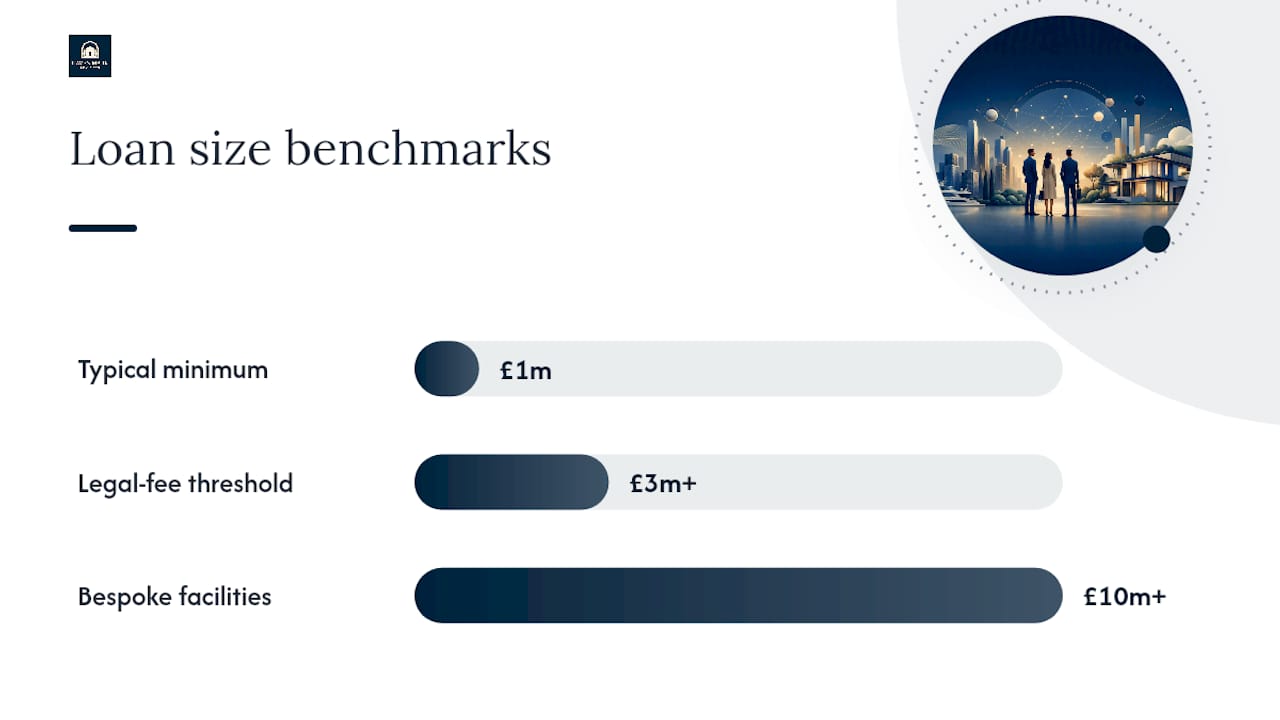
Loan sizes for private client mortgages commonly start around £1m, though specialist underwriters will consider smaller amounts where the borrower's profile is clearly HNW. There is no published upper limit at most private banks; facilities of £10m or more are handled on a fully bespoke basis.
Pricing is not advertised. Rates are negotiated and depend on LTV, the strength of the AUM relationship, the complexity of the income structure and the lender's appetite at the time of application. Arrangement fees, rather than rate alone, are often the more significant cost variable.
Main cost items to budget for:
- Arrangement fee: typically 0.5–1.5% of the loan amount, though negotiable, particularly where an AUM relationship exists.
- Valuation fee: for high-value properties, specialist valuers are required; fees scale with property value and can be substantial for prime or unusual assets.
- Legal fees: dual representation is standard; borrower-side legal costs on a £3m+ facility are material and should be confirmed early.
- Adviser fee: paid on completion for a purchase or remortgage; Haven Mark Advisers operates on a transparent, set-fee basis disclosed at the outset.
- AUM or relationship charge: some private banks price the mortgage as part of a broader wealth relationship; the mortgage rate may be lower but the total cost of the relationship should be assessed.
Pro Tip: Arrangement fees are a genuine negotiation point, especially where you bring or commit to an AUM relationship. Ask your adviser to negotiate the fee as part of the overall terms, not as an afterthought after the rate is agreed.
Documents lenders will ask for
A lender-ready application pack materially improves acceptance odds for HNW cases. Lenders need to verify every element of the financial picture your adviser presents, so incomplete documentation is the single most common cause of delay.
Core document checklist:
- Personal identification: passport and a secondary photo ID; proof of current address dated within three months.
- Residency and immigration status: visa documentation, indefinite leave to remain, or British National (Overseas) documentation where applicable. Borrowers with international profiles should review the guidance on foreign national mortgages early in the process.
- Tax returns: three years of self-assessment returns (SA302s and tax year overviews) or equivalent for non-UK-resident borrowers.
- Employer or partnership letters: confirmation of salary, bonus structure, carried interest or profit-share arrangements; for finance professionals, see the guidance on mortgages for finance professionals.
- Investment and portfolio statements: three to six months of statements from all investment accounts, showing current valuations and liquidity.
- Business accounts: two to three years of certified accounts for self-employed borrowers or company directors; see the self-employed mortgage guidance for documentation specifics.
- Trust or company ownership documents: trust deeds, letters of wishes, company ownership structure and any relevant trustee resolutions.
- Repayment strategy letter: a short, clear document setting out how the capital will be repaid at the end of the term; this is non-negotiable for interest-only facilities.
- AML source of funds evidence: bank statements and, where relevant, documentation of the original wealth event (sale proceeds, inheritance, business exit).
Pro Tip: Gather tax returns and investment statements first. These take the longest to obtain and are the documents most likely to trigger follow-up queries from the lender's compliance team. Having them ready before your adviser submits the application removes the most common bottleneck.
How the HNW mortgage process works from enquiry to offer
A well-managed HNW mortgage case typically runs from initial enquiry to formal offer in six to twelve weeks, though complex structures or international assets can extend that timeline. The adviser's role is to compress the process by running tasks in parallel and anticipating lender queries before they arise.
Typical phase-by-phase timeline:
- Week 1–2 (Initial assessment): adviser reviews your financial profile, confirms lender fit, and identifies the document requirements specific to your case.
- Week 2–4 (Document collation): you gather and submit documents; adviser prepares the application narrative and repayment strategy summary.
- Week 4–5 (Lender submission): adviser submits a complete, lender-ready pack to the selected lender; incomplete packs reset the clock.
- Week 5–8 (Underwriting and credit approval): lender reviews the case; queries are handled by the adviser directly with the underwriter.
- Week 6–10 (Valuation): specialist valuation instructed; for prime or unusual properties, this can take two to three weeks.
- Week 8–12 (Legal and completion): solicitors exchange and complete; trustee permissions or complex title searches add time here.
Common delays to plan for:
- Anti-money laundering (AML) checks on large or international asset pools.
- Trustee sign-off where assets are held in trust.
- Complex title searches on prime or unusual properties.
- Lender credit committee review for very large facilities.
Pro Tip: Ask your adviser to instruct the valuation and brief your solicitor at the same time as the lender submission, not after credit approval. Running legal and valuation in parallel with underwriting can save three to four weeks on a straightforward case.
How to pick a specialist HNW mortgage adviser
Choose an adviser with demonstrable HNW case experience, clear FCA regulation awareness and a single-adviser model that gives you one point of contact from enquiry to completion. Haven Mark Advisers operates on exactly that basis, with over ten years of experience handling complex income and asset-based cases for lawyers, finance professionals and business owners.
Questions to ask any adviser before instructing them:
- How many HNW cases have you completed in the past 12 months, and what was the typical loan size?
- Which lenders are on your panel, and do you have direct relationships with private bank underwriters?
- Can you provide anonymised examples of cases involving trust structures, offshore assets or multi-currency income?
- What is your fee structure, and do you receive commission from lenders in addition to your adviser fee?
- Who will manage my case day to day, and will I have a single point of contact throughout?
Red flags to watch for:
- Vague or undocumented repayment plans for interest-only facilities.
- Reluctance to request full documentation early in the process.
- Opaque fee structures or undisclosed lender commission.
- Defaulting to a single lender without explaining why it is the best fit for your profile.
- No evidence of handling cases with complexity comparable to yours.
Pro Tip: Ask for a process overview document and at least one anonymised case study before you instruct. A credible HNW adviser will have both ready. If they cannot produce either, that tells you something about how they manage cases.
Why a specialist adviser matters for HNW borrowers
Specialist advisers reduce friction, present complex financial stories clearly to underwriters, and access lenders that a standard broker route cannot reach. The difference between a declined application and a formal offer often comes down to how the case is packaged, not the underlying financial strength of the borrower.
Consider a borrower with £8m in a managed portfolio, £60,000 in dividend income, and no PAYE salary. A standard mortgage application would fail on income multiples immediately. A specialist adviser structures the case under the MCOB 3A asset route, prepares a liquidity analysis showing a 30-month runway, documents a repayment plan tied to a planned portfolio drawdown, and submits to a private bank with which they have an existing underwriter relationship.
Direct benefits of working with a specialist adviser:
- Lender matching based on your specific asset profile, income type and residency status.
- Preparation of a complete, lender-ready document pack that reduces underwriting queries.
- Direct negotiation on arrangement fees, rate and structure.
- Proactive case management with a single adviser who knows your file throughout.
- Access to private bank desks and specialist underwriters not available through standard broker channels.
Haven Mark Advisers assigns one dedicated adviser to each case, from initial assessment through to completion. Fees are disclosed transparently at the outset, and the firm's client overview sets out the full range of borrower profiles it handles.
An adviser's perspective on HNW mortgage cases
The cases that stall are rarely the ones with the weakest financial positions. They stall because the application does not tell a coherent story. An asset-rich borrower with a complex income structure and no PAYE record can be an excellent credit risk. The lender's underwriter needs to see that clearly, in a format they can take to credit committee, with every document in place and a repayment plan that holds up under scrutiny.
The most consistent pattern is this: borrowers who engage a specialist adviser early, gather documents before they are asked for them, and commit to a clear repayment strategy reach offer faster and on better terms than those who approach lenders directly or use a generalist broker unfamiliar with private bank underwriting. The process is not complicated, but it requires precision.
If your case involves complex income, trust structures, international assets or an unusual property, speak with Haven Mark Advisers before you approach any lender. One dedicated adviser will assess your profile, confirm lender fit and prepare your application from the outset.
Haven Mark Advisers: structured advice for complex mortgage cases
Complex income, significant assets and a time-sensitive transaction are exactly the conditions where a generalist broker adds friction rather than removing it. Haven Mark Advisers provides structured mortgage advice for professionals with precisely these profiles, including lawyers, finance professionals, self-employed business owners and foreign nationals with UK property interests.

Each client is assigned a single dedicated adviser who manages the case from initial assessment to completion. There are no handoffs, no repeated explanations, and no delays caused by internal referrals. The firm's approach covers bespoke lender-matching, full document pack preparation, direct negotiation on fees and structure, and proactive case management throughout underwriting.
What a typical engagement includes:
- Initial profile assessment and lender shortlist.
- Document checklist tailored to your income type and asset structure.
- Preparation of the application narrative and repayment strategy summary.
- Submission to the selected lender with direct underwriter contact.
- Management of valuation, legal coordination and completion.
Fees are set and disclosed at the outset. The firm's fee structure is available to review before you instruct. To discuss your case with a dedicated adviser, visit the residential mortgages page or contact Haven Mark Advisers directly to arrange an initial consultation.
YOUR HOME MAY BE REPOSSESSED IF YOU DO NOT KEEP UP REPAYMENTS ON YOUR MORTGAGE. Haven Mark Advisers is a fee-based regulated mortgage adviser. A fee is payable on completion. The firm may also receive commission from lenders.
Key Takeaways
A high net worth mortgage is assessed on your full balance sheet under FCA-permitted tailored provisions, not a standard income multiple. Preparation, lender selection and a documented repayment strategy determine the outcome.
| Point | Details |
|---|---|
| FCA threshold | Meeting the FCA criteria for high net worth mortgage customer qualifies you for tailored underwriting. |
| Lender selection | Private banks, building society HNW desks and specialist underwriters each suit a different asset and relationship profile. |
| Repayment strategy | Interest-only facilities require a formal, documented repayment plan; this is a non-negotiable underwriting requirement. |
| Liquidity modelling | Private banks model a 24–36 month liquidity runway as part of underwriting for large mortgage facilities. |
| Haven Mark Advisers | Assigns one dedicated adviser per case, with over ten years of HNW experience and transparent fees disclosed at the outset. |
This article is general information, not a substitute for advice from a qualified financial advisor. Consult a qualified financial professional about your own circumstances before acting on anything here.
Sources
- FCA Handbook
- FCA finalised guidance FG14/08
- High Net Worth Mortgages UK 2026: The Ultimate Guide - EHF Mortgages