

IMPORTANT: YOUR HOME MAY BE REPOSSESSED IF YOU DO NOT KEEP UP REPAYMENTS ON YOUR MORTGAGE.
An inside IR35 mortgage is still achievable. Being inside IR35 does not stop lenders approving your application, but it does change which income figure they will use. ContractorUK confirms that the effect on future applications depends entirely on how each lender chooses to assess your pay.
That shift matters because it usually shrinks the number lenders will lend against.
- Provable income often falls once tax and National Insurance are handled through PAYE rather than a gross contract rate.
- You will typically need payslips, a P60, or umbrella statements rather than just a signed contract.
- Some specialist lenders will still look through to your gross contract value, which is why lender choice matters as much as your day rate.
Key Takeaways
Inside IR35 status changes which income figure lenders will use, not whether they will lend to you at all, and matching your paperwork to the right lender type is what determines your borrowing power.
| Point | Details |
|---|---|
| IR35 does not block mortgages | It changes whether lenders use payslip income or gross contract value, not your eligibility itself. |
| Net income falls significantly | Employer NI, the Apprenticeship Levy, and umbrella fees reduce the gross contract value significantly before it appears as payslip income. |
| Build payslip history first | Three to six months of clean payslips satisfies most payslip based lenders without an unnecessary long wait. |
| Lender policy varies widely | High street banks generally use payslips; specialist lenders may look through to your gross contract value. |
| Get specialist advice early | Haven Mark Advisers assigns one dedicated adviser to match your case to the right lender and package your evidence pack. |
Table of Contents
- How lenders typically assess your income inside IR35
- What documents will lenders ask you for?
- What does inside IR35 do to your borrowing power?
- Which lenders should you approach inside IR35?
- How can you strengthen your application before submitting?
- Why work with a specialist mortgage adviser?
- The gap between advice you'll read online and what actually works
- Get specialist help with your inside IR35 mortgage
- Frequently asked questions
- Sources
How lenders typically assess your income inside IR35
Most mainstream lenders treat inside IR35 pay much like standard employment. They want payslips and P60s, not your contract's headline day rate. A handful of specialist lenders take a different approach and look through the umbrella arrangement to the underlying contract value instead.
Three calculation methods turn up repeatedly in lending manuals:
- Payslip/PAYE assessment: the lender annualises your recent net payslip figures, treating you much like an employee.
- 46 week multiplier: some lenders multiply your weekly umbrella pay by 46 weeks rather than 52, to account for likely downtime between contracts, as set out in Darlington's lending manual.
- Gross contract look through: a smaller pool of specialist lenders will assess the contract's day rate directly, before umbrella deductions.
Statistic callout: Industry guidance suggests only around 58 to 62% of your gross contract value tends to reach you as payslip income once employer National Insurance, the Apprenticeship Levy, and umbrella fees are stripped out, and Virgin Money's intermediary lending criteria confirms lenders deduct these employer costs before annualising your pay. Halifax's approach is often cited as a sensible yardstick for how a high street lender treats this income, though every lender's policy differs. Running your own figures through ContractorCalculator or checking practitioner threads on ContractorUK before you apply saves wasted time.
What documents will lenders ask you for?
Expect to hand over a fairly standard evidence pack, whichever lender you approach. Most want:
- Three to six months of payslips, plus your most recent P60.
- Umbrella payslip breakdowns showing gross pay, deductions, and net pay separately.
- The underlying contract or assignment schedule, ideally with time still remaining on it.
- Three months of personal bank statements showing the contract income landing.
- An employer or umbrella confirmation letter, where your umbrella company can provide one.
Lenders following the Darlington lending manual typically want the current contract to have at least half its term left, or clear proof of renewal, alongside three months of bank statements. Deductions for employer National Insurance are applied before the 46 week multiplier, not after, which catches out a fair few applicants who calculate their own numbers first. If you have gaps between contracts, be ready to explain them plainly rather than let an underwriter guess.
What does inside IR35 do to your borrowing power?
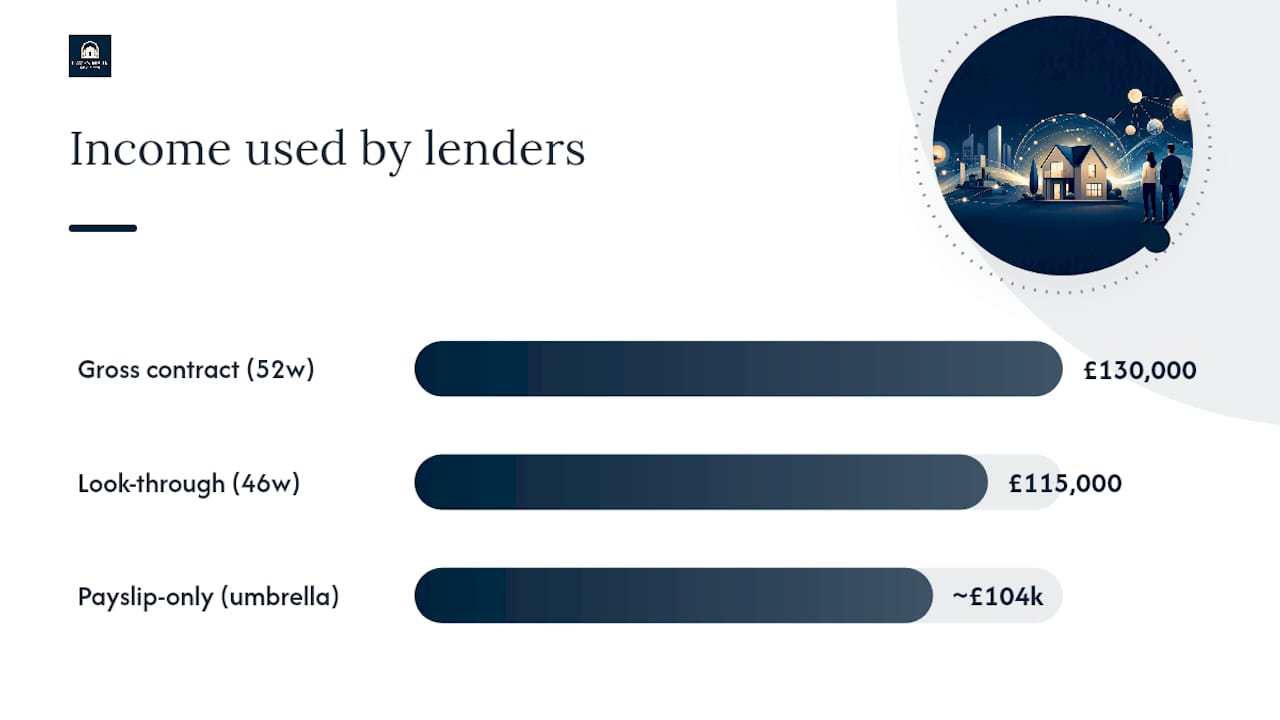
Take a contractor charging £500 a day. Worked five days a week across a full year, the gross contract value is calculated based on typical working days. Once you are inside IR35, that figure never reaches your bank account as gross pay. Employer National Insurance, the Apprenticeship Levy, and umbrella fees come off first, and MortgageAffordability's guide to contractor mortgages shows how differently payslip only lenders and gross look through lenders then treat what remains.
A payslip only lender will annualise your net umbrella salary, often landing well below the £130,000 headline figure. A specialist lender using gross contract look through, applying the 46 week convention, works from a figure much closer to your day rate. The gap between those two assessments can run into six figures of borrowing capacity, and industry commentary from IR35Guide puts the typical reduction in provable income at around 20% or more. These numbers are illustrative. Every lender's multiplier and deduction rules differ, so treat any figure as a starting point, not a promise.
- Run your own day rate through a tool like ContractorCalculator or check Haven Mark Advisers's day rate contractor guide for a quick sense check.
Pro Tip: If you can time your application while still outside IR35, do it before the contract changes. If you are already inside, building three to six months of clean payslip history before you apply often opens up more lenders than rushing in with one or two payslips.
Which lenders should you approach inside IR35?
Lender type matters more than lender size here. High street banks generally default to payslip or SA302 based assessment, treating you as close to a standard employee. Specialist contractor lenders and some building societies are more willing to apply gross contract look through, particularly where you can show a stable contracting history.
Signals worth checking before you apply:
- Does the lender publish a gross contract look through policy, or do they rely on payslips only?
- Will they accept umbrella payslips as primary evidence, or do they want SA302s too?
- Do they require continuity of contract, or will a recent move inside IR35 count against you?
Halifax's published contractor guidance is often used as an industry benchmark for how a mainstream lender handles this income type, but its rules will not match every specialist panel lender. Going direct to a high street branch without checking their policy first risks a declined application landing on your credit file for no good reason. A broker with access to a wider lender panel usually spots the mismatch before you waste an application.
How can you strengthen your application before submitting?
Preparation beats speed here. Before you approach any lender, gather your evidence pack in full: payslips, umbrella statements, the contract or assignment schedule, and business bank statements showing the pattern of income arriving.
Ask each lender, or your broker, these questions early:
- Do you assess on payslips alone, or will you look through to the underlying contract?
- What documentation do you require for umbrella income specifically?
- How do you treat employer NI and payroll service deductions in your calculation?
Watch for these red flags before you submit anything:
- A short or non renewable contract with little time left to run.
- Only one or two payslips since moving inside IR35.
- Umbrella deductions that are not clearly itemised.
- Unexplained gaps in income between contracts.
Pro Tip: Speak to a specialist broker before you apply anywhere. It costs nothing to find out which lenders will undervalue your income, and everything to discover it after a hard credit check.
Why work with a specialist mortgage adviser?

A regulated specialist adviser typically improves your odds because they know which lenders on the panel will use gross contract look through and which will not, and they can access lenders you would not find applying directly. That knowledge alone often changes the outcome for contractors with mixed IR35 histories.
Good advisers add value in three concrete ways: choosing lenders that suit your actual income pattern, packaging your evidence pack properly, and writing a short covering note that explains your current status to an underwriter before they ask.
Haven Mark Advisers has spent over ten years advising professionals with complex income, including contractors moving in and out of IR35, and assigns one dedicated adviser to manage your case from first call to completion. Budget for arrangement fees and, in some cases, a slightly higher rate where a lender treats your income as non standard; Haven Mark Advisers sets out its fee structure clearly before any work begins. Timescales vary by lender, but a well packaged case tends to move noticeably faster than one submitted without preparation.
The gap between advice you'll read online and what actually works
Most guides treat IR35 status as a binary switch, as if being inside it simply caps your borrowing at some fixed percentage of outside IR35 levels. That is not what the evidence shows. The real determinant is lender policy, not your IR35 status itself. Two applicants with identical day rates and identical IR35 status can walk away with wildly different offers depending purely on whether their chosen lender annualises payslips or looks through to the contract.
The conventional advice, wait until you have a long PAYE history before applying, is often too cautious. Three to six months of clean payslips is frequently enough for a payslip based lender, and waiting longer costs you house hunting time for no real gain if your history is already tidy.
What should you prioritise first? Find out how a lender actually calculates contractor income before you fall in love with a property. A five minute policy check saves months of frustration, and it is the one step contractors skip most often because they assume all lenders work the same way. They do not, and that single fact explains most of the disappointment contractors report during this process.
Get specialist help with your inside IR35 mortgage
Haven Mark Advisers exists precisely for cases like this, where a headline day rate and a lender's actual assessment rarely match. Rather than approaching lenders one at a time and hoping for the best, you get one dedicated adviser who already knows which lenders will use your umbrella payslips fairly and which will undervalue your income before you even apply.

That single point of contact matters more than it sounds. Your adviser packages your evidence pack, writes the covering note explaining your IR35 position, and manages the case proactively rather than leaving you to chase updates. Haven Mark Advisers also advises self-employed business owners and contractors with mixed histories, so your case is not being handled by someone unfamiliar with how umbrella deductions distort a payslip. If you are ready to find out what you can actually borrow, get in touch through Haven Mark Advisers's residential mortgage advice page and start the conversation with your adviser directly.
Frequently asked questions
Does being inside IR35 stop me getting a mortgage? No. It changes which income figure a lender will assess, not your eligibility to apply. Lenders may use your payslip income rather than your gross contract rate, which can lower your borrowing but does not prevent approval.
How much less can I borrow inside IR35 compared with outside IR35?
What documents do I need for an inside IR35 mortgage application? Most lenders want three to six months of payslips, your P60, umbrella payslip breakdowns, your current contract or assignment schedule, and three months of bank statements.
Will Halifax accept an inside IR35 contractor? Halifax's published contractor guidance is often used as a benchmark for mainstream lender policy, though every lender's exact treatment of umbrella income differs, so check current criteria or ask a broker before applying.
Should I wait before applying if I've just moved inside IR35? If you have only one or two payslips, building three to six months of history often widens your choice of lender. A specialist broker can also identify lenders that will accept a shorter history.
This article is general information, not a substitute for advice from a qualified financial advisor. Consult a qualified financial professional about your own circumstances before acting on anything here.
Sources
- Intermediaries: Lending criteria — contractors (Virgin Money)
- Lending Manual 3.14 (Darlington) — contractor criteria
- Contractor mortgages: day rate, umbrella & CIS explained (MortgageAffordability)