

A Joint Borrower Sole Proprietor (JBSP) mortgage lets multiple people name themselves on the mortgage contract while only one person holds legal ownership of the property. This structure is most useful when a buyer's income alone is insufficient to borrow the amount needed, and a parent or family member wants to support without becoming a co-owner.
Three situations where a JBSP mortgage is the right tool:
- A first-time buyer whose salary qualifies for less than the purchase price, and whose parents want to contribute their income without acquiring a share of the home.
- A supporting family member who already owns property and wants to avoid the higher rates of Stamp Duty Land Tax that apply when a second property is added to their name.
- A family that wants a clear, documented path to removing the supporting borrowers from the mortgage once the buyer's income grows.
One critical point before proceeding: every person named on the mortgage is jointly and severally liable for the full debt from day one. Non-owners are legally required to obtain independent legal advice before signing; this typically costs around £300.
Table of Contents
- What is a JBSP mortgage, and how does it differ from joint ownership?
- How does a JBSP mortgage work in practice?
- What are the pros and cons for families considering JBSP?
- Which UK lenders offer JBSP-style or family-backed mortgages?
- What should supporting borrowers check before agreeing to a JBSP mortgage?
- How do you apply for a JBSP mortgage, step by step?
- How does JBSP compare to guarantor mortgages, joint ownership, and gifted deposits?
- When does regulated mortgage advice make a material difference for JBSP cases?
- How does a JBSP mortgage affect tax and inheritance for the sole proprietor?
- Key Takeaways
- The part of JBSP planning most families get wrong
- How Havenmarkadvisers structures JBSP cases from day one
- Useful sources to verify rules and lender details
What is a JBSP mortgage, and how does it differ from joint ownership?
A joint borrower sole proprietor mortgage places up to four people on the mortgage contract while only one individual is registered as the legal owner on the title deeds. The distinction matters enormously in practice. Being on the mortgage means accepting financial liability. Being on the title means owning the asset.
In a standard joint mortgage, both parties appear on the mortgage and on the deeds. In a JBSP arrangement, the supporting borrowers are on the mortgage only. They have no ownership stake, no right to occupy, and no share of any future sale proceeds.
A worked example: A buyer earns a moderate annual income. Adding a parent as a supporting borrower increases the combined income, which in turn boosts the mortgage amount they can afford together, while the buyer remains the sole owner. The parent's income is counted; their name does not appear on the deeds.
Lenders typically allow up to four named borrowers, though most JBSP cases involve two or three. Because the supporting borrowers do not appear on the title, the buyer's first-time buyer status is preserved, and the stamp duty treatment is determined by the sole proprietor's ownership position rather than the supporters' existing property holdings.
How does a JBSP mortgage work in practice?
The mechanics of a JBSP mortgage differ from a guarantor mortgage in one critical way: liability is immediate. All borrowers named on the mortgage are equally and fully responsible for the debt from the start of the mortgage term, not only when the primary borrower defaults. A guarantor, by contrast, is typically called upon only after the main borrower has missed payments, as MoneyHelper's consumer guidance on guarantor arrangements confirms.
This distinction has real consequences. If the sole proprietor misses a payment, the lender can pursue any named borrower for the full amount. The mortgage appears on all named borrowers' credit files from the outset.
Lenders assess all named borrowers during underwriting. Supporting borrowers must provide payslips, P60s, SA302s if self-employed, pension statements, and bank statements. Lenders also review existing credit commitments, outstanding mortgages, and living expenses for every applicant. The combined picture determines the maximum loan.
The ownership and liability split is the structural feature that makes JBSP useful for families where the supporter already owns a home. Because the supporter is not on the title, stamp duty is assessed on the sole proprietor's position, not the supporter's. A parent who owns their own home does not trigger the higher rates that apply when a second property is acquired.
Independent legal advice for non-owners is not optional. Most lenders require a signed confirmation that supporting borrowers have received that advice before the mortgage completes. StepChange's guidance on guarantor responsibilities applies equally here: accepting liability for another person's debt carries real financial and credit risk that must be understood before signing.
What are the pros and cons for families considering JBSP?
| Factor | Benefit | Consideration |
|---|---|---|
| Borrowing capacity | Combined incomes can materially increase the maximum loan | Supporters take on full, immediate liability for the debt |
| Ownership | Sole proprietor retains full legal ownership and all future equity | Supporters have no ownership stake despite carrying financial risk |
| Stamp duty | Sole proprietor's first-time buyer relief is preserved; supporters avoid second-home surcharge | Sole proprietor must remain the only owner for this to hold |
| Credit impact | No credit impact on sole proprietor beyond the mortgage itself | Mortgage appears on all named borrowers' credit files from day one |
| Mortgage term | Flexible term based on lender criteria | Term may be shortened if the oldest borrower is close to the lender's maximum age |
| Exit flexibility | Supporters can be removed via remortgage once the sole proprietor qualifies alone | Remortgage requires the sole proprietor to meet affordability criteria independently |
| Legal costs | Arrangement is straightforward if all parties are informed | Independent legal advice for non-owners typically costs around £300 and is mandatory |
The stamp duty advantage deserves emphasis. Under HMRC's Stamp Duty Land Tax rules, ownership on the title determines SDLT liability. A supporting borrower who already owns a home does not add a second property to their name in a JBSP arrangement, so the higher rates that apply to additional dwellings do not apply to them. The sole proprietor, if a first-time buyer, retains eligibility for first-time buyer relief on qualifying purchases.
Pro Tip: Plan the exit before you sign. Most families target a remortgage after 3–5 years, once the sole proprietor has a track record of payments and, ideally, a salary increase. Factor the cost of life and critical illness cover into affordability planning from the start. If a supporter becomes unable to work, the sole proprietor needs a way to cover the full payment without defaulting.
Which UK lenders offer JBSP-style or family-backed mortgages?
Many high-street lenders and building societies offer JBSP-style products, though the product names vary considerably. The mechanics are the same: multiple borrowers, one owner. The label on the product sheet is different.
NatWest offers a product called the Family-Backed Mortgage. NatWest's criteria include age limits and a requirement for independent legal advice for non-owner borrowers, and the mortgage term is capped by the oldest borrower's age. NatWest is one of the more accessible high-street options for families exploring this route.
Barclays has offered an Income Booster product, which allows a family member's income to be added to the application without that person appearing on the title. Specific eligibility criteria, including age limits and the number of permitted supporters, are set at the product level and subject to change.
Skipton Building Society has provided family-backed mortgage options with criteria that can be more flexible than some high-street banks, particularly for borrowers with non-standard income profiles. Skipton's approach to affordability assessment is worth exploring through a broker if the primary applicant's income is complex.
Metro Bank has also offered JBSP-style products and tends to take a more manual underwriting approach, which can benefit applicants whose circumstances do not fit standard automated credit scoring.
Specialist building societies often have more flexible criteria than the major banks, particularly around income types and age limits. Because product availability and criteria change regularly, a regulated broker with whole-of-market access is the most reliable way to identify which lender currently offers the best fit for a specific case.
What should supporting borrowers check before agreeing to a JBSP mortgage?
Supporting borrowers take on significant legal and financial obligations. These are the checks that should be completed before signing.
Legal and financial checklist:
- Independent legal advice: Non-owner borrowers must obtain this before completion. The cost is typically around £300 and is paid separately from the main conveyancing fees. Request a non-owner advice letter from the solicitor.
Insurance: Life cover and critical illness cover for all named borrowers should be arranged before or at completion. If a supporting borrower becomes seriously ill or dies, the sole proprietor needs to be able to service the full mortgage without defaulting.
Pro Tip: Ask the lender directly whether the JBSP mortgage will be reported to credit reference agencies under all named borrowers' profiles. Most will confirm yes. Factor this into any plans the supporting borrower has to remortgage their own home or take out new credit within the next few years.
How do you apply for a JBSP mortgage, step by step?
-
Affordability assessment and mortgage in principle (MIP): All named borrowers provide income and expenditure details. A broker or lender calculates the maximum loan and issues a mortgage in principle. This confirms the arrangement is viable before any formal application.
-
Select lender and product: Based on the MIP, identify the lender whose criteria best fit the case. Consider age limits, the number of permitted supporters, income types accepted, and product rates. A broker with whole-of-market access is the most efficient route.
-
Gather documentation for all borrowers: Employed borrowers provide three months of payslips and the most recent P60. Self-employed borrowers provide two years of SA302s and corresponding tax year overviews. All borrowers provide three months of bank statements, proof of identity (passport or driving license), and proof of address (utility bill or bank statement dated within three months). Retired supporters provide pension award letters or statements.
-
Supporting borrowers obtain independent legal advice: Each non-owner borrower instructs a solicitor separately from the main conveyancing solicitor. The solicitor confirms in writing that the borrower understands their obligations. This letter is submitted to the lender.
-
Formal application and underwriting: The lender reviews all documentation, runs credit checks on every named borrower, and stress-tests affordability. Additional queries are common at this stage, particularly around complex income or age-limit calculations.
-
Mortgage offer: Once underwriting is complete, the lender issues a formal mortgage offer. Review the offer carefully, particularly the term, the monthly payment, and any conditions attached to the non-owner borrowers.
-
Exchange and completion: The conveyancing solicitor handles exchange of contracts and completion. The mortgage is registered against the property in the sole proprietor's name only.
-
Post-completion planning: Set a calendar reminder for the remortgage review date. Most families target removal of supporting borrowers after 3–5 years, aligned with the end of the initial fixed-rate period.
Timeline: From MIP to completion typically takes 8–12 weeks, though complex cases with multiple income types or solicitor scheduling delays can extend this to 16 weeks or more.
How does JBSP compare to guarantor mortgages, joint ownership, and gifted deposits?
| Route | Ownership | Immediate liability | Stamp duty impact | Exit flexibility | Key documentation |
|---|---|---|---|---|---|
| JBSP mortgage | Sole proprietor only | All named borrowers from day one | Based on sole proprietor's position; supporters avoid second-home surcharge | Remortgage in sole proprietor's name when income qualifies | Income evidence for all borrowers; independent legal advice for non-owners |
| Guarantor mortgage | Sole proprietor only | Guarantor liable only on default | Based on sole proprietor's position | Guarantor removed when lender agrees; typically requires reapplication | Guarantor income and asset evidence; guarantor liability confirmed in writing |
| Joint mortgage | Both parties on title | Both parties from day one | Both owners' positions assessed; second-home surcharge applies if either owns property | Requires transfer of equity and lender consent to remove a party | Income evidence for all owners; standard conveyancing |
| Gifted deposit | Sole proprietor only | Sole proprietor only | Based on sole proprietor's position | No ongoing liability for donor | Gift letter confirming no repayment required; donor's bank statements |
A guarantor mortgage suits families where the supporter's income is not needed to meet the lender's affordability threshold, but a credit or deposit shortfall needs backing. The guarantor carries less immediate risk than a JBSP supporting borrower, but the credit consequences of a default are equally serious.
A joint mortgage is appropriate when both parties genuinely want shared ownership and are comfortable with the stamp duty consequences. If the supporter already owns a home, the higher rates of SDLT apply to the purchase, which can add a material cost.
A gifted deposit removes the supporter from the mortgage entirely. If the supporter wants a future equity stake in the property, a Declaration of Trust can document that arrangement, but this changes the ownership picture and has tax and inheritance implications that require legal advice.
When does regulated mortgage advice make a material difference for JBSP cases?
JBSP applications involve more moving parts than a standard residential mortgage. Age limits, multiple income types, the independent legal advice requirement, and exit planning all create points where an unadvised application can stall or fail.
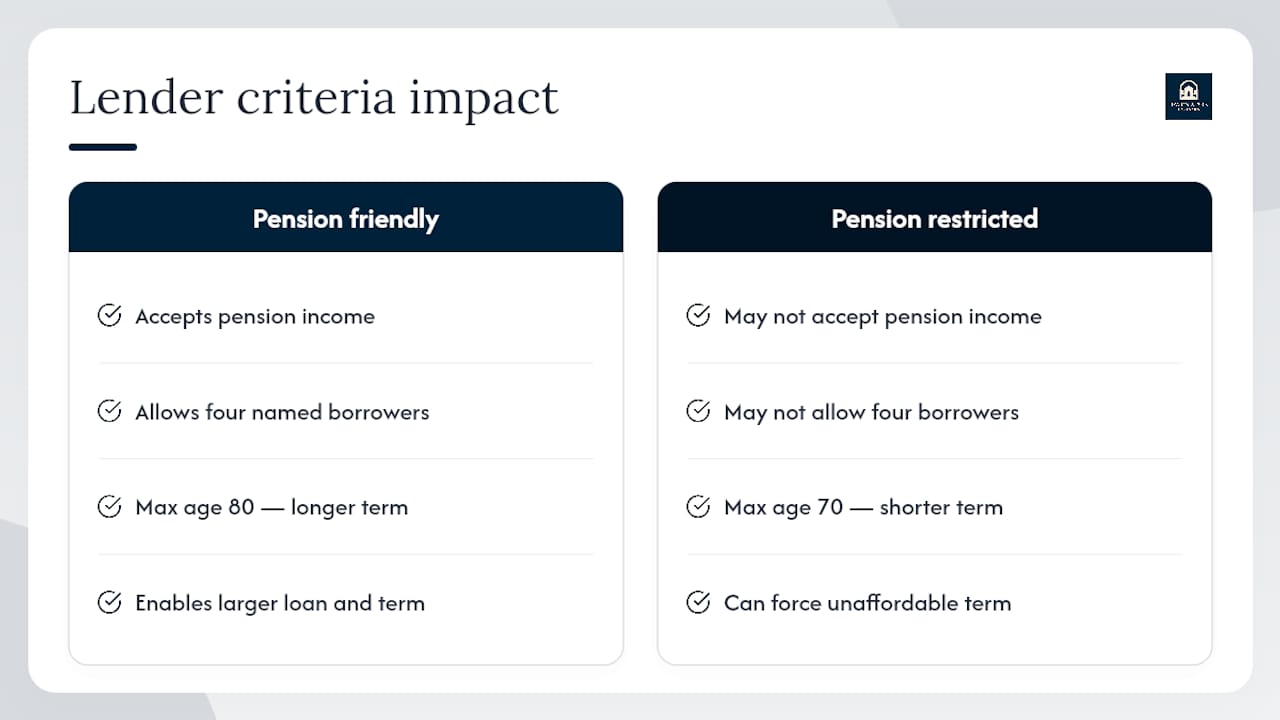
A regulated adviser adds value in several specific ways. First, whole-of-market access means the adviser can match the case to lenders whose criteria fit the specific combination of borrower ages, income types, and loan size. Not every lender accepts pension income from supporting borrowers, and not every lender allows four named borrowers. Second, an adviser can model the term impact of the oldest borrower's age across multiple lenders before the application is submitted, avoiding a situation where the chosen lender's age cap forces a term that is unaffordable.
A practical example: a first-time buyer earns £38,000. Their parents are both retired with combined pension income of £32,000 per year. A lender that accepts pension income and sets its maximum age at 80 allows a longer term than one that caps at 70. An adviser who knows which lenders take this approach can structure the application to maximize both the loan size and the term.
Pro Tip: When speaking to a mortgage adviser about a JBSP case, ask three specific questions: Which lenders on your panel accept pension income from supporting borrowers? What is the maximum term available given the oldest borrower's age at each of those lenders? And who will be my single point of contact from application to completion? The answers will tell you quickly whether the adviser has genuine experience with family-backed cases.
For first-time buyers navigating this for the first time, a dedicated adviser who manages the lender relationship, coordinates the independent legal advice requirement, and plans the exit remortgage from the outset is the most efficient route to a completed application.
How does a JBSP mortgage affect tax and inheritance for the sole proprietor?
Because the sole proprietor is the only legal owner, the tax and inheritance position is straightforward in most cases. Capital gains tax on a future sale is assessed against the sole proprietor's ownership position. If the property is the sole proprietor's primary residence, principal private residence relief typically applies, reducing or eliminating CGT liability.
Inheritance tax follows the same logic. The property forms part of the sole proprietor's estate, not the supporting borrowers' estates. This is an advantage for families where the supporter's estate is already close to the inheritance tax threshold.
The position becomes more complex if a Declaration of Trust is used to give supporters a future equity interest. Once a trust document records that a non-owner has a beneficial interest in the property, the tax treatment changes. The supporter's share of the property may then be treated as part of their estate for IHT purposes, and any transfer of that interest could trigger CGT. Legal advice is required before any such arrangement is put in place.
Stamp duty on the purchase is assessed at the point of completion. Because the sole proprietor is the only owner, the SDLT calculation is based on their position alone. A first-time buyer purchasing a property within the relevant thresholds retains eligibility for first-time buyer relief. The supporting borrowers' existing property holdings are not relevant to this calculation.
This article provides general information, not legal, tax, or financial advice. Confirm current rules with HMRC, HM Land Registry, or a qualified professional before proceeding.
Key Takeaways
A JBSP mortgage can materially increase a first-time buyer's borrowing capacity while keeping sole legal ownership with the buyer, but every named borrower carries full financial liability from day one.
| Point | Details |
|---|---|
| Ownership vs. liability | Only the sole proprietor owns the property; all named borrowers are fully liable for the mortgage debt from completion. |
| Stamp duty advantage | Sole proprietor's first-time buyer relief is preserved; supporting borrowers avoid second-home surcharge because they are not on the title. |
| Age limit impact | The oldest borrower's age caps the mortgage term, which can increase monthly payments and reduce the maximum loan. |
| Independent legal advice | Non-owner borrowers must obtain independent legal advice before completion; this typically costs around £300 and is mandatory. |
| Havenmarkadvisers | Havenmarkadvisers provides structured JBSP mortgage advice with a single dedicated adviser, whole-of-market lender access, and coordinated exit planning for family-backed cases. |
The part of JBSP planning most families get wrong
The structural elegance of a JBSP mortgage can obscure a practical problem that surfaces two or three years into the arrangement. Families focus on the borrowing uplift and the stamp duty advantage, both of which are real and significant. What they underestimate is the exit.
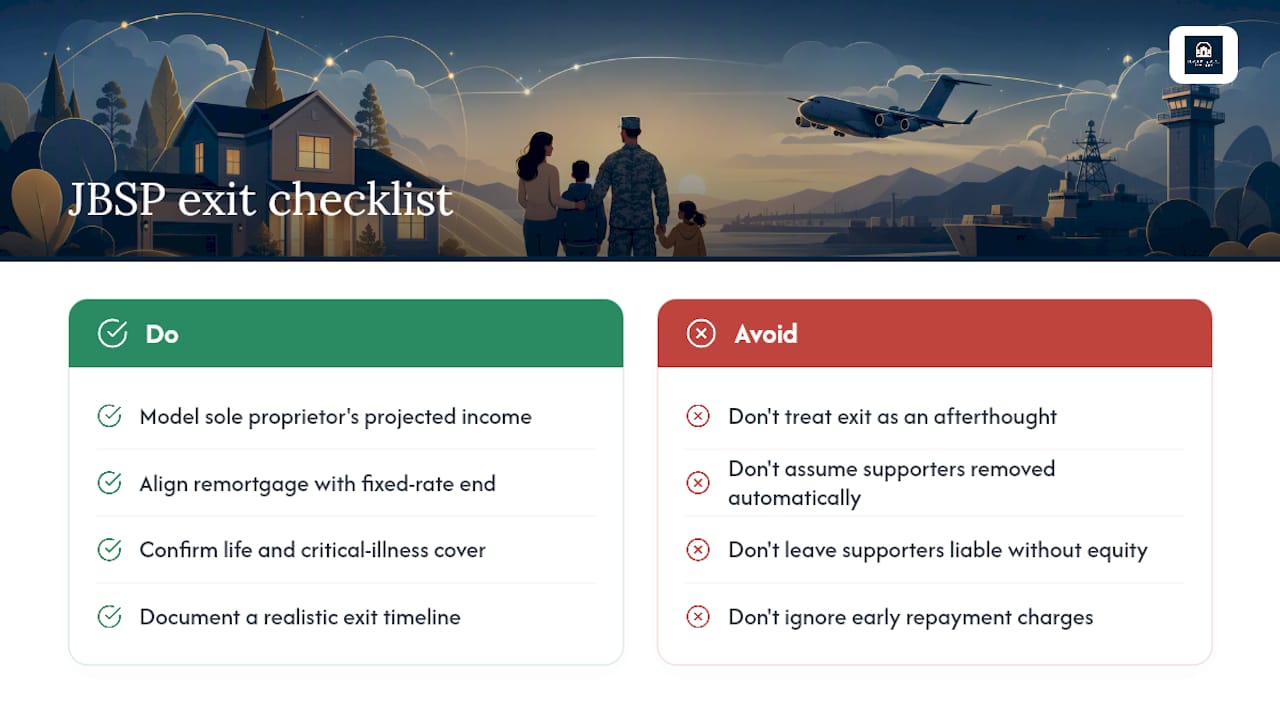
Removing a supporting borrower from a mortgage is not automatic. It requires a remortgage application in the sole proprietor's name, assessed on their income alone at that point. If the sole proprietor's salary has not grown as expected, or if the property's value has fallen and the loan-to-value ratio has worsened, the remortgage may not be available on acceptable terms. The supporters remain on the mortgage, and their credit file continues to carry the commitment.
The practical implication is that the exit plan should be treated as part of the original application, not an afterthought. That means modeling the sole proprietor's projected income at the remortgage date, aligning the remortgage with the end of the initial fixed-rate period to avoid early repayment charges, and confirming that life and critical illness cover is in place for all named borrowers throughout the term.
One more point that rarely appears in standard guides: the Telegraph's analysis of JBSP arrangements notes that the single most overlooked risk is that non-owners accept full financial liability without equity. Supporters who understand this clearly before signing are far less likely to face the relationship strain that comes when a missed payment or a failed remortgage makes the arrangement visible in ways the family did not anticipate.
A JBSP mortgage is a well-designed tool. Used with clear documentation, a realistic exit timeline, and proper insurance, it works. Used without those elements, it transfers risk to people who may not fully understand what they have signed.
How Havenmarkadvisers structures JBSP cases from day one
JBSP cases require more coordination than a standard residential application: multiple income types to document, age-limit modeling across lenders, independent legal advice to arrange for non-owners, and an exit remortgage to plan before the ink is dry on the mortgage deed.

Havenmarkadvisers assigns a single dedicated adviser to every case. That adviser manages the lender relationship, coordinates the independent legal advice requirement, and models the remortgage timeline as part of the initial affordability review. There is no handoff between teams and no repeated explanation of your circumstances to a new contact.
For families where income is complex, whether the sole proprietor is self-employed, a contractor, or a professional with variable earnings, Havenmarkadvisers has access to lenders who assess those income types accurately rather than defaulting to the most conservative calculation. Fees are confirmed in writing before any application is submitted.
To request an initial affordability review for a family-backed residential mortgage, prepare three months of payslips and bank statements for all named borrowers, plus pension statements if any supporter is retired. Contact Havenmarkadvisers to arrange a structured first meeting and receive a written summary of the lenders and terms available for your specific case.
Useful sources to verify rules and lender details
- What is a joint borrower sole proprietor mortgage? | Unbiased
- Joint Borrower Sole Proprietor Mortgages (JBSP) | money.co.uk
- JBSP Mortgage Calculator & Guide — Joint Borrower Sole Proprietor 2026
- Joint borrower sole proprietor mortgages: should you get one? | Telegraph
- Family-Backed Mortgage | Mortgages | NatWest
- Stamp Duty Land Tax — gov.uk
- Guarantor loans explained | MoneyHelper
- Being a guarantor for rent, loans, mortgage | StepChange