

IMPORTANT: YOUR HOME MAY BE REPOSSESSED IF YOU DO NOT KEEP UP REPAYMENTS ON YOUR MORTGAGE.
A large loan mortgage in England is generally anything from around £500,000, though most lenders treat borrowing above £750,000 to £1 million as genuinely "large" and route it to specialist underwriting teams. The lender you approach, and the pricing and flexibility you get, depend heavily on which side of that line you sit.
Three channels handle this end of the market, each with different appetite and process:
- High-street large-loan desks, which apply manual underwriting above their standard thresholds but keep familiar product ranges.
- Specialist high-net-worth lenders, built around bonus, dividend and equity-based income.
- Private banks, which often link lending to assets under management rather than income alone.
If you're borrowing at this level, the single most useful step is engaging a specialist adviser early, before you approach any lender directly, so your case is packaged for the right desk the first time.
Key Takeaways
Securing a large loan mortgage in England depends on matching your income structure to the right lender channel and presenting a well-documented case from the outset.
| Point | Details |
|---|---|
| Threshold varies by lender | Most desks treat £500,000 to £750,000 as the point where manual underwriting begins. |
| Three lender routes exist | High-street large-loan desks, specialist HNW lenders and private banks each suit different income profiles. |
| Deposits rise with loan size | Expect tighter LTVs and larger deposits as you move from £500,000 to £1 million and above into the £1 million to £3 million bracket. |
| Documentation drives approval | Multi-year income evidence, a clear repayment plan and consistent paperwork reduce delays significantly. |
| Haven Mark Advisers offers one dedicated adviser | A single point of contact packages your case, accesses a broad UK lender panel, and charges a transparent fee on completion. |
This article is general information, not a substitute for advice from a qualified financial advisor. Consult a qualified financial professional about your own circumstances before acting on anything here.
Table of Contents
- What counts as a large loan mortgage in England?
- Which lenders will consider a large residential loan?
- What do underwriters actually look for on large applications?
- How much deposit and income do you need at each loan level?
- How do you prepare a strong large loan application?
- What loan structures do large borrowers actually use?
- How long does a large mortgage take and what will it cost?
- How does credit history affect large mortgage lending?
- What tax considerations apply to large mortgage borrowing?
- How are interest rates and lending policy shifting for large loans?
- How Haven Mark Advisers can help with your large loan mortgage
- Sources
- FAQ
What counts as a large loan mortgage in England?
There's no single legal definition of a large mortgage. It's a market convention, and lenders each draw their own line. A mainstream bank might treat anything above £500,000 to £750,000 as requiring extra scrutiny, while a private bank's "standard" loan might start at £2 million. Brokers tend to use ranges rather than a fixed figure precisely because the threshold moves depending on which lender you're talking to.
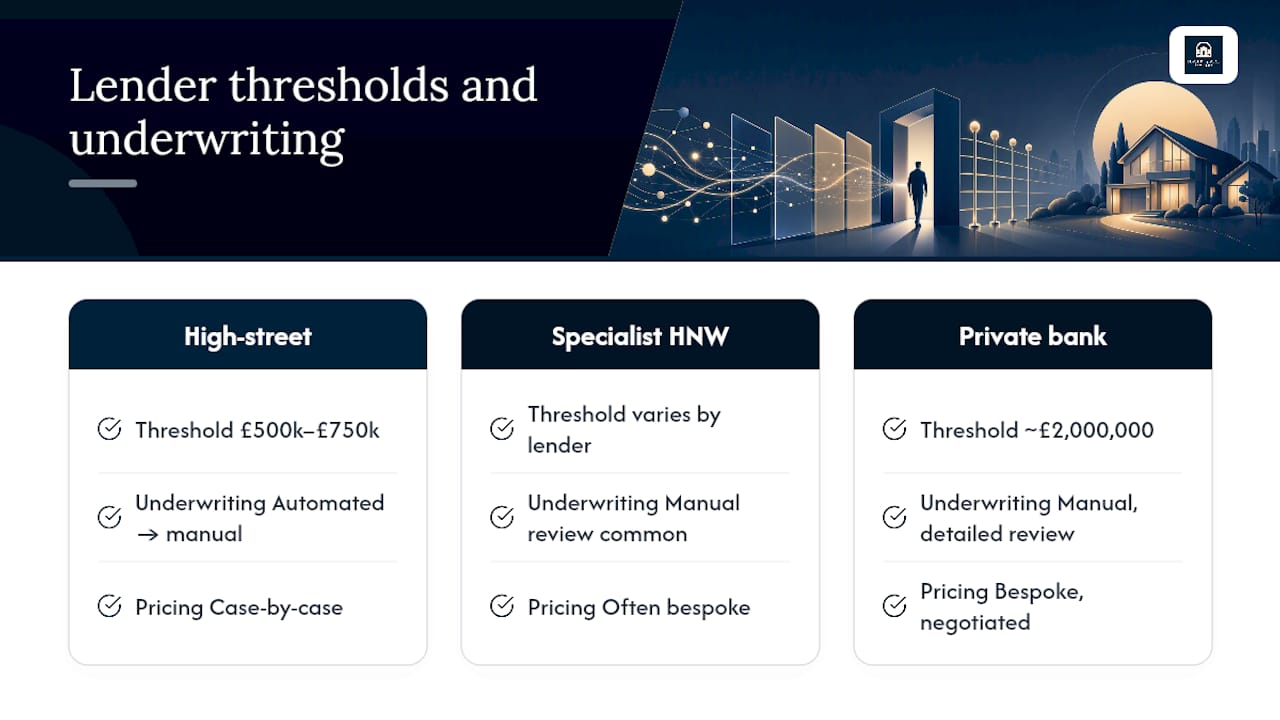
What does change consistently once you cross a lender's internal threshold is the underwriting process itself. Automated credit-scoring and standard affordability calculators give way to manual underwriting, where a human reviews your income structure, assets and the wider picture rather than running your details through a scorecard. Pricing often becomes bespoke too, negotiated case by case rather than pulled from a published rate sheet.
Statistic callout: The FCA sets a formal threshold for tailored treatment: a high net worth mortgage customer is defined as someone with annual income of at least £300,000, or net assets of at least £3 million excluding their main home and pensions. This isn't a lending limit, but it's the regulatory basis that lets firms use different documentation and disclosure processes for borrowers who qualify, and it's a useful signal that the entire system is built to flex for complex, high-value cases.
Which lenders will consider a large residential loan?
Not every lender wants your business at this loan size, and the ones that do split into three distinct groups with genuinely different appetites.
High-street large-loan desks sit within familiar high-street banks but operate separately from standard mortgage teams. They're often competitive on rate for straightforward employed income, and Santander for Intermediaries is one example of a lender publishing tiered loan-to-value guidance that tightens as the loan size increases, with maximum LTVs typically falling on the largest facilities.
Specialist high-net-worth lenders build their underwriting around exactly the income types high-street desks find awkward: bonuses, dividends, carried interest, restricted stock units and multi-currency earnings. They tend to favour cases where income is real but doesn't fit a payslip-shaped box.
Private banks operate differently again. Many will only lend where you also hold, or agree to hold, investment assets with them, an arrangement known as assets under management or AUM-linked lending. That can unlock higher LTVs or sharper pricing, but it ties your mortgage to a broader banking relationship, not just a loan.
A few property types narrow your lender panel regardless of which channel you approach: listed buildings, homes with significant acreage, and anything genuinely non-standard in construction. Expect fewer lenders and more conditions attached to any offer on these.
What do underwriters actually look for on large applications?
Manual underwriting means a real person is reading your case, not just your numbers, which changes what "a strong application" looks like. Packaging matters as much as the figures themselves: a clear narrative explaining how your income works, alongside the supporting documents, tends to move faster than a folder of statements with no context.
Underwriters on large cases typically focus on:
- Income verification over multiple years. A single strong year rarely satisfies an underwriter reviewing variable income; two to three years of consistent or growing earnings carries far more weight.
- Stress testing against future rate rises. Lenders model your ability to keep paying if rates increase, and loan-to-income multiples are applied more conservatively as loan size grows.
- Evidence of a credible repayment or exit plan, particularly for interest-only elements, since lenders want to see how the capital will actually be cleared.
- Consistency across documents. Figures on your accounts, bank statements and application form need to align; discrepancies trigger further questions and delay.
Lenders also ration how much high-multiple lending they extend in any given period, which means appetite for stretched multiples can shift even if your circumstances haven't changed. The FCA's recent policy work on mortgage rules points toward more flexibility in affordability assessment under the Consumer Duty, but that flexibility is applied at the lender's discretion, not as a guaranteed concession.
Pro Tip: Don't wait for an underwriter to ask why your income varies year to year. Have your accountant or adviser write a short covering explanation upfront, it often prevents a case being referred for additional review altogether.
How much deposit and income do you need at each loan level?
Rules of thumb help here, but they're indicative ranges, not promises from any lender. Income multiples tend to narrow as the loan grows: a borrower seeking £400,000 might see offers based on 5 to 5.5 times income, while at £2 million or above, that ceiling often compresses as lenders apply more conservative stress assumptions to larger exposures.
Deposit expectations rise in step with loan size:
- £500,000 to £1 million: many lenders still work with 10% to 15% deposits for strong, straightforward cases.
- £1 million to £3 million: deposit expectations typically climb, with market guidance noting that lending in this bracket is individually underwritten and private banks or specialist lenders become increasingly relevant.
- £3 million and above: expect closer scrutiny of the entire balance sheet, not just deposit percentage, with private banks often the primary route.
AUM-linked lending can change these numbers considerably. A borrower placing a substantial investment portfolio with a private bank might secure a higher LTV than the same income profile would achieve on the high street, because the bank is weighing the whole relationship, not just the mortgage. As a rough illustration only: someone seeking a £1.5 million loan against a £2 million property, with strong bonus-based income and a portfolio held elsewhere, might find a private bank offers better terms than a high-street desk purely because of what else they bring to the table, though actual terms depend entirely on individual lender assessment.
How do you prepare a strong large loan application?
Underwriters on complex, high-value cases are essentially asking one question: can they trust the numbers and the story behind them? Getting your documentation right the first time avoids the single biggest cause of delay on large cases, repeated requests for further evidence.
Build your submission around these documents:
- Three to six months of payslips, or SA302s and tax year overviews if you're self-employed or run your own business.
- Two to three years of company accounts where relevant, particularly for limited company directors.
- Bonus, commission or RSU vesting schedules covering a multi-year history, not just the most recent payout.
- Investment and pension statements showing the assets behind your application.
- A statement of assets and liabilities giving underwriters the full financial picture in one place.
- Proof of deposit source, particularly important where funds come from asset sales, gifts or overseas transfers.
Alongside the paperwork, frame your repayment strategy clearly, especially for any interest-only portion. Underwriters at this loan size want to see a genuine route to clearing the capital: a planned property sale, portfolio realisation, a pension lump sum timed to maturity, or proceeds from a business sale are all commonly accepted, provided they're backed by evidence rather than intention alone.
Pro Tip: If part of your income arrives in a foreign currency, some large-loan desks, including Santander for Intermediaries, will accept USD, EUR, CHF or AED income with the right supporting evidence. Flag this early so your adviser targets lenders whose panel already accommodates it.

This is precisely where a broker earns their fee: packaging your case, matching it to the right lender, and in many instances negotiating bespoke terms that wouldn't appear on a published rate sheet.
What loan structures do large borrowers actually use?
Most large loans aren't straightforward repayment mortgages. Interest-only arrangements are common, particularly where a borrower has a clear future capital event, but every lender will want documented evidence of the repayment vehicle before agreeing terms. Part-and-part structures, splitting the loan between interest-only and capital repayment, offer a middle ground, keeping monthly costs manageable while still reducing the balance over time.
AUM-linked lending deserves particular attention for larger borrowers. Placing investments with a private bank can unlock a higher LTV or more competitive pricing than the same income would achieve elsewhere, because the lender is assessing the full relationship rather than the mortgage in isolation.
- Interest-only: lower monthly payments, evidenced exit plan required.
- Part-and-part: balances affordability with capital reduction.
- AUM-linked: can improve LTV, but ties you into a wider banking relationship.
Whichever structure you consider, the lender is weighing your entire financial profile, not just the loan amount against your income.
How long does a large mortgage take and what will it cost?
Bespoke underwriting takes longer than an automated decision, but it typically secures better-suited terms. Budget for these stages:
- Initial fact-find and packaging: one to two weeks with your adviser, longer if documentation needs gathering from multiple sources.
- Underwriting: two to six weeks on complex cases, sometimes longer where a lender requests additional evidence.
- Valuation: timing varies by property type; non-standard or high-value properties often need a bespoke surveyor visit rather than a desktop valuation.
- Legal completion: four to eight weeks once mortgage offer is issued, depending on the wider chain.
Typical costs include your adviser's fee, usually charged on completion, a valuation fee scaled to property value, solicitor's fees, and potentially a lender arrangement fee, which can be added to the loan or paid upfront. Haven Mark Advisers is transparent about how it charges, so you know the fee structure before you commit to working with an adviser.
How does credit history affect large mortgage lending?
Credit history matters at every loan size, but its role shifts once you're borrowing significantly. A standard credit score algorithm carries less weight in manual underwriting than it does in automated decisioning, because a human underwriter is reviewing the full picture rather than relying on a single number to approve or decline.

That doesn't mean credit history becomes irrelevant. Missed payments, high utilisation on existing credit, or a county court judgment will still raise questions, and some specialist and private bank lenders apply their own internal credit policies that can be more or less forgiving than mainstream scoring models depending on the wider case. A borrower with an excellent income profile but a historic credit blemish may still secure lending, provided the underwriter can see a clear, documented explanation.
Where credit history becomes genuinely important is in demonstrating financial discipline around large, irregular income. Underwriters reviewing bonus-dependent or dividend-based earners often look at how that income has been managed historically, whether savings and investments reflect sensible planning, because it supports the affordability picture beyond the raw credit file. If your credit history includes anything unusual, flag it to your adviser before applying rather than letting an underwriter discover it mid-process; a proactive explanation reads very differently to lenders than an unexplained gap.
What tax considerations apply to large mortgage borrowing?
Large mortgages don't carry a special tax regime of their own, but the income and assets behind them often do, and that's where high earners need to think carefully. If your deposit or repayment strategy relies on realising investments, selling a business, or receiving a pension lump sum, each of those events can trigger its own tax liability, capital gains tax on investment or property sales, for instance, which is separate from the mortgage itself but directly affects how much capital you have available.
Stamp Duty Land Tax also scales with property value, meaning a large purchase carries a proportionately larger upfront tax cost that needs factoring into your overall budget alongside the deposit. For high earners whose income includes significant dividends or carried interest, the tax treatment of that income can affect how lenders calculate affordability, since some income types are assessed net of tax in different ways depending on the lender's policy.
None of this replaces proper tax advice. A large mortgage decision often intersects with wider financial planning, pension drawdown timing, business exit structuring, or portfolio disposal, and getting the sequencing wrong can create an unnecessary tax bill. Speaking to a qualified tax adviser alongside your mortgage adviser before finalising your repayment strategy is worth the time, particularly where an interest-only structure depends on a future capital event.
How are interest rates and lending policy shifting for large loans?
Pricing on large loans moves with the same broader market forces as the rest of the mortgage market, but the effect can be sharper at this end because so much lending is individually priced rather than pulled from a published rate card. Market commentary links indicative five-year fixed pricing on large loans to the Bank of England base rate, though actual offers vary weekly and by lender, so treat any published range as a starting point for discussion rather than a guaranteed rate.
Lending policy itself is also shifting. The FCA's ongoing Mortgage Rule Review, set out in its recent policy statement, signals a direction toward more flexible affordability assessment under the Consumer Duty framework. In practice, that could mean more lenders willing to apply tailored underwriting for complex or high-value cases, though how quickly individual lenders adopt that flexibility varies considerably.
For borrowers, the practical takeaway is that lender appetite for large loans isn't fixed. It responds to base rate movements, regulatory direction, and each lender's own capital position at any given time. A lender competitive on large loans this quarter may tighten criteria the next, which is precisely why working with an adviser who tracks panel appetite across multiple lenders, rather than approaching a single bank directly, matters more at this loan size than almost any other.
How Haven Mark Advisers can help with your large loan mortgage
If everything above sounds like a lot to coordinate alone, that's because it is. Large loan cases involve more documentation, more lender variation, and more room for delay than a standard mortgage, which is exactly why Haven Mark Advisers assigns one dedicated adviser to your case from first enquiry through to completion.

That single point of contact matters more than it sounds. Instead of your case passing between different specialists at different stages, one adviser holds the full picture, your income structure, your property, your timeline, and uses it to select the right lender the first time rather than after a decline.
Haven Mark Advisers works with:
- Professionals with complex income, including lawyers, finance professionals and business owners.
- Foreign nationals and UK visa holders navigating residency and non-GBP income requirements.
- Day-rate contractors whose income doesn't fit standard employed-income underwriting.
Access to a broad panel of UK lenders means your case is matched against genuine appetite, not a single institution's current criteria. Fees are agreed and explained upfront, payable on completion, with no surprises added along the way. If you're ready to discuss your situation, Haven Mark Advisers' residential mortgage service is the place to start that conversation.
Sources
- FCA Handbook — glossary: high net worth mortgage customer
- £1m to £3m mortgages UK 2026 | Lenders, rates, LTI — Fox Davidson
FAQ
What is the largest mortgage you can get in the UK?
There's no fixed legal maximum. Lending above £1 million to £3 million is individually underwritten by specialist and private bank lenders, and facilities well beyond that are arranged case by case based on income, assets and security offered.
Is there a 100% mortgage in the UK?
Some guarantor-backed or family-assisted products exist at lower loan values, but they're rare and not typically available on large residential loans, where lenders expect meaningful deposits that increase with loan size.
Can I get a 30 year mortgage at 55?
Some lenders will extend terms past traditional retirement age, but they'll want evidence of how repayments continue into retirement, whether through pension income, investments or a planned repayment vehicle, and policies vary considerably between lenders.
What salary do I need for a 600k mortgage in the UK?
Income multiples tend to narrow as the loan grows, and affordability depends on deposit, existing debt and the specific lender's criteria, so this is illustrative only, not a guarantee.
How does Haven Mark Advisers help with large loan applications?
Haven Mark Advisers assigns one dedicated adviser to package your documentation, select from a broad panel of UK lenders, and manage your case proactively through underwriting to completion.
Recommended
- ew Build Mortgages | Clear, Structured Advice | Haven Mark A
- Residential Mortgages in London | Haven Mark Advisers
- Residential Mortgages | Clear, Structured Advice | Haven Mar
- Remortgage Advice | Haven Mark Advisers
This article provides general information only and does not constitute personalised mortgage advice. Mortgage availability, affordability and lender criteria depend on individual circumstances and may change. Please seek advice tailored to your circumstances before acting on this information.