

IMPORTANT: YOUR HOME MAY BE REPOSSESSED IF YOU DO NOT KEEP UP REPAYMENTS ON YOUR MORTGAGE.
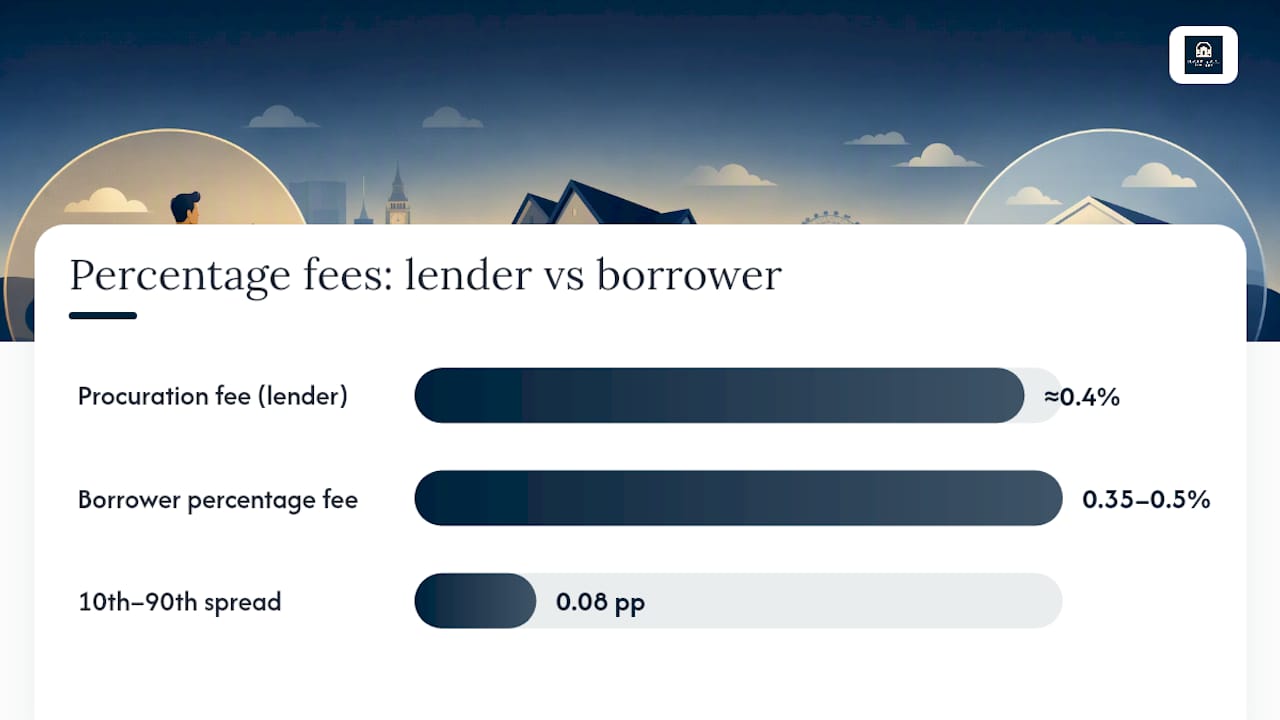
Most mortgage brokers in the UK are paid through a combination of a lender-paid procuration fee and, in many cases, a direct borrower fee. The procuration fee typically sits at a median of approximately 0.4% of the loan amount, with the 10th–90th percentile range spanning roughly 0.33%–0.41%. Consumer-facing fees vary more widely.
Typical borrower-facing costs break down as follows:
- Fee-free: £0 (broker paid entirely by lender commission)
- Standard residential cases: commonly £300–£700, with market averages around £643 for purchases and £623 for remortgages in early 2026
- Specialist cases (self-employed, foreign nationals, portfolio landlords): often £750–£2,000 or above
- Percentage-based fees: typically 0.35%–0.5% of the loan, charged instead of or alongside a fixed fee
Paying a broker fee tends to make sense when your income is complex, your lender options are limited, or the interest saving from a better product outweighs the cost. Which? recommends always checking how a broker is paid before committing, regardless of whether a fee applies.
Key takeaways
Most borrowers pay either nothing directly (fee-free, lender-paid) or a fixed fee of £300–£700 for standard cases, with specialist cases attracting higher charges — and the FCA requires all brokers to disclose fees and commission in writing before you commit.
| Point | Details |
|---|---|
| Procuration fee band | Lenders pay brokers a median of approximately 0.4% of the loan; the 10th–90th percentile range is only 0.08 percentage points. |
| Consumer fee ranges | Standard cases: commonly £0–£700; specialist cases often £750–£2,000 or above. |
| Completion-based fees | Fees payable only on completion carry the lowest risk; avoid large non-refundable upfront charges. |
| FCA disclosure rights | Under CONC 4.5, brokers must disclose all fees and commission in writing before you enter any agreement; request the IDD at first contact. |
| Haven Mark Advisers | Provides dedicated, FCA-authorised advice with written fee disclosure for professionals, self-employed borrowers, and foreign nationals. |
Table of Contents
- How mortgage brokers get paid: fee, commission, or a mix
- What you might actually pay: fee structures and worked examples
- What broker fees actually cover
- Who pays and when — timing, refunds, and what happens if the deal falls through
- How FCA regulation and transparency protect you
- What the research shows about lender panels, procuration fees, and mortgage pricing
- Questions to ask a mortgage broker — and red flags to watch for
- When paying a broker fee makes sense for professionals and complex cases
- Structured mortgage advice with full fee transparency: Haven Mark Advisers
- Sources
How mortgage brokers get paid: fee, commission, or a mix
Brokers operate under three broad payment models, each with different implications for the borrower.
Procuration fee (lender commission). When a broker places a mortgage with a lender, the lender pays the broker a procuration fee, typically expressed as a percentage of the loan. This is the dominant revenue source for most brokers. The FCA's research shows little dispersion in these fees: the median sits at approximately 0.4%, and the spread between the 10th and 90th percentile is only about 0.08 percentage points. In practical terms, lenders pay brokers within a narrow, consistent band.
Borrower-facing fees. Some brokers charge the borrower directly, either as a fixed sum, a percentage of the loan, or an hourly rate. Fixed fees are most common for standard residential cases. Percentage fees are more typical in specialist or high-value cases where the complexity warrants it. Hourly billing is rare but does appear in advisory-only arrangements.
Hybrid model. Many brokers receive both: a procuration fee from the lender and a separate fee from the borrower. This is common among specialist advisers and whole-of-market firms where the work involved exceeds what lender commission alone covers.
| Payment model | Who pays | Typical amount | Common use case |
|---|---|---|---|
| Procuration fee only | Lender | 0.33%–0.41% of loan | Fee-free brokers |
| Fixed borrower fee | Borrower | £300–£700 (standard) | Residential purchases |
| Percentage borrower fee | Borrower | 0.35%–0.5% of loan | Specialist or high-value cases |
| Hybrid (fee + procuration) | Both | Variable | Complex income, buy-to-let |
Under FCA rules, brokers are required to disclose their remuneration arrangements before you enter any regulated credit agreement.
Under CONC 4.5.3R, a credit broker must disclose the existence and nature of any commission, fee, or other remuneration it receives, and explain how that remuneration may affect the amounts payable by the customer — all in good time before the agreement is entered into.
This disclosure obligation applies whether the broker charges you directly, receives lender commission, or both. You can read the full CONC 4.5 requirements in the FCA handbook.
What you might actually pay: fee structures and worked examples
The fee model a broker uses shapes the total cost significantly, particularly as loan sizes increase.

Fixed fee is the most straightforward. You pay a set amount regardless of the loan size. This benefits borrowers with larger mortgages, since the fee does not scale with the loan.
Percentage fee scales with the loan. For smaller loans, a percentage fee can be competitive. For larger ones, a fixed fee is usually cheaper.
Fee-free means the broker is paid solely by the lender. The borrower pays nothing directly, though the lender's procuration cost is built into the product pricing.
Specialist case fees reflect the additional underwriting, lender negotiation, and case management involved. Self-employed income, complex immigration status, and portfolio landlord structures all typically attract higher fees.
The table below illustrates how fee models compare at three common loan sizes, using market-reported ranges:
A fixed fee becomes proportionally cheaper as the loan grows. A percentage fee can be justified where the complexity of the case demands it — for instance, where the broker must approach multiple specialist lenders or structure income evidence for a self-employed application.
Pro Tip: Ask the broker to confirm their fee in writing before any work begins, and ask whether the fee changes if your loan size changes. A percentage fee that looks reasonable on a £200,000 loan can become significant on a £500,000 one.
What broker fees actually cover
A broker fee is not simply a charge for finding a product. The work behind a well-managed mortgage case includes several distinct stages, each of which takes professional time.
Typical services covered by a broker fee:
- Initial advice and fact-find: assessing your income, credit position, deposit, and objectives to identify suitable products
- Whole-of-market or panel search: comparing products across multiple lenders, including those not accessible directly
- Application preparation: compiling and presenting documentation to the lender's underwriting standards
- Lender negotiation: liaising with underwriters on complex income or non-standard cases
- Ongoing case management: tracking the application through valuation, offer, and exchange, and resolving queries
- Post-offer support: handling conditions attached to the mortgage offer and coordinating with solicitors
The elements that drive higher fees are those requiring specialist knowledge. Self-employed income underwriting, for example, requires a broker to present accounts, retained profit, and director salary in a way that satisfies lender criteria — criteria that vary significantly across the market. Similarly, buy-to-let and portfolio cases involve stress-testing calculations and portfolio schedules that add material work.
A fee-free broker may cover all of the above for a standard employed borrower with a clean credit file. Where the case is more complex, the additional work is what the fee reflects.
Pro Tip: Before agreeing to a fee, ask the broker to outline the specific services included. A clear written scope of service lets you judge whether the fee is proportionate to the work involved.
Who pays and when — timing, refunds, and what happens if the deal falls through
Payment timing matters as much as the amount. The point at which a fee becomes due determines your financial exposure if the mortgage does not proceed.
On instruction means the fee is payable when you formally engage the broker, before any application is submitted. This carries the highest risk for the borrower: if the lender declines or you withdraw, the fee may not be refunded.
On offer means the fee is due when the lender issues a formal mortgage offer. This is a lower-risk point, since an offer confirms the lender is willing to lend.
On completion means the fee is charged only when the mortgage completes. This is the lowest-risk model for the borrower, as no fee is payable if the transaction does not proceed.
A broker who charges a substantial non-refundable fee upfront, before submitting any application, places the full financial risk of a failed transaction on the borrower. Completion-based fees align the broker's incentive with the borrower's outcome.
Red flags to watch for:
- A large non-refundable fee required before any lender contact
- Vague or verbal-only descriptions of when the fee is triggered
- No written confirmation of refund policy if the mortgage does not proceed
- A fee that increases without explanation after the initial quote
Always request written fee terms before engaging a broker. The terms should state the exact amount, the trigger event, and the refund policy in plain language. If a broker is unwilling to provide this in writing, that is itself a warning sign.
How FCA regulation and transparency protect you
The Financial Conduct Authority regulates mortgage advice in the UK. Any firm or individual giving regulated mortgage advice must be authorised by the FCA, and their authorisation can be verified on the FCA register.
CONC 4.5 requires brokers to disclose the existence and nature of any commission or fee, and to explain how it may affect the amounts you pay — before you enter into any regulated credit agreement. This is not optional: it is a regulatory requirement.
Practical steps to protect yourself:
- Check the FCA register before engaging any broker. Search by firm name or reference number at register.fca.org.uk. Confirm the firm is authorised for mortgage advice, not just credit broking.
- Request the Initial Disclosure Document (IDD). A compliant broker provides this at first contact. It sets out the firm's regulatory status, the scope of advice, and how the broker is remunerated.
- Ask for written fee disclosure. The IDD should confirm whether the broker charges a borrower fee, receives lender commission, or both — and the likely amounts.
- Escalate complaints to the Financial Ombudsman Service (FOS) if a broker fails to disclose fees properly or acts outside their authorisation. The FOS handles disputes between consumers and regulated financial firms at no cost to the complainant.
A compliant fee disclosure looks like this: a written statement confirming the fee amount (or the basis for calculating it), when it is payable, whether it is refundable, and whether the broker also receives a procuration fee from the lender. If any of these elements are absent, ask for them before proceeding.
What the research shows about lender panels, procuration fees, and mortgage pricing
The FCA's Occasional Paper No. 35 provides the most detailed published analysis of how intermediary behaviour relates to mortgage pricing in the UK market.
Two findings are particularly relevant for borrowers evaluating broker value.
First, procuration fees are tightly clustered. This means lenders pay brokers within a narrow, consistent band, and the procuration fee alone is unlikely to explain significant variation in the advice you receive.
The FCA paper found that intermediaries using a greater number of lenders tend to sell cheaper products on average than those using fewer lenders. This is a correlation, not a proven causal relationship, but it is a structural signal worth understanding.
Second, the number of lenders a broker accesses correlates with the average price of the products they place. Brokers with wider panels tend to place cheaper mortgages on average. For borrowers with complex income or non-standard circumstances, this matters: a broker restricted to a small panel may not be able to access the lender most suited to your situation.
This is one reason why whole-of-market access carries practical value for professionals, contractors, and foreign nationals. Haven Mark Advisers' case management approach is built around accessing a broader lender panel for exactly these client profiles, including limited company directors and those with non-standard income structures.
Questions to ask a mortgage broker — and red flags to watch for
The following questions give you the information needed to assess a broker's fee structure, independence, and suitability before committing.
Questions to ask in writing:
- What is your exact fee, and when does it become payable?
- Do you receive a procuration fee from the lender, and if so, what is the typical amount?
- How many lenders are on your panel, and do you have access to the whole market?
- Is your fee refundable if the mortgage does not proceed, and under what conditions?
- Are you directly authorised by the FCA, or are you an appointed representative?
- Will you provide a written Initial Disclosure Document before we proceed?
Sample phrasing you can use:
"Before we proceed, please confirm in writing: your fee amount and payment trigger, whether you receive lender commission, the size of your lender panel, and your refund policy if the application is unsuccessful."
Red flags that warrant caution:
- Vague or verbal-only fee disclosures with no written confirmation
- Refusal to provide the IDD or FCA registration details on request
- Insistence on a large non-refundable upfront fee before any lender contact
- Inability or unwillingness to confirm the number of lenders on their panel
- Pressure to proceed quickly without time to review written terms
A broker who cannot or will not answer these questions clearly, in writing, before you engage them is not meeting the standard the FCA requires. Authorised brokers are obligated to disclose their remuneration and regulatory status at first contact.
When paying a broker fee makes sense for professionals and complex cases
The question of whether to pay a broker fee is, at its core, a calculation: does the advice unlock a product or outcome that justifies the cost?
For a straightforward employed borrower with a clean credit file, a fee-free broker may be entirely adequate. The lender panel is often sufficient, the application is standard, and the procuration fee covers the broker's work.
For professionals with complex income — self-employed business owners, day-rate contractors, lawyers and legal professionals, or foreign nationals — the calculus shifts. The lender most suited to your income structure may not be accessible through a restricted panel. The underwriting of retained profit, contract day rates, or overseas income requires a broker who understands how to present that evidence. A fee paid for that expertise is not an overhead; it is the cost of accessing the right lender at the right rate.

The total cost of a mortgage is interest plus fees, not fees alone. The fee is a small fraction of that saving.
Adviser continuity also matters. A dedicated adviser who manages your case from initial fact-find through to completion reduces the risk of errors, delays, and miscommunication — particularly in complex cases where underwriting queries require prompt, informed responses.
Structured mortgage advice with full fee transparency: Haven Mark Advisers
For professionals who need more than a product search, Haven Mark Advisers provides regulated mortgage advice with a single dedicated adviser from first contact through to completion. Services cover residential mortgages, self-employed and business owner cases, buy-to-let, remortgaging, and foreign national applications — all with access to a broader lender panel suited to complex income and residency situations.

Fees are disclosed in writing at the outset, in line with FCA requirements. Haven Mark Advisers is FCA-authorised, and clients receive a written breakdown of all charges before any work begins. The firm charges a fee upon completion for purchase and remortgage cases, and may also receive a procuration fee from the lender — both are disclosed clearly in the fee and remuneration policy. If you want to understand exactly what you would pay and what is covered, the right starting point is to speak with a dedicated adviser about your specific situation.
This article provides general information only and is not a substitute for regulated mortgage advice. Confirm current rules and your personal eligibility with a qualified adviser or the FCA directly.
Sources
The following sources were used in preparing this article and are recommended for further verification:
- Occasional Paper No. 35: Six of One…? Choice of Intermediary in the UK Mortgage Market
- Should you use a broker to get a mortgage? - Which?
- Average Mortgage Broker Fee UK 2026: What Brokers Charge Explained
- How Much Does a Mortgage Broker Cost? (2026 Guide) | Mortgage118
Keep a copy of your IDD and any written fee disclosure for your records. If a broker's charges or conduct appear inconsistent with what was disclosed, contact the Financial Ombudsman Service.