

IMPORTANT: YOUR HOME MAY BE REPOSSESSED IF YOU DO NOT KEEP UP REPAYMENTS ON YOUR MORTGAGE.
An offset mortgage links your savings to your home loan so the lender only charges interest on the difference between the two. That single mechanism makes it most valuable to higher and additional-rate taxpayers, and to anyone sitting on a sizeable, stable cash balance who still wants to keep that money within reach.
- Best suited to: higher-rate taxpayers, additional-rate taxpayers, and borrowers with a sizeable amount of savings they don't need day-to-day.
- Least suited to: borrowers with modest savings, or anyone who expects to draw down that cash regularly.
Offset premium: Offset deals typically carry a higher rate than standard mortgages, and far fewer lenders offer them, so the maths only works once your savings clear that premium.
Key Takeaways
Offset mortgages reduce interest by netting savings against your mortgage balance, and they deliver the most value to higher-rate and additional-rate taxpayers holding sizeable, stable cash reserves.
| Point | Details |
|---|---|
| Best fit | Higher and additional-rate taxpayers with a sizeable amount of savings they don't need immediately. |
| Rate premium exists | Offset deals usually cost more than standard equivalents, so savings must clear that gap to win. |
| Tax and protection matter | The Personal Savings Allowance and FSCS protection up to £120,000 from 1 December 2025 both shape the maths. |
| Discipline is essential | Withdrawing linked savings immediately raises your interest charge, undoing months of benefit. |
| Specialist help pays off | Haven Mark Advisers assigns one dedicated adviser to match complex-income clients with niche offset lenders. |
Table of Contents
- How does an offset mortgage work?
- Who actually benefits from offsetting your savings?
- What does an offset mortgage calculation actually look like?
- Are offset mortgages widely available in the UK?
- What tax and consumer protection rules apply to offset savings?
- How should you decide if offsetting suits you?
- Does an offset mortgage affect your credit score?
- How does offsetting compare with tracker and fixed-rate mortgages?
- What should couples and joint applicants think about?
- What are the long-term planning implications of choosing offset?
- How Haven Mark Advisers helps you weigh up offset mortgages
- Frequently asked questions
- Sources
How does an offset mortgage work?
The mechanics are simpler than most borrowers expect. Your lender takes your outstanding mortgage balance, subtracts whatever sits in your linked savings account, and charges interest only on what's left. If you owe a mortgage amount and hold a linked savings account, you pay interest on the difference between the two balances. Most lenders recalculate this net balance daily, so a deposit made on a Tuesday starts reducing your interest bill that same day.
There's a trade-off built into the structure: money sitting in the offset account earns no interest of its own while it's linked. You're not being paid on those savings. You're avoiding a mortgage interest charge instead, which for many higher earners turns out to be the better deal once tax is factored in.
Offsetting works across different mortgage structures, not just one flavour of deal:
- Repayment offset – reduces the interest charged each month, so more of your payment clears the capital faster.
- Interest-only offset – used mainly by landlords or investors, where the savings offset interest but the capital balance stays fixed until maturity.
- Fixed, tracker, or discount offset – the offset mechanism sits on top of whichever rate structure you choose, though fixed and tracker offset products are considerably rarer than standard equivalents.
Most lenders allow you to link a current account and a dedicated savings account, and some extend this to family members' accounts too. Withdrawals are usually unrestricted, though a handful of lenders cap how much of your balance can be offset.
Pro Tip: Check whether your lender recalculates interest daily or monthly before you sign. A daily calculation rewards you the moment you deposit funds; a monthly one delays the benefit and can cost you meaningfully over a longer mortgage term.
Who actually benefits from offsetting your savings?
Offsetting tends to reward a specific type of borrower rather than everyone equally. The clearest winners are higher-rate and additional-rate taxpayers, because offsetting sidesteps the tax you'd otherwise pay on savings interest entirely.
The case for offsetting:
- Effectively delivers a tax-free return equal to your mortgage rate, which beats most standard savings accounts once tax is deducted.
- Keeps your capital fully liquid, unlike overpaying, which locks money into the property.
- Some lenders let family members link their savings too, helping parents support a child's mortgage without gifting the money outright.
The case against:
- Offset rates typically sit above standard equivalents, and lender choice is far narrower.
- Some offset products demand a larger deposit or lower loan-to-value ratio.
- You earn precisely nothing on the linked cash while it stays offset.
Run through a quick checklist first: how much you'll realistically keep in savings, whether you've used your ISA allowance, your tax band, and whether you have the discipline to leave the money untouched.
What does an offset mortgage calculation actually look like?
Numbers settle the argument faster than theory. Consider an example mortgage at a certain interest rate alongside an offset mortgage carrying a small rate premium, with a significant linked savings balance.
| Taxpayer type | Standard mortgage + separate savings (after tax) | Offset mortgage net position |
|---|---|---|
| Basic-rate | Savings interest partly taxable above £1,000 PSA | Broadly similar outcome; smaller pots may not clear the premium |
| Higher-rate | Savings interest taxed above £500 PSA, eroding returns | Offsetting usually wins once savings exceed a moderate threshold amount. |
| Additional-rate | No PSA at all; nearly all interest taxed | Offsetting typically wins by the widest margin |
To run your own numbers:
- Note your quoted offset rate and the premium over the best standard equivalent deal.
- Estimate the average balance you'll genuinely keep in savings, not your peak balance.
- Apply your tax band to work out what that cash would earn after tax in a normal account.
One benchmark worth remembering: worked comparisons show offset arrangements can favour higher-rate taxpayers holding six-figure sums, while smaller savings pots often fail to clear the rate premium at all.
Are offset mortgages widely available in the UK?
Offset deals remain a niche corner of the market. You'll find far fewer lenders offering them than standard fixed or tracker products, and the choice of term lengths shrinks accordingly.
Typical eligibility conditions include:
- A minimum deposit that is generally higher than some standard deals demand.
- A minimum loan size, since smaller mortgages rarely justify a lender's offset infrastructure.
- Stricter equity requirements on interest-only or buy-to-let offset variants, where lenders impose tighter LTV limits.
- Specific rules on family-offset arrangements, varying widely between providers.
Because the market is so fragmented, a specialist broker with wider lender access can surface options that never appear on comparison sites.
What tax and consumer protection rules apply to offset savings?
The Personal Savings Allowance shapes almost everything here. Basic-rate taxpayers can earn £1,000 of savings interest tax-free, higher-rate taxpayers get £500, and additional-rate taxpayers get nothing at all. Offsetting sidesteps this entirely by never generating taxable interest in the first place.
- Your linked savings still sit in an authorised deposit account, and FSCS protection covers up to £120,000 per eligible person per institution from 1 December 2025, rising to £240,000 for joint accounts.
- Every offset lender must be PRA-authorised and FCA-regulated, giving you the same statutory protections as any other regulated mortgage.
- Read the small print on early repayment charges (ERCs) and overpayment limits, since offsetting large sums quickly can sometimes brush against these caps.
How should you decide if offsetting suits you?
Work through this in order rather than jumping straight to a lender comparison:
- Calculate your realistic average offset balance over the next two to three years, not your current peak savings.
- Compare the net cost: offset rate premium against what that cash would earn after tax in a standard account.
- Ask any lender directly which accounts can be linked, the minimum and maximum balances allowed, their ERC terms, and whether family members can join the arrangement.
- Establish whether overpayments are capped separately from offset balances.
Company directors, contractors on day rates, and anyone with several income streams tend to need this checked by a specialist adviser rather than a generic comparison tool, since irregular income complicates both affordability assessment and tax planning simultaneously.
Pro Tip: Ask lenders for their offset calculation frequency in writing. Verbal assurances of "daily calculation" sometimes turn out to mean something closer to monthly once you read the actual mortgage offer.
Does an offset mortgage affect your credit score?
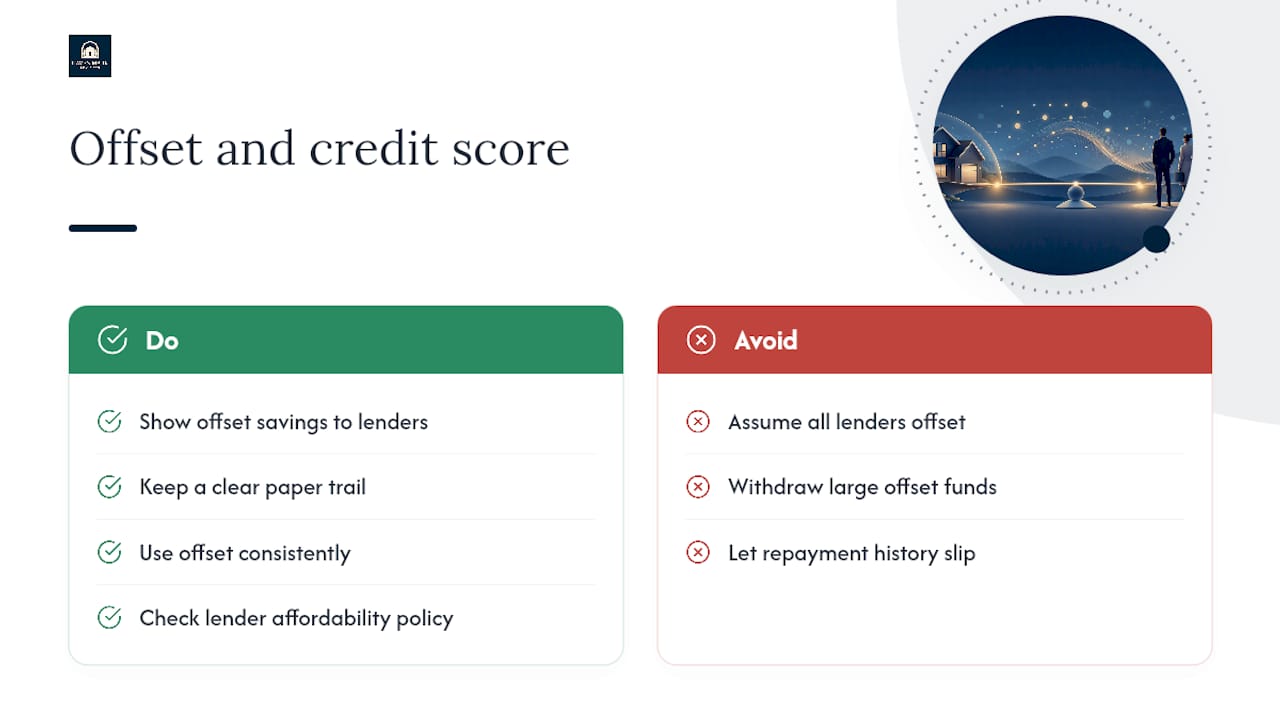
An offset mortgage is reported to credit reference agencies exactly like any other mortgage. Opening the account, your repayment history, and your outstanding balance all appear on your credit file in the same way a standard repayment or interest-only mortgage would. There's no separate "offset" category that credit scoring models treat differently.
Where offsetting can genuinely help is affordability for future borrowing. Because your net interest-bearing balance is lower each month, some lenders' affordability calculations may show a more comfortable debt-to-income position, which matters if you're planning to remortgage or take out further lending within a few years. This isn't guaranteed across every lender, since some assess affordability against the gross mortgage balance regardless of your offset savings.
The behavioural risk sits elsewhere. If you rely on your offset balance to keep monthly payments low, then withdraw a large chunk of those savings for another purpose, your interest charge jumps immediately, and if that pushes you closer to your affordability ceiling, it can complicate a future application. Lenders assessing you for additional borrowing will typically look at your actual current balance and repayment record, not a hypothetical scenario with your savings intact.
Keep your offset savings visible and well documented if you're planning to remortgage or apply for further credit. A clear paper trail showing consistent, disciplined use of the offset facility works in your favour when a new lender reviews your file.
How does offsetting compare with tracker and fixed-rate mortgages?
Tracker and fixed-rate mortgages compete on rate alone. A tracker moves with the Bank of England base rate, giving you cheaper payments when rates fall and higher ones when they rise. A fixed rate locks your payment for two, five, or occasionally ten years, trading flexibility for certainty. Neither product does anything with savings you hold elsewhere.
Offsetting adds a second lever entirely. You can pair an offset facility with either a fixed or tracker rate structure, though fixed-rate offset deals are considerably scarcer than tracker offset equivalents. The real comparison isn't "offset versus fixed" but "offset versus keeping your savings separate while on a standard fixed or tracker deal."
For a borrower with minimal savings, a standard tracker or fixed-rate mortgage almost always wins on cost, since there's no offset premium to justify. For someone holding £50,000 or more in cash they don't need immediately, the offset version of either structure frequently produces a lower net cost once tax on separate savings interest is accounted for.
Flexibility differs too. Overpaying a standard mortgage reduces your balance permanently. Recovering that money later usually means a further advance or a fresh application. Offsetting keeps the same cash fully liquid: withdraw it tomorrow if you need to, with your interest charge simply rising to reflect the smaller offset amount. That reversibility is the single biggest practical difference between offsetting and overpaying, and it matters most to professionals with irregular income who might need access to a cash buffer at short notice.

What should couples and joint applicants think about?
Joint offset mortgages work the same way as joint standard mortgages for affordability and credit assessment. Both applicants' incomes and credit histories are assessed together, and both are jointly and severally liable for the full mortgage debt, not just half each.
The added complication is savings ownership. Some couples hold separate accounts, contribute unevenly, or have very different tax positions, one partner a higher-rate taxpayer, the other basic-rate. Offsetting is most valuable to the higher-rate taxpayer in the relationship, so it's worth agreeing upfront whose savings sit in the linked account and how that's tracked if the relationship or finances change.
Family-offset products extend this further, allowing parents or other relatives to link their own savings to a couple's mortgage without being named on the mortgage itself. This can help a couple secure a larger loan or reduce their interest cost using a parent's savings, without that parent gifting money outright or being added to the property title. Terms vary significantly by lender, so check exactly how withdrawal rights and ownership of the linked account work before relying on this arrangement.
Communication matters more with offsetting than with a standard mortgage, since one partner withdrawing a large sum from the linked account immediately raises the other's effective interest cost too.
What are the long-term planning implications of choosing offset?
An offset mortgage isn't a set-and-forget product. Its value shifts as your savings balance, tax band, and financial priorities change over the years, which makes it worth revisiting annually rather than assuming the deal that suited you at completion still suits you five years later.
Career progression is the most common shift among Haven Mark Advisers' professional clients. A borrower who takes out an offset mortgage as a basic-rate taxpayer and moves into higher-rate territory within a few years often finds the product becomes considerably more valuable over time, not less. The reverse applies too: someone who draws down their savings for a business investment, school fees, or a house extension loses much of the benefit until that balance rebuilds.
Retirement planning interacts with offsetting in a way that's easy to overlook. Cash held in an offset account isn't growing through investment returns the way it might in a pension or a stocks and shares ISA. For younger borrowers with decades until retirement, weigh the guaranteed, tax-free return from offsetting against the potential (but not guaranteed) higher long-term return from investing that same cash instead.
Offsetting also interacts with mortgage term decisions. Directing offset savings toward a shorter effective term, rather than simply lower monthly payments, accelerates the point at which you own your property outright, which matters for anyone planning their finances around a specific retirement age or income change.
A short note from the adviser's desk
The offset borrowers who do best are disciplined ones. I've seen clients build a healthy offset balance over years, then drain it for a renovation and wonder why their interest charge jumped overnight. Run the numbers properly, and get regulated advice before you commit to a niche product like this.
How Haven Mark Advisers helps you weigh up offset mortgages
Offsetting rewards borrowers who can prove exactly how their income and savings behave over time, which is precisely where a single dedicated adviser earns their keep. Haven Mark Advisers assigns one adviser to your case from first enquiry through to completion, so nobody re-explains irregular contractor income or a director's dividend structure to a different person at each stage.

That continuity matters most when comparing offset against standard products, since it usually takes proper lender-matching, not a comparison site, to find the handful of providers offering competitive offset rates for your exact income profile. Haven Mark Advisers has over ten years of experience navigating this niche corner of the market for lawyers, banking professionals, contractors, and business owners, with transparent fees agreed upfront.
If you're weighing offset against a standard residential mortgage, or you have income that doesn't fit a standard lender's tick-box criteria, get in touch for an initial review of which structure actually fits your numbers, whether that's an offset deal, a remortgage onto a better rate, or specialist support if you're a self-employed business owner.
Frequently asked questions
Is an offset mortgage worth it for a basic-rate taxpayer? Often not, unless your savings balance is substantial. The £1,000 Personal Savings Allowance already shelters most basic-rate taxpayers' interest from tax, narrowing the gap offsetting can close.
Can self-employed borrowers get an offset mortgage? Yes, though lenders scrutinise self-employed income closely regardless of product type. A specialist adviser can help identify which offset lenders accept your specific income evidence.
Does offsetting reduce my mortgage term or my monthly payment? Either, depending on how your lender structures the product. Some automatically shorten your term as savings offset the balance; others simply reduce your monthly payment while keeping the original term.
What happens to my offset savings if I remortgage? You'll need to check whether your new lender offers an equivalent offset facility, since the arrangement typically doesn't transfer automatically between providers when you switch deals.
This article is general information, not a substitute for advice from a qualified financial advisor. Consult a qualified financial professional about your own circumstances before acting on anything here.
Sources
For deeper detail on tax thresholds, consult RSM UK's analysis of offset tax savings. For FSCS protection and mechanics, see Personal Finance Clarity's guide. For broader consumer guidance, Which?'s overview of offset mortgages is worth reading in full.
- How an offset mortgage could provide better tax savings — RSM UK
- Offset Mortgages — HomeOwners Alliance
- Offset mortgages: when they make sense and when they don't — Personal Finance Clarity
- What is an offset mortgage and how much money could it save me in tax? — The Independent