

IMPORTANT: YOUR HOME MAY BE REPOSSESSED IF YOU DO NOT KEEP UP REPAYMENTS ON YOUR MORTGAGE.
Most residential mortgages can be ported to a new property, but porting a mortgage is never a guaranteed transfer. It is a fresh lending decision, so the priority before anything else is confirming portability with your lender and securing a decision in principle (DIP).
Before you contact estate agents or book a survey, work through this:
- Check your mortgage offer or annual statement for the word "portable" and any conditions attached to it.
- Work out whether you need to borrow more or less than your current balance.
- Get a DIP or written portability confirmation from your lender before you pay for valuations or legal work.
Pro Tip: If you need to top up, model the blended cost of the ported rate plus the new top-up rate against simply paying the early repayment charge (ERC) and remortgaging elsewhere. The cheaper route isn't always the obvious one.
Key Takeaways
Porting a mortgage keeps your existing rate on a new property, but it always requires a fresh lender application with current affordability and property checks.
| Point | Details |
|---|---|
| Confirm portability first | Check your offer document and get written confirmation before spending on valuations or legal fees. |
| Expect a full reassessment | Lenders re-check income, credit and the new property under today's criteria, not your original terms. |
| Understand the ERC trade-off | Simultaneous completion usually avoids the ERC, typically 1% to 5% of the outstanding balance. |
| Model top-up costs carefully | A hybrid structure blends your old rate with a new-rate top-up, which can outweigh the ERC saving. |
| Get specialist support for complex income | Haven Mark Advisers assigns one dedicated adviser to package non-standard income and manage lender matching. |
This article is general information, not a substitute for advice from a qualified financial advisor. Consult a qualified financial professional about your own circumstances before acting on anything here.
Table of Contents
- What porting a mortgage actually means
- Can I port my mortgage? Eligibility and common pitfalls
- Topping up or borrowing less: how the numbers change
- Costs, fees and how long porting actually takes
- How to prepare and apply to port your mortgage
- If your lender refuses to port: what else you can do
- When specialist advice helps: how Haven Mark Advisers supports porting for professionals
- Sources
What porting a mortgage actually means
Porting does not mean your existing loan account follows you to the new house. The lender redeems your current mortgage and issues a fresh offer that mirrors your old product's rate and remaining term, according to Which?. The paperwork changes; the deal you're used to, ideally, does not.
That distinction matters because it means the lender treats you as a new borrower on completion day, even though you're keeping a product you already hold. A two-year fix with eighteen months left, for example, can be carried across to a new purchase so you keep paying the same rate for the remaining eighteen months, with any extra borrowing bolted on as a separate tranche.
Not everything is portable, though:
- Most standard residential fixed and variable-rate mortgages allow porting.
- Some specialist, high-loan-to-value, and many buy-to-let products exclude portability entirely, notes Forbes Advisor.
- Your offer document is the only reliable source. Never assume based on what a previous mortgage allowed.
Can I port my mortgage? Eligibility and common pitfalls
Because porting counts as new lending, your lender reassesses you exactly as it would any other applicant, under today's criteria rather than the criteria in place when you first borrowed. That catches people out. Income that comfortably passed affordability three years ago might not clear the bar now, particularly if lending rules have tightened or your circumstances have shifted, as The Independent points out.
The most common reasons a port gets refused:
- Income has changed, dropped, or become harder to evidence (common for the newly self-employed or those who've switched from PAYE to contracting).
- A recent credit blip, even a missed utility payment, shows up on a fresh check.
- The new property falls outside the lender's current policy, whether that's a non-standard construction, a flat above a shop, or a block with cladding issues.
- The valuation comes in lower than expected, changing your loan-to-value.
- Payment history on the existing mortgage has slipped.
Before you commit to anything financially, gather your last three months of bank statements and payslips, or two to three years of accounts and an SA302 if you're self-employed, along with proof of your deposit or equity position.
Keep any DIP or portability confirmation in writing. Verbal reassurance from a call centre is not something you can rely on if the underwriters later disagree.
Pro Tip: Push for a written DIP or explicit portability confirmation as early as possible in your search. It's the single cheapest way to avoid paying for a valuation and legal work on a move that never completes.
Topping up or borrowing less: how the numbers change
Porting rarely means transferring an identical loan amount. Most home moves involve either borrowing more to cover a price gap or borrowing less because you're downsizing, and each scenario behaves differently.
If you need extra borrowing, the ported portion keeps your original rate, but the top-up is priced at the lender's current rates, creating a hybrid mortgage with two parts running side by side, as explained by Mortgageaffordability. Say you have £150,000 remaining at 3.5% and need another £50,000 at a current rate of 5.5%. You'll end up with two separate monthly calculations, not one blended figure, and two potential end dates.

Borrowing less works the other way. You can usually port a smaller amount than your current balance, though lenders often set a minimum loan size, and repaying more than 10% of the balance annually without penalty is a common but not universal allowance.
Worth thinking through before you commit:
- A hybrid structure means two products with potentially different end dates, which complicates your next remortgage.
- Some lenders charge a separate arrangement fee for the top-up portion.
- Staggered product expiries can mean you're juggling two renewal dates a few years down the line.
Costs, fees and how long porting actually takes
The appeal of porting a mortgage usually comes down to one thing: dodging the early repayment charge on your existing deal. When your sale and purchase complete on the same day, the ERC on the redeemed loan is typically waived, since you're not technically leaving the product early. Miss that alignment and the charge can apply, sometimes with a later refund once the port formally completes.
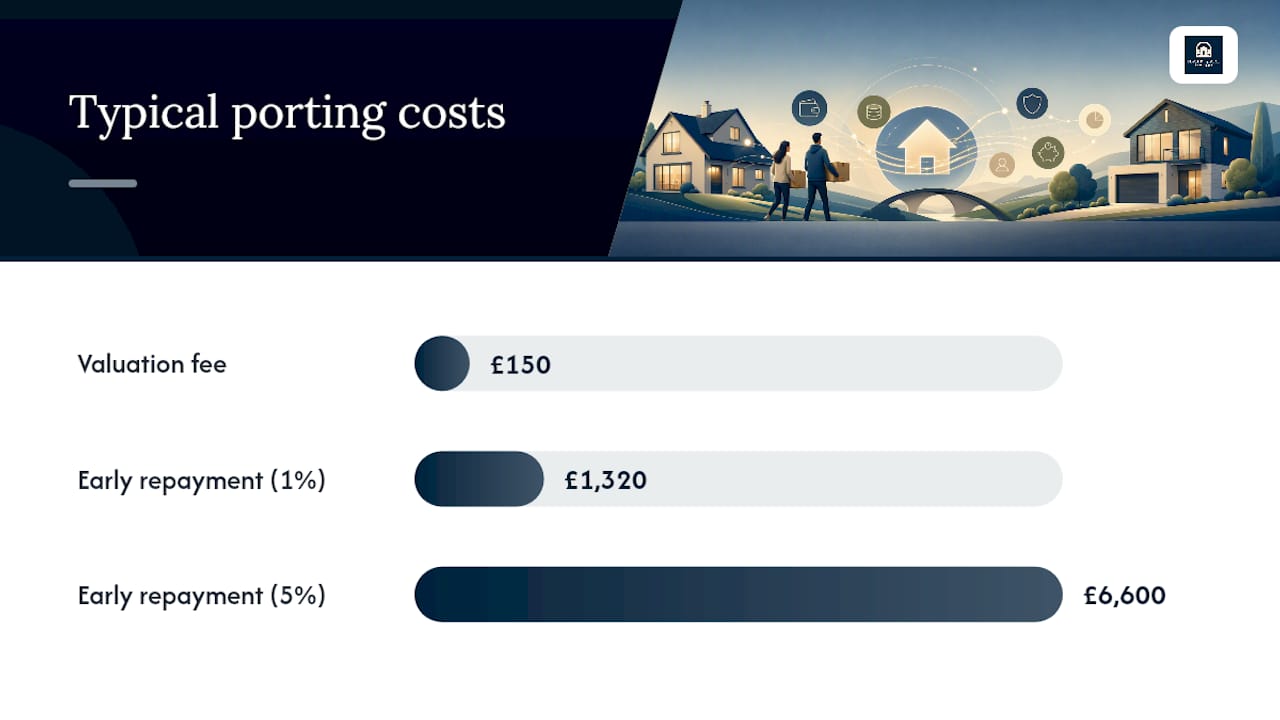
ERCs typically run at around 1% to 5% of your outstanding balance. On the UK's average mortgage balance of £132,000, that translates to somewhere between £1,320 and £6,600, according to The Independent, which is real money to protect against a timing slip.
| Cost item | Typical range or note |
|---|---|
| Valuation fee | Set by lender, often free on standard products, otherwise around £150 |
| Legal/conveyancing fees | Standard home-move conveyancing costs apply as normal |
| Top-up arrangement fee | Charged by some lenders on the additional borrowing portion only |
| Early repayment charge | Around 1% to 5% of outstanding balance if timing doesn't align |
Realistically, expect the whole process to take anywhere from around 30 days up to three months, according to MoneySuperMarket, depending on valuation turnaround and how neatly your sale and purchase line up. Many portable products also include a grace period, commonly up to 90 days, during which you can still complete the port and have any ERC refunded even if your dates don't match perfectly, per MortgageAffordability.co.uk.
Pro Tip: Get the ERC refund policy and the grace period length confirmed in writing from your lender before exchange. Both details vary between lenders and can make or break your moving timeline.
How to prepare and apply to port your mortgage
Porting rewards preparation. Work through these steps roughly in order:
- Confirm portability in your mortgage offer document (do this first, before viewing properties seriously).
- Request a DIP from your lender, factoring in your current income and the new property's likely price.
- Gather paperwork: payslips, bank statements, accounts, ID, and proof of deposit or equity.
- Instruct a solicitor to handle the sale and purchase together.
- Book the valuation and survey on the new property as soon as an offer is accepted.
- Submit the full port application with your lender.
- Track underwriting through to a formal mortgage offer, then completion.
Timescales vary, but a DIP can often be turned around within days, valuations typically take one to two weeks to schedule and report, and full underwriting to offer can take several weeks on top. Altogether, the 30-day to three-month window is the realistic planning range.
If your sale and purchase dates slip out of sync, don't panic. Many lenders will let you pay the ERC upfront and refund it once completion lines up, or apply the grace period built into your product. Haven Mark Advisers' guide on getting ready to offer covers the preparatory steps that tend to shorten this stage.
If your lender refuses to port: what else you can do
A declined port isn't the end of the move. A handful of realistic alternatives exist, each with a different cost and speed trade-off.
- Remortgage with a new lender: you'll likely pay the ERC, but you gain access to the whole market and potentially a better rate.
- Product transfer with your existing lender: faster and avoids some checks, but keeps you tied to one lender's range.
- Second charge lending: useful if you want to avoid disturbing your main mortgage, though it usually costs more overall.
- Delay the move: waiting until your fixed term ends removes the ERC question entirely, if your timeline allows it.
Weighing these against comparing financing routes generally, as Emory Lending sets out for borrowers assessing hybrid options, can help clarify which trade-off suits your situation.
Pro Tip: If the refusal is about the property rather than you, commission an independent survey before walking away. It sometimes unblocks underwriting that a lender's own valuer flagged too cautiously.
When specialist advice helps: how Haven Mark Advisers supports porting for professionals
Porting gets genuinely complicated for people with income that doesn't fit a standard payslip. Lawyers with variable bonus structures, contractors on day rates, and limited company directors often find that lenders scrutinise their fresh application far more closely than the original one.
Haven Mark Advisers assigns one dedicated adviser for the entire process, from portability checks through to completion, rather than handing you between departments. That single point of contact matters most where income needs explaining rather than simply reporting, and where the right lender match, not just any lender, decides whether the port succeeds.
Clients who benefit most tend to include:
- Self-employed business owners and limited company directors with non-standard income evidence.
- Day-rate contractors whose income pattern needs proper packaging for underwriters.
- Foreign nationals and visa holders facing additional residency documentation.
Specialist adviser support tends to matter most where a low fixed rate is genuinely worth protecting and lender criteria are strict, per Forbes Advisor.
Author's note: when I recommend porting and when I don't
Porting earns its keep when you're sitting on a genuinely low rate and the ERC would sting. It earns rejection when rates have since fallen, or when a messy top-up split would cost more than starting fresh.
How Haven Mark Advisers can help you port a mortgage
Trying to port alone often means repeating your story to three different lender departments before anyone actually checks whether the port works for your income. Haven Mark Advisers assigns one adviser who checks portability, structures any top-up, and manages the paperwork with the lender directly, so you're not the one chasing updates mid-move.

This suits professionals with complex income particularly well; a dedicated adviser who already understands variable pay, contract structures, or foreign income evidence can present your case in the way underwriters expect, rather than leaving you to translate it yourself. Fees are agreed and confirmed at completion, and the service is regulated, so you know the cost structure before anything is submitted.
If you're planning a move and want to know whether your current deal will port cleanly, start with Haven Mark Advisers' residential mortgage advice page and request an initial check before you commit to a valuation or legal fees.
Sources
- Porting a mortgage: how does it work? - Which?
- Why porting a mortgage might be right for you when moving to a new home | The Independent
- Porting Your Mortgage to a New Property | UK Guide 2026
- Porting a mortgage from one home to another explained | Forbes Advisor