

For most UK homeowners with sufficient equity and a project costing more than a few thousand pounds, a remortgage for home improvements is often the most cost-effective way to borrow. Mortgage rates are typically lower than unsecured lending, and spreading repayments over the mortgage term keeps monthly costs manageable. That said, it is not the right choice in every situation.
Remortgaging rarely makes sense for small jobs, for homeowners locked into a low fixed rate with significant early repayment charges, or where income is unstable. The secured nature of the debt means your home is at risk if repayments are not maintained.
Before reading further, three immediate actions are worth taking:
- Check your current equity by estimating your property's value and subtracting your outstanding mortgage balance.
- Review your mortgage agreement for early repayment charges and when your current deal expires.
- Obtain at least one contractor quote to establish a realistic project budget.
Key takeaways
Remortgaging for home improvements is cost-effective for larger projects where sufficient equity exists, but the total cost over the mortgage term must be calculated carefully before proceeding.
| Point | Details |
|---|---|
| Check equity and ERCs first | Confirm available equity and any early repayment charges before comparing options. |
| LTV determines your limit | Most lenders cap additional borrowing at 80–90% LTV; staying below 75% secures better rates. |
| Total cost, not monthly payment | Calculate arrangement fees, legal costs, and total interest over the term, not just the monthly figure. |
| Match the route to the project | Full remortgage suits large projects; a further advance or personal loan may be more practical for smaller works. |
| Haven Mark Advisers | Provides regulated, dedicated-adviser remortgage support with whole-of-market access and transparent fees. |
This article provides general information only and is not a substitute for regulated financial advice. Confirm current mortgage terms, rates, and eligibility with your lender or a qualified, FCA-authorised adviser before making any borrowing decision.
Table of Contents
- How does remortgaging to release funds for renovations work?
- What are the pros and cons of remortgaging for home improvements?
- How much can you borrow? LTV, income multiples, and a worked example
- Remortgage vs further advance vs personal loan: which suits your project?
- What costs should you include in your remortgage calculation?
- What do lenders check, and what documents will you need?
- What is the typical remortgage timeline?
- When does remortgaging make sense? A decision checklist
- When does specialist mortgage advice make a real difference?
- Haven Mark Advisers: structured remortgage advice for your renovation
- Sources
How does remortgaging to release funds for renovations work?
A remortgage means switching your existing mortgage to a new deal, usually with a different lender, and borrowing more than your current outstanding balance to release cash. A product transfer keeps you with the same lender on a new rate but does not always allow additional borrowing. A further advance is a separate loan from your existing lender, secured against the same property, without changing your main mortgage deal.
The process for a full remortgage to fund home improvements follows these steps:
- Estimate your property value and equity. Use recent local sale prices as a guide. Your equity is the difference between that value and your outstanding mortgage balance.
- Check your current mortgage terms. Confirm when your fixed or tracker period ends and what early repayment charges apply if you leave early.
- Get a project budget. Lenders often ask for contractor estimates, particularly for larger renovation budgets, before approving additional borrowing.
- Apply for a decision in principle. A lender or adviser runs an affordability check and credit assessment before a formal application.
- Formal application and valuation. The lender instructs a surveyor to confirm the property's current value, which determines how much you can borrow.
- Solicitor and legal work. A conveyancer handles the legal transfer of the mortgage. This is required for a full remortgage but not always for a product transfer or further advance.
- Completion and funds release. Once all checks are satisfied, the new mortgage completes and the additional funds are released, typically to your solicitor and then to you.
Three terms appear throughout this process and are worth understanding clearly. Equity is the portion of your property's value you own outright. Loan-to-value (LTV) is the ratio of your mortgage balance to the property's value, expressed as a percentage. Early repayment charge (ERC) is a penalty fee, usually a percentage of the outstanding loan, charged if you leave a fixed-rate deal before its end date.
What are the pros and cons of remortgaging for home improvements?
Advantages
- Mortgage rates are generally lower than personal loan or credit card rates, reducing the monthly cost of borrowing.
- A single monthly payment replaces multiple debt obligations, which simplifies budgeting.
- You can borrow larger sums than most unsecured lenders will offer, making remortgaging practical for extensions, loft conversions, or full refurbishments.
- Well-chosen improvements, such as an additional bedroom or upgraded insulation, can increase the property's value and partially offset the cost of borrowing.
Disadvantages
- Spreading additional borrowing over a 20 or 25-year mortgage term can significantly increase the total interest paid, even at a lower rate. MoneySavingExpert notes that extending a mortgage term usually increases total interest and adds fees to consider.
- The debt is secured against your home. Failure to maintain repayments puts the property at risk.
- Early repayment charges on your current deal can erode or eliminate any short-term savings from switching.
- Taking on more secured debt can affect your credit profile and reduce the amount you can borrow for other purposes in the future.
Pro Tip: Consider staging your borrowing if the renovation is phased. Borrowing only what you need for the first phase, then applying for a further advance when the next phase begins, can reduce the total interest you pay compared with drawing down the full sum on day one. This approach also gives you a clearer picture of actual costs before committing to the full amount.
How much can you borrow? LTV, income multiples, and a worked example
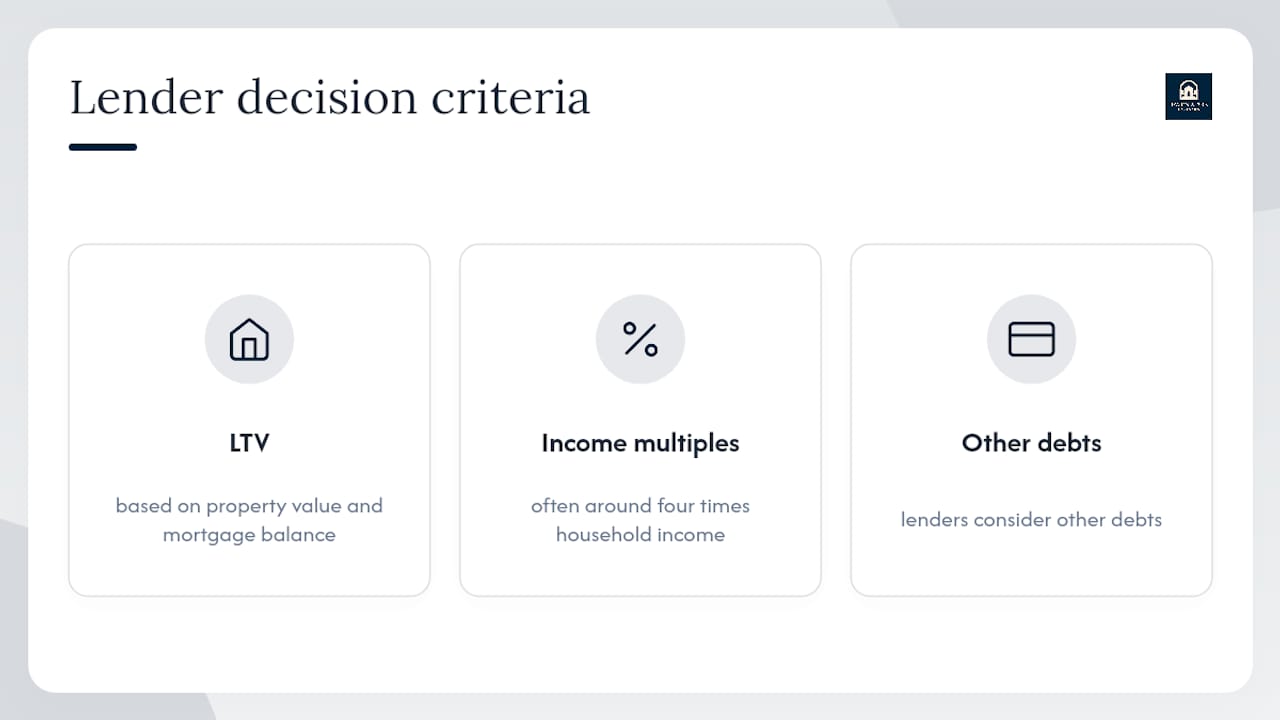
Lenders base their decisions on two primary variables: your loan-to-value ratio and your household income. NerdWallet UK explains that lenders consider current property value, mortgage balance, income, and other debts, with income multiples often around four times household income as a common guide.
LTV bands and how they affect rates
Most lenders will consider secured borrowing up to a high percentage of LTV.
A worked example
In this example, the homeowner could release up to £120,000 before fees, subject to passing affordability checks. The LTV cap is the binding constraint, not the income multiple.
Factors that reduce how much you can borrow
- Existing unsecured debts, such as car finance or personal loans, reduce the income available for mortgage affordability calculations.
- Age and remaining mortgage term: lenders typically require the mortgage to be repaid before a maximum age, often 70 or 75, which limits term length for older applicants.
- Self-employed income volatility: lenders may average the last two or three years of profit, which can reduce the qualifying income figure.
- Poor credit history or recent missed payments can lower the LTV a lender is willing to offer.
Remortgage vs further advance vs personal loan: which suits your project?
The right financing route depends on the size of the project, how quickly you need funds, and the status of your current mortgage deal.

| Feature | Full remortgage | Further advance | Personal loan |
|---|---|---|---|
| Typical cost | Lower rate, but fees apply | Mid-range rate, fewer fees | Higher rate, minimal fees |
| Speed | 6–12 weeks | Often quicker | Days to weeks |
| Paperwork | Full application, valuation, solicitor | Lighter process, same lender | Credit check, income evidence |
| Secured against home | Yes | Yes | No |
| Impact on mortgage term | Can extend or reset | Added to existing term | Separate, no mortgage impact |
| Best for | Large projects, rate improvement | Mid-size works, mid-deal | Small jobs, short payback period |
NatWest's guidance on additional borrowing confirms that a further advance from an existing lender can be quicker with different trade-offs on rate and paperwork compared with a full remortgage.
When to use each option:
- Full remortgage: Your current deal is ending or has already ended, the project is substantial, and you want to secure the best available rate across the whole market.
- Further advance: You are mid-way through a fixed-rate deal with meaningful ERCs, the project is moderate in scale, and your existing lender offers a competitive rate on the additional borrowing.
- Personal loan: The project is small, you want to keep your mortgage entirely separate, or you plan to repay the debt quickly and the total interest cost remains lower than a remortgage would produce over a longer term.
What costs should you include in your remortgage calculation?
A remortgage is not free to arrange. The following costs are standard and should be included in any affordability calculation before proceeding.
- Arrangement fee. Charged by the lender for setting up the new mortgage product. This can range from a few hundred pounds to over £1,000 and is sometimes added to the mortgage balance, in which case interest accrues on it.
- Valuation fee. The lender instructs a surveyor to confirm the property's value. Some lenders offer a free basic valuation, but a more detailed survey is at your own cost.
- Solicitor or conveyancing fees. Legal work is required for a full remortgage. Fees vary but typically fall in the range of £500–£1,500 for a straightforward case.
- Broker fee. If you use a mortgage adviser, a fee is charged upon completion. Haven Mark Advisers operates on a transparent, fixed-fee basis, which is set out clearly before any work begins.
- Early repayment charge. If you leave your current deal before it ends, the ERC is typically calculated as a percentage of the outstanding loan balance. A 2% ERC on a £200,000 balance equals £4,000. That figure must be weighed against any saving from switching to a lower rate.
- Exit fee. Some lenders charge a small administration fee when a mortgage is closed, separate from the ERC.
A note on ERCs and the maths: Suppose your current rate is 2.5% and a new deal offers 4.5%, but your ERC is £4,000. Switching immediately costs more, not less. If your deal ends in six months, waiting is almost always the correct decision unless the renovation cannot be delayed. Run the numbers over the full remaining fixed period, not just the monthly payment.
Beyond mortgage costs, renovation projects routinely run over budget. Planning permission fees, structural engineer reports, and party wall agreements are additional costs that affect the total financing required and should be confirmed before applying.
What do lenders check, and what documents will you need?
Lenders assess both the borrower and the property before approving additional secured borrowing. Gathering the right documents early avoids delays.
Standard documents required:
- Valid photo ID (passport or driving licence)
- Proof of address (utility bill or bank statement, typically dated within three months)
- Last three months' payslips (employed applicants)
- Last two to three years' SA302 tax calculations and tax year overviews (self-employed applicants)
- Last three to six months' bank statements
- Details of existing debts: credit cards, loans, car finance, and any other mortgages
- Contractor quotes or a schedule of works for the planned renovation
What lenders assess beyond documents:
- Credit file. Lenders check your credit report for missed payments, defaults, county court judgements, and overall credit utilisation.
- Affordability. Monthly income minus committed expenditure and existing debt repayments must leave sufficient surplus to cover the new, higher mortgage payment.
- Property condition and minimum value. Some lenders will not lend on properties in poor condition or below a minimum value threshold. A property requiring significant structural work may be valued conservatively.
For self-employed applicants and contractors, the evidence requirements are more involved. Lenders typically want two to three years of accounts prepared by a qualified accountant, alongside SA302 forms. Day-rate contractors may be assessed differently, with some lenders using the annualised day rate rather than drawn salary. Haven Mark Advisers has specific experience with contractor income assessments and limited company director applications, where the standard employed-income approach does not apply.
What is the typical remortgage timeline?
Realistic timescales vary depending on whether you stay with your existing lender or switch to a new one. Consumer guides commonly cite a range of roughly 6–12 weeks for an open-market remortgage, while a product transfer or further advance with the same lender can be considerably quicker.
- Weeks 1–2: Fact-finding and decision in principle. An adviser reviews your income, equity, and project costs. A decision in principle is obtained from a lender.
- Weeks 2–4: Formal application. Documents are submitted. The lender instructs a valuer.
- Weeks 3–5: Valuation and underwriting. The surveyor visits the property. The lender's underwriting team reviews the full application.
- Weeks 4–8: Solicitor and legal work. Conveyancers on both sides exchange documents and conduct searches. This stage is often the longest.
- Weeks 6–12: Completion. The new mortgage completes, the old one is redeemed, and the additional funds are released.
Common causes of delay:
- Incomplete or inconsistent documents submitted at application
- Valuation disputes where the surveyor's figure is lower than expected
- Solicitor capacity, particularly at busy periods
- Lender underwriting queues during high-demand periods
To speed up the process: instruct a solicitor at the same time as submitting the application, not after. Have all documents ready before the application is submitted. If funds are needed quickly, ask your existing lender about a further advance first, as this can sometimes be arranged in two to four weeks without a full legal process.
When does remortgaging make sense? A decision checklist
Use the following criteria to assess whether proceeding is the right course of action.
Signs that remortgaging is likely appropriate:
- The project cost exceeds £15,000–£20,000, making a personal loan less competitive on rate.
- You have at least 20–25% equity remaining after the additional borrowing.
- The renovation is likely to increase the property's value or significantly improve its habitability.
- Your current fixed-rate deal is ending within the next three to six months, minimising ERC exposure.
- Your income is stable and the higher monthly payment is comfortably affordable.
Warning signs that should prompt a pause:
- ERCs would cost more than the interest saving from switching.
- Household costs are rising and the additional monthly payment would stretch the budget.
- You plan to sell the property within two to three years, limiting the time to recoup renovation costs.
- The project is speculative or cosmetic rather than structural, and the value uplift is uncertain.
Running the maths: a step-by-step approach
- Calculate the total cost of the remortgage: arrangement fee, valuation, legal fees, broker fee, and ERC if applicable.
- Calculate the total interest on the additional borrowing over the full mortgage term at the new rate.
- Add steps 1 and 2 to get the true total cost of the remortgage route.
- Compare that figure with the total cost of a personal loan over a shorter term (typically 5–7 years).
- Consider the opportunity cost: if you have savings, what would those funds earn versus what the mortgage interest costs?
Renovation decisions also affect long-term financial position. Housing decisions and net worth are closely linked, and borrowing to improve a property can be a sound financial decision when the value uplift exceeds the cost of borrowing over the ownership period.
When does specialist mortgage advice make a real difference?
For straightforward cases where income is simple and equity is plentiful, a direct application to a lender is feasible. For most homeowners, particularly those with non-standard income, a regulated adviser adds measurable value.
The FCA's revised affordability rules now permit lenders to use a modified affordability assessment (MAA) where a new mortgage is more affordable than a customer's current deal or an indicated new deal from the same lender. This change is permissive, meaning lenders may choose to adopt it, and it can simplify the remortgage process for some applicants. An adviser who understands which lenders have adopted the MAA can direct an application accordingly.
Specialist brokers and whole-of-market advisers add value by modelling ERCs, re-running affordability with possible term changes, and identifying lenders that accept complex income evidence. For self-employed applicants, contractors, and finance or legal professionals, this targeted lender-matching can be the difference between an approval and a decline.
Regulated advice also carries FSCS protection. If an authorised firm fails or cannot meet a claim, the Financial Services Compensation Scheme provides a route to compensation. Checking that any adviser or firm is FCA-authorised before engaging is a straightforward step that protects you throughout the process.
Haven Mark Advisers offers regulated remortgage advice with a single dedicated adviser assigned from the initial fact-find through to completion. The firm's transparent fee structure means there are no hidden charges, and the whole-of-market access means the recommendation is not limited to a panel of preferred lenders.
An adviser's perspective on remortgaging for renovations
Remortgaging to fund home improvements is a sound decision in the right circumstances. The cases where it works well share common features: the project is substantial, the equity is there, the current deal is near its end, and the homeowner has a clear plan for the property over the next several years.
Where it goes wrong is usually one of two scenarios. Either the homeowner underestimates the total cost of the remortgage, particularly the ERC, and the maths never actually stacked up. Or the renovation budget grows during the project, and the original borrowing is insufficient, leading to a second application at a worse time.
The practical advice is to build the contingency into the original borrowing, not as an afterthought. Borrowing £10,000 more than you think you need, at mortgage rates, is almost always cheaper than returning to a lender six months later for a further advance at a different rate and with a second set of fees.
Haven Mark Advisers: structured remortgage advice for your renovation
Remortgaging to fund a renovation involves more moving parts than a standard rate switch. The ERC calculation, the lender's valuation, the affordability assessment against a higher loan balance, and the legal process all need to run in sequence without gaps.

Haven Mark Advisers assigns one dedicated adviser to manage every stage of that process, from the initial equity and ERC review through to completion. With over ten years of experience and access to a broad range of UK lenders, the firm is well-placed to identify the most suitable deal for professionals with complex income structures, including self-employed business owners, contractors, and those in legal or finance roles. Fees are fixed and disclosed before any work begins, with no surprises at completion.
To discuss your renovation remortgage, visit the residential mortgage advice page or explore who Haven Mark Advisers works with to confirm the firm is the right fit for your situation.
Sources
Before engaging any adviser or lender, verify their authorisation status and understand the protections available to you.
- PS25/11: Mortgage rule changes and guidance (FCA)
- Home improvement loans – MoneySavingExpert
- What you need to know about remortgaging to fund your home renovation | Dream of Home
- FSCS — Financial Services Compensation Scheme
Check that any adviser you engage is listed on the FCA Register before proceeding. FSCS protection applies only to firms that are FCA-authorised.