

IMPORTANT: YOUR HOME MAY BE REPOSSESSED IF YOU DO NOT KEEP UP REPAYMENTS ON YOUR MORTGAGE.
Yes, you can remortgage a Help to Buy property. Whether you need permission from Homes England depends on two things: are you switching lender or borrowing more, and do you plan to repay some or all of the equity loan at the same time?
If you stay with your current lender and don't increase your borrowing, you usually won't need to apply for Homes England's permission, though your lender may still require a Deed of Postponement. Change lender, borrow more, or repay part of the equity loan, and you'll need to go through Homes England's formal process.
Your first move, before anything else, is this:
- Contact your current mortgage lender and request a redemption statement.
- Decide whether you intend to borrow more or switch lender.
- Work out whether you want to repay any of the equity loan now.
Pro Tip: Request your redemption statement before you speak to a broker or surveyor. Everything else in the process, from the RICS valuation to the Homes England application, depends on that document being current.
Key Takeaways
Remortgaging a Help to Buy property is straightforward once you know which permission route applies and get the RICS valuation and redemption statement organised early.
| Point | Details |
|---|---|
| Check your permission route | No additional borrowing usually means no Homes England application; new lender or extra borrowing requires one. |
| Get a current redemption statement | It must be no older than 12 working days for applications needing permission. |
| Repayment follows market value | Equity loan repayment is calculated on current market value via a RICS valuation, not your purchase price. |
| Mind the minimum repayment rule | Part repayments must be at least 10% of market value, leaving no less than 5% outstanding. |
| Budget for every fee | Admin fees, RICS valuation, conveyancer costs, and lender charges all apply before completion. |
| Get coordinated support | Haven Mark Advisers assigns one dedicated adviser to manage lender, valuer, and conveyancer together. |
Table of Contents
- When do you need permission to remortgage help to buy?
- How does equity loan repayment work when you remortgage?
- What does it cost to remortgage and repay help to buy?
- Step-by-step: from enquiry to completion
- What do lenders check before approving your remortgage?
- Why do help to buy remortgages get delayed or refused?
- Should you repay part, all, or none of the equity loan?
- How Haven Mark Advisers approaches help to buy remortgages
- Get help with your help to buy remortgage
- Sources
When do you need permission to remortgage help to buy?
The rulebook splits into two clear paths, and knowing which one applies to you saves weeks.

Remortgage without additional borrowing. If you're staying with your existing lender and not borrowing a penny more, you generally don't need to apply to Homes England. The catch is the Deed of Postponement: some lenders will still ask for one before they'll release funds, so it's worth checking early rather than assuming you're exempt.
Remortgage with additional borrowing (or a new lender). Here, permission is compulsory. Homes England needs to approve a Deed of Postponement so your new lender's charge can sit correctly against the property, and it issues Form A or an Authority to Proceed once it has reviewed your application.
| Route | Permission needed? | Key document | Typical validity |
|---|---|---|---|
| Same lender, no extra borrowing | Usually not, but check Deed of Postponement requirement | Redemption statement | No older than 12 working days |
| New lender or additional borrowing | Yes | Form A / Authority to Proceed | 6 months |
Fees differ by route too. A straightforward remortgage application typically carries a smaller admin fee, while remortgaging alongside repaying the equity loan attracts a higher one. Get your redemption statement dated as close to submission as possible: anything older than 12 working days will usually be rejected outright.
How does equity loan repayment work when you remortgage?
Repayment is never based on what you paid for the property. It's calculated on the property's market value at the point you repay, which means a decade of house price growth (or decline) directly changes the sum you owe Homes England.
That figure has to come from a RICS-accredited valuation report, commissioned specifically for this purpose. You can't use an estate agent's estimate or your mortgage lender's automated valuation.
The equity loan is repaid at current market value, not purchase price. Many homeowners are caught out by how much a rising local market has increased the amount they now owe.
Homes England won't accept just any partial repayment either. If you're clearing part of the loan, that payment must be at least 10% of the current market value, and you can't leave less than 5% of the property's value outstanding. In practice, that rules out small, token repayments; you're either making a meaningful dent or clearing the loan in full.
Your conveyancer does the legwork that actually gets the loan discharged or postponed. They prepare the legal undertaking, coordinate the transfer of funds, and submit the paperwork Homes England needs before it will issue the Authority to Complete or finalise the Deed of Postponement.
Timing follows a fairly predictable sequence:
- Obtain the RICS valuation and submit it with your application.
- Pay any outstanding administration fees and clear arrears if applicable.
- Receive your redemption statement or repayment letter.
- Your conveyancer submits the legal undertaking.
- Homes England issues the Authority to Complete within five working days of receiving that undertaking.
Pro Tip: Book your RICS valuer as soon as you've decided to remortgage, not after your mortgage offer arrives. Valuation reports have a limited shelf life, and a delay here is the single most common reason completions slip.
What does it cost to remortgage and repay help to buy?
Budgeting for this properly means looking beyond your new mortgage rate. Several separate fees stack up before completion, and missing one in your planning can throw your numbers off.
- Homes England administration fees, which vary by route: expect a lower fee for a straightforward remortgage application and a higher one, around £200, when the application includes repaying all or part of the equity loan.
- RICS valuation fee, paid to an independent chartered surveyor, separate from any valuation your new lender arranges.
- Conveyancer or solicitor fees for handling the Deed of Postponement, legal undertaking, and redemption paperwork.
- Lender fees, including arrangement fees on the new mortgage and any early repayment charge on your existing deal.
- Ongoing management fees on the equity loan, which continue until repayment actually completes.
Pro Tip: Ask your lender and conveyancer for written fee estimates before you commit. Some lender fees can be added to your new borrowing, but Homes England's policy caps limit how much can be rolled in this way.
Step-by-step: from enquiry to completion
Treat this as your working checklist. The order matters, because several steps depend on the one before it.
- Request a redemption statement from your current lender, no older than 12 working days if your application requires Homes England permission.
- Instruct a RICS valuer to produce the market valuation your repayment figure will be based on.
- Secure your new mortgage offer or agree revised terms with your existing lender.
- Appoint a conveyancer and give them authority to act on the Deed of Postponement and legal undertaking.
- Submit your application to Homes England, including Form A or Authority to Proceed, if you're changing lender, borrowing more, or repaying the loan.
- Pay administration fees and any arrears before permission is finalised.
- Exchange funds and complete, with your conveyancer coordinating timing between old lender, new lender, and Homes England.
- Confirm the Deed of Postponement is recorded, so the new lender's charge sits correctly against the property.
Documents to have ready: your current redemption statement, the RICS valuation report, your mortgage offer, your conveyancer's details, and proof of identity where your lender requests it.
Two timing rules catch people out repeatedly. Form A and Authority to Proceed are typically valid for six months, and once Homes England has your legal undertaking, it aims to issue the Authority to Complete within five working days. Try to align your mortgage offer's expiry with your valuation's validity window; if one lapses before the other, you may end up paying for a second survey.
What do lenders check before approving your remortgage?
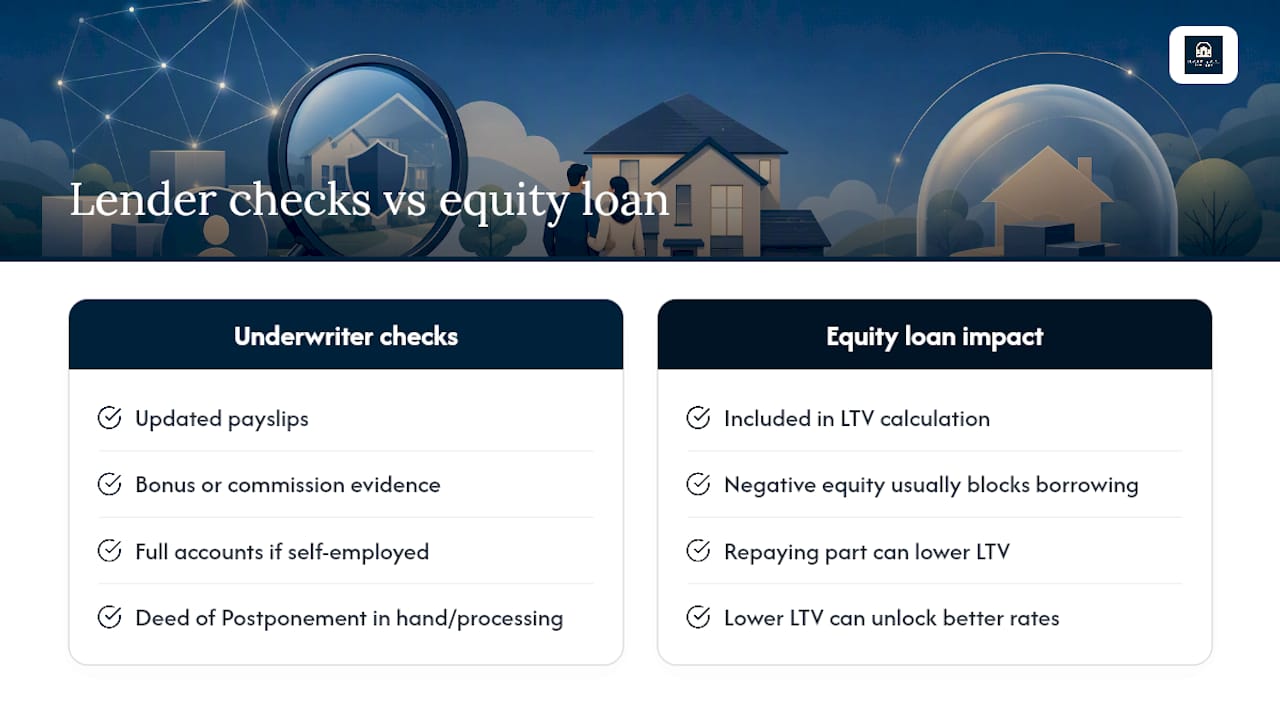
Underwriters look past your income and credit history when a Help to Buy equity loan is in the picture. The loan itself becomes part of their loan-to-value calculation, and that changes what rates and products are open to you.
Lenders will assess affordability using updated payslips, evidence of any bonus or commission income, and full accounts if you're self-employed. They'll also calculate your loan-to-value ratio with the equity loan percentage factored in, and they'll want confirmation that the Deed of Postponement is in hand or being processed.
If the property's current value has fallen below the combined total of your mortgage and equity loan, most lenders will decline additional borrowing outright. Negative equity closes doors that a straightforward remortgage would otherwise keep open.
The upside works the other way too. Repaying even part of the equity loan can shift you into a materially lower LTV band, which sometimes unlocks noticeably better rates. Whether that trade-off is worth it depends entirely on your numbers, which is exactly the kind of modelling a broker who specialises in residential mortgage advice will run before you commit to anything.
Why do help to buy remortgages get delayed or refused?
Most delays trace back to the same handful of avoidable problems, repeated across thousands of cases every year.
- A redemption statement that's expired before the application lands on Homes England's desk.
- A RICS valuation that lapses while the mortgage offer is still being processed.
- Unpaid arrears or management fees on the equity loan that block permission.
- A conveyancer's legal undertaking that's incomplete or submitted late.
- A Deed of Postponement that hasn't been prepared or signed in time.
Pro Tip: Get your conveyancer, valuer, and new lender talking to each other from day one, rather than relaying updates between them yourself. Coordinated instructions cut out most repeated document requests.
This is precisely where proactive case management earns its keep: chasing documents before they go stale, rather than after Homes England bounces an application back.
Should you repay part, all, or none of the equity loan?
There's no single right answer here; it depends on your numbers and your appetite for ongoing charges.
- Keep the loan, remortgage anyway. Works if your priority is simply securing a better mortgage rate without touching the equity loan structure.
- Repay part (minimum 10% of current market value) if that repayment tips you into a meaningfully lower LTV band and unlocks cheaper mortgage rates.
- Repay in full if you want the second charge gone entirely and to stop paying ongoing interest and management fees for good.
Weigh the upfront cost, admin fee, valuation, conveyancer fees, and the repayment sum itself, against what you'd save in mortgage interest or equity loan charges over time.
Pro Tip: Run both scenarios side by side with an adviser: a partial repayment sized to shift your LTV band, versus a full repayment with its breakeven timeline. The right answer is rarely obvious until the numbers are in front of you.
How Haven Mark Advisers approaches help to buy remortgages
We coordinate lender, conveyancer and RICS valuer as one process rather than three separate conversations, because that's where most Help to Buy remortgages lose weeks. Each client works with a single dedicated adviser throughout, which matters particularly when income is complex or documentation needs chasing across multiple parties.
Get help with your help to buy remortgage
There are other routes to remortgaging a Help to Buy property. You can approach your existing lender directly, use a comparison site, or manage the Homes England application yourself. Each of these leaves you juggling the redemption statement, RICS valuer, conveyancer, and Homes England paperwork on your own timeline.

Haven Mark Advisers assigns one dedicated adviser to your case from first enquiry to completion, so nothing gets lost between the lender, the surveyor, and the conveyancer. Case management includes coordinating your RICS valuation timing, matching you to lenders who handle Help to Buy equity loans without unnecessary friction, and gathering documents in the order Homes England actually needs them. Fees are agreed and made transparent at the point of engagement, before any work begins.
If you're weighing up a partial repayment against a full one, or simply want your remortgage handled by someone who has coordinated this exact process before, get in touch to arrange a review of your situation.
Sources
For the underlying rules, go straight to GOV.UK's Help to Buy: Equity Loan pages, which cover remortgaging, repayment, and the forms involved. RICS maintains a directory for finding an accredited valuer for the mandatory valuation report.
- How to remortgage your Help to Buy home without borrowing more money
This article is general information, not a substitute for advice from a qualified financial advisor. Consult a qualified financial professional about your own circumstances before acting on anything here.