

IMPORTANT: YOUR HOME MAY BE REPOSSESSED IF YOU DO NOT KEEP UP REPAYMENTS ON YOUR MORTGAGE.
You can get a second home mortgage in the UK, but the process differs from buying a first property in three material ways: lenders typically require a larger deposit, affordability checks are stricter because your existing mortgage payments count against you, and you will pay a 5% Stamp Duty Land Tax surcharge in addition to the standard residential rates. That surcharge cannot be added to your mortgage. It must come from liquid cash and is due within 14 days of completion, so it must sit inside your budget from day one.
Before making any offer, take these three steps:
- Run a mortgage calculator to check what you can borrow after your existing commitments are factored in.
- Obtain an Agreement in Principle (AIP) from a lender or adviser so you know your position before instructing solicitors.
- Gather your core documents: three months' payslips or two years' SA302s, three months' bank statements, proof of address, and photo ID.
Key takeaways
A second home mortgage in the UK requires a larger deposit, a higher SDLT liability payable in cash at completion, and a stricter affordability assessment than a first purchase.
| Point | Details |
|---|---|
| SDLT surcharge is 5% from the first pound | Budget for SDLT before setting your offer price; it cannot be added to the mortgage and is due within 14 days of completion. |
| Deposit typically 15–25% | Buy-to-let lenders commonly require 25% as a minimum; second-residential lenders may accept 15% for strong applications. |
| Lender stress-test variation matters | Under FCA rules, lenders set their own stress-test methodology; the same income can produce different maximum loan figures across lenders. |
| Rental income is taxable | Declare rental income to HMRC; the mortgage interest restriction limits deductions for higher-rate taxpayers. |
| Haven Mark Advisers | Provides dedicated-adviser mortgage advice for second-home and buy-to-let purchases, including complex-income and foreign-national cases. |
Table of Contents
- What counts as a second home and the main mortgage types
- Upfront and ongoing costs to budget for
- How lenders assess affordability for a second home mortgage
- How buy-to-let mortgages differ from second-residential mortgages
- Buying a second home overseas: what to check first
- Practical steps to improve your approval chances
- Step-by-step application process and realistic timeline
- When regulated mortgage advice is genuinely worth it
- What most buyers get wrong about second home costs
- Haven Mark Advisers: structured advice for second-home buyers
- Sources
What counts as a second home and the main mortgage types
A property is treated as a second home for mortgage and tax purposes when you already own another residential property at the point of completion. The intended use of the new property determines which mortgage product you need, and lenders assess each type differently.
Additional residential purchase. You buy a second property to use personally, perhaps as a city flat alongside a rural main home. A standard residential mortgage applies, but lenders will factor in your existing mortgage payments when calculating affordability.
Holiday home. You intend to use the property seasonally and may let it occasionally. Some lenders will accept a residential mortgage with a consent-to-let clause; others require a specialist holiday-let product. Seasonal income from letting is treated differently from long-term rental income.
Buy-to-let. You purchase primarily to rent to tenants. A buy-to-let mortgage is required. Underwriting centres on projected rental income and yield rather than personal income alone, though most lenders still carry out a personal affordability check.
Family-support purchase. You buy a property for a family member to live in. This is sometimes structured as a regulated buy-to-let, a joint-borrower sole-proprietor arrangement, or a guarantor mortgage, depending on the lender and the occupancy arrangement.
The surcharge applies regardless of intended use: ownership at completion is the only test.
| Intended use | Typical mortgage type | Key lender consideration |
|---|---|---|
| Personal second residence | Additional residential | Existing mortgage payments reduce affordability |
| Holiday home (occasional let) | Residential or holiday-let | Seasonal income assessed cautiously; some lenders restrict short-term letting |
| Long-term rental | Buy-to-let | Rental coverage ratio and yield; personal income secondary |
| Family occupancy | Regulated buy-to-let or joint-borrower | Occupancy status and relationship to borrower |
Upfront and ongoing costs to budget for
The deposit is only one part of the cash you need available. Many buyers underestimate the total outlay because SDLT and fees are not visible in the headline purchase price.
Upfront costs:
- Deposit. Lenders typically require 15–25% for a second residential property. Buy-to-let lenders commonly require 25% as a minimum.
- SDLT surcharge. The 5% additional-dwelling surcharge was raised from 3% to 5% in October 2024 and applies from the first pound of the purchase price. On a £300,000 property, that is £15,000 in surcharge alone, before the standard SDLT bands are applied.
- Legal fees. Solicitor or conveyancer fees typically range from £1,000 to £2,500 depending on complexity.
- Valuation and survey fees. A basic lender valuation may be included in the mortgage product; an independent survey adds £400–£1,500.
- Mortgage arrangement fee. Many products carry an arrangement fee of £999–£2,000, sometimes added to the loan, though this increases the total interest paid.
- Broker fee. A regulated adviser may charge a fee payable on completion.
Ongoing costs:
- Mortgage repayments on both properties.
- Buildings and contents insurance.
- Council tax (second homes may attract a council tax premium in some local authority areas).
- Maintenance and repair.
- Letting-agent fees if you rent the property (typically 10–15% of rental income).
- Income tax on rental income and capital gains tax on eventual sale.
Worked SDLT example. On a £400,000 second home purchased in England in 2026, the SDLT calculation works as follows. Standard residential SDLT on £400,000 is £10,000. Total SDLT: £30,000, payable in cash within 14 days of completion. If you later sell your main residence within 36 months of buying the second property, you may be eligible to claim a refund of the surcharge element under the 36-month rule.
Pro Tip: *Add your SDLT liability and all fees to your deposit figure before you set your maximum offer price.
How lenders assess affordability for a second home mortgage
Lenders do not assess a second home mortgage in isolation. Your existing mortgage payments, any other secured debt, and your total committed expenditure all reduce the amount you can borrow. The affordability check is more demanding than for a first purchase.
What lenders look at:
- Current mortgage balance and monthly payment on your primary residence.
- Gross income: payslips and P60 for employed applicants; SA302s and tax-year overviews for the self-employed; company accounts and director's salary plus dividends for limited company directors.
- Three to six months' bank statements showing income and expenditure patterns.
- Credit file: existing credit commitments, payment history, and any adverse entries.
- Proof of rental income or tenancy agreements where the property will be let.
- Photo ID and proof of current address.
Stress-testing. Under FCA rules on interest-rate stress testing, lenders may set their own stress-test methodology. This variation means two lenders can reach materially different maximum loan figures from identical income and expenditure data. Comparing headline rates alone is not sufficient.
MCOB 11 sets out the FCA's responsible-lending framework, including affordability assessment requirements and specific provisions for interest-only mortgages. Lenders must demonstrate they have assessed the borrower's ability to repay across the mortgage term.
The FCA allows lenders flexibility in how they set the stress-test margin under MCOB 11.6.18R. For borrowers with complex income, this means the lender's chosen methodology can be as important as the rate itself. Selecting a lender whose model suits your income profile is not a minor detail; it can be the difference between approval and decline.
Pro Tip: If your income is irregular, prepare a brief written explanation for the underwriter before submission. A clear narrative alongside your documents reduces the risk of delays or requests for additional evidence.
How buy-to-let mortgages differ from second-residential mortgages
The distinction between a buy-to-let mortgage and a second-residential mortgage is not cosmetic. The products are underwritten differently, carry different regulatory protections, and have distinct tax consequences.
Product differences:
- Buy-to-let underwriting focuses on the rental coverage ratio: projected monthly rent must typically cover 125–145% of the monthly mortgage payment, tested at a stress rate. Personal income is secondary for many lenders, though minimum income thresholds often apply.
- Buy-to-let mortgages are generally interest-only, which reduces monthly payments but means no capital is repaid unless you make overpayments or remortgage to a repayment product.
- Deposit requirements are higher: 25% is a common minimum, and rates tend to be above equivalent residential rates.
- Buy-to-let lending is not regulated by the FCA in the same way as residential lending when the borrower is not occupying the property, though consumer buy-to-let (where the borrower is an accidental landlord) carries additional protections.
Tax consequences of letting:
Rental income is taxable. Allowable expenses, including mortgage interest (subject to restrictions introduced since 2017), letting-agent fees, and maintenance costs, can be deducted. On disposal, capital gains tax may apply to any gain above the annual exempt amount.
Holiday lets are treated differently. Furnished holiday lettings rules previously offered favourable tax treatment, but the furnished holiday lettings regime was abolished from April 2025. Properties that previously qualified are now taxed as standard residential lettings.
Rental income from a second property must be declared to HMRC. The tax position depends on your income tax band, the structure of ownership, and whether the property qualifies under any specific letting rules. Consulting a qualified accountant before committing to a purchase is advisable, not optional.
Buying a second home overseas: what to check first
Most UK high-street lenders will not offer a mortgage secured against an overseas property. This is a firm policy restriction for the majority of mainstream lenders, not a case-by-case decision.
Before committing to any overseas purchase, check the following:
- Lender jurisdiction policy. Confirm in writing whether the lender will accept a charge over property in the target country. Allowable jurisdictions vary significantly between lenders.
- Currency risk. If the mortgage is denominated in a foreign currency, exchange-rate movements affect your repayment costs. Some lenders require income in the same currency as the loan.
- Local tax treatment. Property ownership, rental income, and capital gains may be taxed in the country where the property sits, in the UK, or both, depending on double-taxation treaties.
- Conveyancing requirements. Legal processes abroad differ materially from English conveyancing. A local notary or solicitor qualified in that jurisdiction is required.
- SDLT and UK tax position. Owning an overseas residential property may still count towards your UK SDLT position depending on the specific circumstances; take advice before assuming it does not.
Pro Tip: Confirm the lender's overseas-property policy before instructing any surveys or solicitors. Discovering a restriction after paying for a survey wastes both money and time.
Practical steps to improve your approval chances
A stronger application reduces the risk of decline and tends to attract better rates. These steps are worth taking before you submit, not after a rejection.
- Increase your deposit. Moving from 15% to 25% can open access to lower-rate products and reduces the lender's risk. On a buy-to-let, 25% is often the entry point.
- Reduce revolving credit balances. Outstanding balances on credit cards and personal loans reduce affordability. Paying these down before application improves your debt-to-income position.
- Check and correct your credit file. Obtain reports from Experian, Equifax, and TransUnion. Dispute any errors before applying; a correction can take several weeks.
- Gather two years of accounts. Self-employed applicants and limited company directors should have two full years of SA302s, tax-year overviews, and company accounts ready before approaching lenders.
- Secure a tenancy agreement. If the property is already let or you have a prospective tenant, a signed tenancy agreement strengthens a buy-to-let application by evidencing rental income.
- Obtain an AIP. An Agreement in Principle gives you a lender's indicative decision before you make an offer. It also signals to vendors and agents that you are a credible buyer.
- Match the lender to your income type. Not all lenders assess self-employed income, contractor day rates, or foreign-national income in the same way. Choosing a lender whose criteria fit your profile is more effective than applying broadly and hoping.
Pro Tip: Self-employed applicants, contractors, limited company directors, and foreign nationals benefit most from lender-matching. A lender that specialises in your income type will often lend more, at better terms, than a mainstream lender applying a standard employed-income model. Haven Mark Advisers works with professionals across these income types and can identify which lenders are most likely to approve your specific profile.
Step-by-step application process and realistic timeline
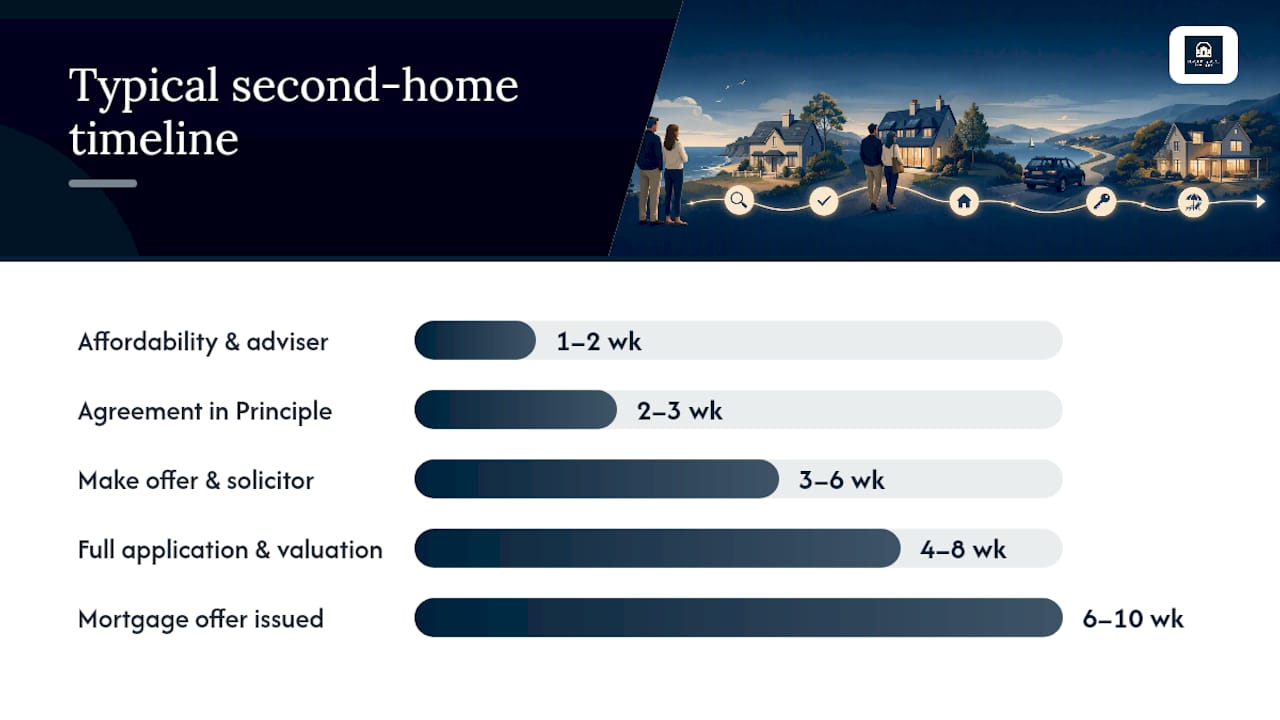
The process from initial research to completion typically takes 8–16 weeks for a straightforward second-home purchase. Complex cases, leasehold properties, or overseas elements extend this.
Application steps:
- Affordability check and mortgage calculator (Week 1). Use a mortgage calculator to estimate borrowing capacity after existing commitments. This is indicative only; a lender's formal assessment may differ.
- Engage a regulated adviser or approach lenders directly (Week 1–2). For complex income or buy-to-let, a regulated adviser adds value at this stage by identifying suitable lenders before any application is submitted.
- Agreement in Principle (Week 2–3). Submit income and expenditure data for an AIP. Most lenders issue an AIP within 24–72 hours. An AIP is not a guarantee of a mortgage offer.
- Make an offer on a property (Week 3–6). Once an AIP is in place, make your offer. Instruct a solicitor at this point.
- Full mortgage application (Week 4–7). Submit the full application with all supporting documents. The lender orders a valuation.
- Valuation and survey (Week 5–8). The lender's valuation confirms the property is adequate security. An independent survey (HomeBuyer Report or Building Survey) runs in parallel.
- Mortgage offer issued (Week 6–10). Once the lender is satisfied with the valuation and application, a formal mortgage offer is issued. This is valid for a set period, typically three to six months.
- Exchange of contracts (Week 8–14). Solicitors exchange contracts; you pay your deposit and become legally committed to the purchase.
- Completion (Week 10–16). Funds transfer, keys are released, and SDLT is due within 14 days.
Documents checklist by applicant type:
- Employed: three months' payslips, latest P60, three months' bank statements, photo ID, proof of address.
- Self-employed: two years' SA302s and tax-year overviews, two years' company accounts (if limited company), three months' business and personal bank statements, photo ID, proof of address.
- Limited company director: SA302s, company accounts, evidence of dividends, director's salary confirmation, three months' business bank statements.
- Foreign national: passport, current visa or indefinite leave to remain documentation, proof of UK address, three months' bank statements, employment contract or evidence of business ownership.
When regulated mortgage advice is genuinely worth it
For a straightforward employed applicant buying a second residential property with a clean credit file, approaching lenders directly is feasible. For most other situations, regulated advice delivers measurable practical value.
Regulated mortgage advice is recommended where income is non-standard, where the purchase intersects with tax planning, or where lender access is restricted by employment type, residency status, or property use. An adviser operating under FCA regulation has a duty to recommend a product that is suitable for your circumstances, not merely one that is available.
Cases where an adviser adds the most value:
- Self-employed applicants with two years of accounts showing variable income.
- Limited company directors whose income is split between salary and dividends.
- Contractors paid on a day-rate basis, where lenders assess income differently.
- Foreign nationals or visa holders whose residency status affects lender eligibility and SDLT surcharge calculations.
- Buy-to-let investors building a portfolio, where lender stress-test assumptions affect maximum loan size across multiple properties.
- Buyers with complex ownership structures, such as joint-borrower sole-proprietor arrangements or family-support purchases.
A regulated adviser with access to a broad lender panel can identify which lenders' stress-test models suit your income profile, prepare your documents to underwriter standard, and manage the case proactively to avoid delays. For foreign nationals and visa holders, lender eligibility varies considerably, and an adviser who understands the relevant criteria reduces the risk of wasted applications.
What most buyers get wrong about second home costs
The single most common surprise in second-home purchases is not the mortgage rate. It is the cash requirement at completion.

On a £350,000 property, that can mean £25,000–£40,000 in additional outgoings that were not factored into the original budget. SDLT cannot be deferred, financed, or added to the mortgage. It is due within 14 days of completion, in full, from cleared funds.
The practical correction is simple: calculate your total SDLT liability using the SDLT calculator on gov.uk before you agree a purchase price, not after. Add that figure, plus estimated legal fees and arrangement costs, to your deposit. The resulting number is your true minimum cash requirement. If it exceeds what you have available, adjust the purchase price or timeline before making an offer.
Haven Mark Advisers: structured advice for second-home buyers
Second-home and buy-to-let purchases involve more moving parts than a first purchase: two affordability assessments, SDLT planning, lender-matching for complex income, and in some cases tax structuring before the application is even submitted. Haven Mark Advisers provides structured, adviser-led mortgage advice specifically for these situations.

Each client is assigned a single dedicated adviser from initial enquiry through to completion. That adviser handles lender-matching, document preparation, and proactive case management, so nothing falls between the gaps. Haven Mark Advisers works with employed professionals, self-employed business owners, contractors, limited company directors, and foreign nationals, and has access to a broad panel of UK lenders including those that specialise in non-standard income.
For buy-to-let purchases, the buy-to-let mortgage service covers rental coverage assessment, lender selection, and the full application process. For second residential purchases, the residential mortgage service applies the same dedicated-adviser model. Fees are transparent and payable on completion. To understand your position before making an offer, speak with an adviser or request an Agreement in Principle through Haven Mark Advisers.
Sources
- Gov
- Interest-rate stress test rule (FCA)
- Second-Home Stamp Duty Surcharge (2026/27) | HomeBuyingCosts UK
This article is general information, not a substitute for advice from a qualified financial advisor. Consult a qualified financial professional about your own circumstances before acting on anything here.