

Yes, self-employed borrowers can get a mortgage in the UK. The single most important factor is demonstrable, consistent income, evidenced through HMRC records or accountant-prepared accounts. Lenders are not opposed to self-employed applications; they simply require a clearer paper trail than a standard payslip provides.
Before you proceed, confirm you have the following in place:
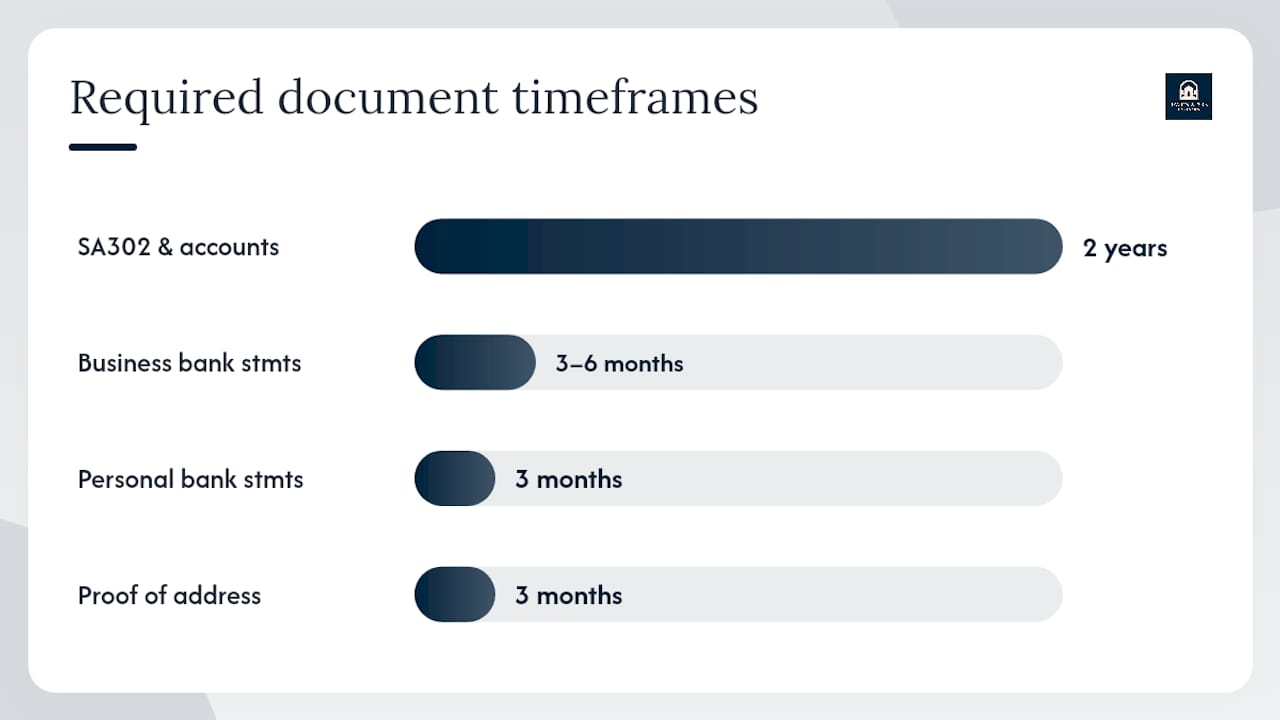
- SA302 tax calculations from HMRC covering the last two years
- Full self-assessment tax returns for the same period
- Accountant-signed business accounts (for limited company directors, these must be company accounts)
- Business and personal bank statements, typically covering three to six months
- Two years of self-employment history (most lenders; some accept one year with strong supporting evidence)
- A deposit of at least 10%, though 5% is possible with specific lenders and stronger documentation
- Regulated mortgage advice, particularly if your income structure is complex
Pro Tip: Request your SA302 directly from HMRC via your online Self Assessment account. Most lenders accept the digital version, and having it ready before you approach any lender saves weeks.
Key takeaways
Self-employed borrowers in the UK can access a full range of mortgage products, provided their income is verifiable, their documentation is complete, and their trading history meets lender thresholds.
| Point | Details |
|---|---|
| Two years of accounts is the standard | Most lenders require two years of SA302s and accountant-prepared accounts to assess qualifying income. |
| Net profit, not turnover, is what counts | Lenders base affordability on declared net profit or salary plus dividends, not gross business revenue. |
| Deposit size affects lender choice | A 10% deposit opens significantly more options; 5% is possible but requires stronger documentation and specialist lenders. |
| File tax returns promptly | SA302 availability is the single most common timing bottleneck; filing early removes it. |
| Havenmarkadvisers provides dedicated adviser support | One adviser manages each case from consultation to completion, with transparent fees payable at completion. |
Table of Contents
- Which self-employment type affects what lenders ask for
- How lenders calculate your self-employed income
- What documents do you need for a self-employed mortgage?
- How long do you need to be self-employed before applying?
- Is a 5% deposit realistic for self-employed borrowers?
- What determines how much you can borrow?
- How to improve your chances as a self-employed applicant
- Why a specialist mortgage adviser matters for self-employed borrowers
- Your application checklist and next steps
- Why we focus on paperwork and adviser-led cases
- Structured mortgage advice for self-employed professionals
- Sources
Which self-employment type affects what lenders ask for
Lenders do not treat all self-employed borrowers identically. The legal structure of your business determines which documents they request and how they calculate your qualifying income.
Sole traders are the most straightforward case. Lenders assess net profit from your self-assessment tax return, not your gross turnover. If you turn over £80,000 but declare £30,000 net profit after expenses, the lender works from £30,000.
Partnerships follow a similar logic. Each partner's share of the net profit, as shown on their individual tax return, is the figure lenders use. Joint liability for business debts may also be factored into affordability.
Limited company directors face the most nuanced assessment. Lenders typically combine director's salary (shown on payslips and P60) with dividends drawn from the company. Some lenders, particularly specialist ones, will also consider retained profit within the company, which is useful for directors who leave profit in the business for tax efficiency. For a detailed breakdown of how this works in practice, see Havenmarkadvisers' guidance on mortgages for limited company directors.
Contractors and freelancers are assessed differently depending on the lender. Some use annualised day rate (daily rate multiplied by 46 or 48 weeks), which can produce a significantly higher qualifying income than net profit from accounts. Others treat contractors as sole traders and use tax returns. The distinction matters considerably for borrowing power.
Umbrella company workers are often treated as employed rather than self-employed, since the umbrella company is technically the employer. Payslips from the umbrella company may suffice, though lenders will still scrutinise contract continuity.
Gig economy workers face the most scrutiny. Income from platforms such as delivery or ride-hailing apps is typically treated as self-employed income, and lenders will want to see consistent earnings over at least two years, not just recent months.
A common threshold: lenders generally classify a borrower as self-employed when they own a significant ownership stake in the business. Below that, employed status may apply even if you are a director.
How lenders calculate your self-employed income
The method lenders use to translate your paperwork into a qualifying income figure is where many applications succeed or fail. Mortgage underwriters typically prefer net income shown on tax returns to gross turnover and may adjust qualifying income for recurring trends, add-backs, and one-off items.
The two-year averaging method
Most high-street lenders average your net profit across the last two years. If year one shows £40,000 and year two shows £50,000, the qualifying income is £45,000. Some lenders will use the lower of the two years if income has declined, which is a material difference.
If income is rising, certain lenders will weight the most recent year more heavily, or accept year-to-date profit and loss figures alongside client contracts as supporting evidence. Lenders commonly average two years of income; if income has risen, some lenders will give extra weight to the most recent year or allow year-to-date P&L plus client contracts.
Add-backs and adjustments
Lenders use net profit as the starting point, but some will add back specific non-cash expenses. Depreciation is the most common add-back: if your accounts show £5,000 in depreciation charges, a lender may add that back to produce an adjusted income of £55,000 rather than £50,000. One-off losses, such as a bad debt write-off that is unlikely to recur, may also be excluded. However, this varies by lender and underwriter, and not all will accept add-backs without an accountant's letter explaining the item.
Worked example: two-year average calculation
| Year | Net profit (sole trader) |
|---|---|
| — | £38,000 |
| — | £45,000 |
| Average | £42,000 |
At a standard income multiple of 4.5x, this borrower's maximum loan would be approximately £189,000. Add a 10% deposit of £21,000 and the maximum property value is around £210,000. A lender using only the lower year (£38,000) would produce a maximum loan of £171,000, a difference of £18,000 on the same application.
For directors, the calculation replaces net profit with salary plus dividends. A director taking £12,570 salary and £30,000 in dividends has qualifying income of £42,570 under this method, producing a similar result.
What documents do you need for a self-employed mortgage?
Lenders commonly request two years' tax returns or SA302s, plus year-to-date profit and loss and business bank statements for self-employed applicants. The list below covers what most lenders will ask for, with notes on what each document demonstrates.
Core documents for all self-employed applicants:
- SA302 tax calculations (last two years): The official HMRC income summary lenders use to verify declared earnings. Download from your Self Assessment online account.
- Full self-assessment tax returns (last two years): Provides the detailed breakdown behind the SA302 figure.
- Accountant-prepared business accounts (last two years): For sole traders, this is a profit and loss statement. For limited companies, this means full statutory accounts including balance sheet.
- Year-to-date profit and loss statement: Particularly useful if your most recent tax year shows strong growth. Must be prepared or certified by your accountant.
- Business bank statements (last three to six months): Demonstrates cash flow and confirms that declared income is actually landing in the account.
- Personal bank statements (last three months): Shows personal expenditure patterns and confirms deposit funds are genuine savings.
- Proof of identity: Passport or driving licence.
- Proof of address: Utility bill, council tax statement, or electoral roll registration dated within three months.
Additional documents for limited company directors:
- Company statutory accounts for the last two years
- Dividend vouchers confirming amounts drawn
- Company bank statements (some lenders request these)
- Evidence of retained profit if the lender is willing to consider it
Additional documents for contractors:
- Current contract(s) with client name, day rate, and end date
- Evidence of contract renewals or pipeline work
- Agency statements if working through a recruitment agency
An accountant's cover letter or certified accounts that clearly separate personal and business expenses helps underwriters accept adjusted income figures. If your accounts contain any unusual items, a brief explanatory letter from your accountant can prevent a lender from declining on a technicality.
How long do you need to be self-employed before applying?
Trading history is one of the most common barriers for self-employed mortgage applicants. The table below summarises what most UK lenders expect at each stage.
| Trading history | Lender availability | What you typically need |
|---|---|---|
| Less than 1 year | Very limited | Specialist lenders only; prior salaried employment in the same field helps |
| 1 year | Limited | Some lenders accept with strong prior employed history and full accounts |
| 2 years | Most lenders | SA302s, tax returns, and accountant-prepared accounts for both years |
| 3+ years | Widest choice | Full accounts history; strongest position for rate and LTV negotiation |
Most lenders require two years of self-employment history, though some accept one year with a strong prior salaried record or substantial supporting evidence. If you moved from employment to self-employment in the same profession, for example a solicitor who left a firm to practise independently, some lenders will treat the combined track record more favourably.
Pro Tip: Time your application to follow your tax return filing. Once HMRC processes your return and your SA302 is available, your documentation is complete. Applying before your most recent year's SA302 exists forces lenders to rely on older figures, which may understate your current income.
The practical timeline for most applicants: file your tax return as early as possible after 5 April, obtain your SA302 from HMRC, instruct your accountant to finalise accounts, then approach a broker or lender. This sequence typically takes four to eight weeks from the tax year end.
Is a 5% deposit realistic for self-employed borrowers?
A 5% deposit is possible but not straightforward for self-employed applicants. Most lenders offering 95% LTV products apply stricter underwriting criteria to self-employed borrowers than to employed ones, and some exclude self-employed applicants from their highest LTV tiers entirely.
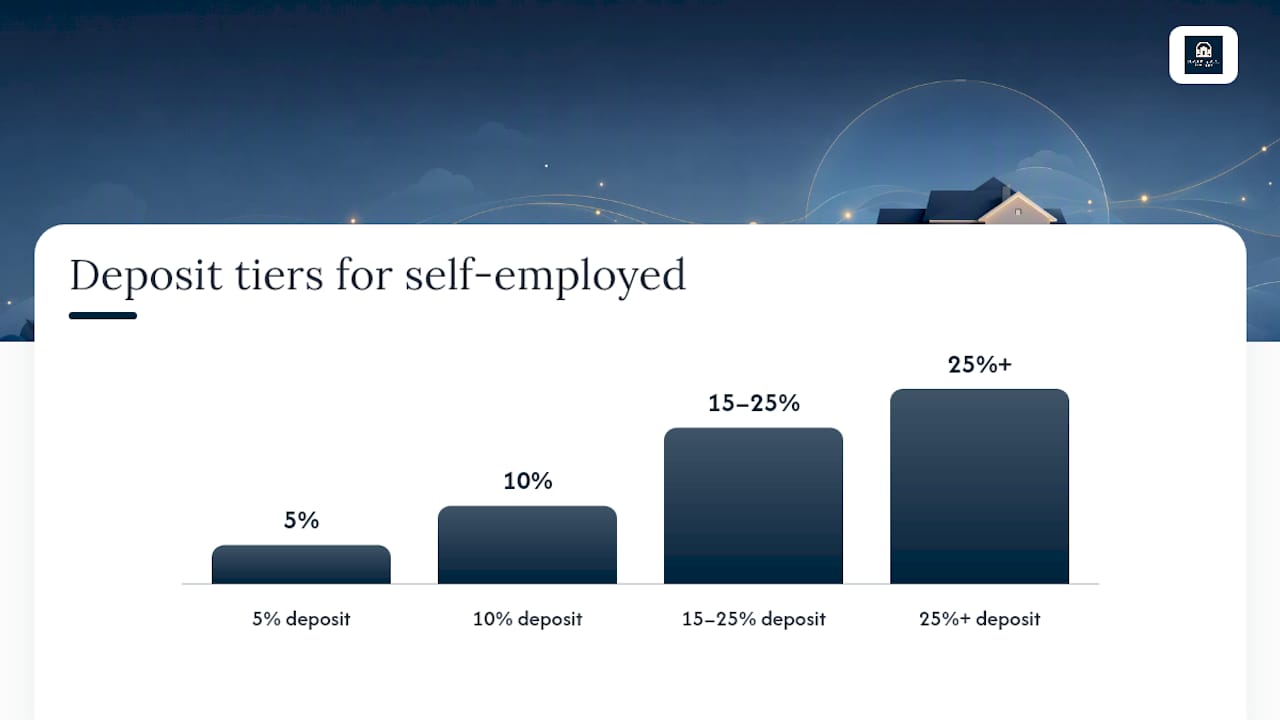
Self-employed applicants may face stricter scrutiny and sometimes need larger deposits; brokers can help find lenders that will accept non-standard income profiles. The practical reality is that a 10% deposit (90% LTV) opens significantly more lender options, and 15–25% (75–85% LTV) provides the widest choice and most competitive rates.
Deposit and LTV considerations:
- 5% deposit (95% LTV): Available from select lenders, typically requiring two years of clean accounts, strong credit history, and income that is stable or rising.
- 10% deposit (90% LTV): More lenders participate; underwriting is still thorough but the pool of available products is meaningfully larger.
- 15–25% deposit (75–85% LTV): The most accessible tier for self-employed borrowers with complex income structures or one year of accounts.
- 25%+ deposit (75% LTV and below): Strongest negotiating position; specialist lenders are more willing to consider retained profit, add-backs, or non-standard income evidence.
Pro Tip: Bank-statement mortgage products exist for borrowers who cannot or prefer not to use tax returns as their primary income evidence. These products assess income from business account deposits over 12–24 months. They carry higher rates and tighter cash-flow scrutiny, but they are a legitimate route for borrowers whose declared taxable income does not reflect their actual earnings capacity.
A specialist broker with access to the whole market, including lenders not available on the high street, is the most direct route to finding a 95% LTV product if your documentation is strong. For day-rate contractors specifically, contractor mortgage options based on annualised day rate rather than net profit can unlock higher borrowing at lower LTV thresholds.
What determines how much you can borrow?
Affordability for self-employed borrowers is assessed on the same broad framework as employed borrowers, but the income figure used is the critical variable. Lenders evaluate capacity to repay using combined evidence of income, employment history and business stability; alternative documentation can sometimes substitute for standard payslips.
The key inputs lenders assess:
- Qualifying income: Net profit (sole traders), salary plus dividends (directors), or annualised day rate (contractors), averaged over two years where applicable.
- Existing debt commitments: Credit cards, car finance, student loans, and any other mortgages. These reduce the monthly surplus available for a new mortgage payment.
- Regular business outgoings: Some lenders factor in business loan repayments or lease obligations when assessing personal affordability.
- Credit history: County Court Judgements, missed payments, or high credit utilisation will reduce available options and may affect the rate offered.
Worked affordability example
A sole trader with averaged qualifying income of £42,000 and no existing debt commitments:
- Maximum loan at 4.5x income: £189,000
- Stress-tested monthly payment (at a rate approximately 3% above the product rate, as lenders typically apply): £1,050 per month
- After subtracting estimated living costs of £1,500 per month from net monthly income of approximately £2,800, the residual is £1,300, which comfortably covers the stress-tested payment
Add a car finance commitment of £350 per month, and the residual drops to £950, which may fall below the lender's minimum affordability threshold. That single liability can reduce the maximum loan by £30,000 or more.
For limited company directors, the decision about how much salary and dividends to draw in the year before applying is worth discussing with both an accountant and a mortgage adviser. Directors who minimise drawings for tax efficiency often find their qualifying income is lower than their actual financial position suggests.
How to improve your chances as a self-employed applicant
The steps below are ordered by when to take them, not by importance. Start early and the application itself becomes straightforward.
- Check and tidy your credit file. Obtain reports from Experian, Equifax, and TransUnion. Correct any errors, pay down revolving credit balances below 30% of their limits, and avoid new credit applications in the six months before your mortgage application.
- Separate business and personal finances. A dedicated business current account makes it straightforward for lenders to verify income and distinguish personal drawings from business expenses. Mixed accounts raise underwriting questions.
- File tax returns promptly. The sooner your return is filed after 5 April, the sooner your SA302 is available. Late filing or outstanding tax liabilities are red flags for lenders.
- Instruct a qualified accountant to prepare your accounts. Lender-ready accounts are not the same as accounts prepared purely for tax minimisation. An accountant who understands mortgage underwriting can present your figures in the most accurate and acceptable format.
- Build your deposit. Every additional percentage point of deposit reduces underwriting scrutiny and opens more lender options. Aim for at least 10% before approaching lenders.
- Avoid large purchases or new credit before applying. A new car on finance, a large credit card balance, or a business loan taken out in the months before application all reduce your affordability calculation.
- Obtain an Agreement in Principle (AIP). An AIP from a lender confirms they are willing to lend in principle, subject to full underwriting. It strengthens your position when making an offer on a property and identifies any issues before you are committed.
- Prepare a year-to-date P&L and client contracts. If your income is rising, a current profit and loss statement prepared by your accountant, alongside active client contracts, gives lenders evidence that the trend is continuing.
Pro Tip: If your income fluctuated significantly due to economic disruption in recent years, an accountant's letter explaining the cause and the subsequent recovery can prevent a lender from treating the lower year as representative of your ongoing earnings capacity.
Why a specialist mortgage adviser matters for self-employed borrowers
A specialist adviser does not simply submit your application to the lender with the best advertised rate. The value is in lender selection, income packaging, and case management, particularly when your income structure does not fit a standard template.
You can get a mortgage if you're self-employed by showing consistent income over time; lenders typically request tax returns, bank statements and business records and will review credit and DTI. A specialist adviser knows which lenders in their panel are most receptive to your specific income type, whether that is retained profit for a director, annualised day rate for a contractor, or bank-statement income for a borrower with complex tax affairs.
What a specialist adviser provides:
- Access to lenders not available directly on the high street, including specialist and private banks
- Guidance on how to present SA302s, accounts, and P&L to maximise qualifying income within lender guidelines
- Negotiation on LTV and rate where your documentation supports a stronger case than a standard application would suggest
- Proactive case management to keep underwriting moving and prevent delays caused by missing or misformatted documents
- Fee transparency before you commit, so there are no surprises at completion
Questions to ask any adviser before instructing them:
- Are you regulated by the Financial Conduct Authority (FCA)?
- Do you have access to the whole market, or are you restricted to a panel?
- What is your experience with limited company directors and complex income structures?
- How are your fees structured, and when are they payable?
- What is your typical timeline from initial consultation to Agreement in Principle?
- Will I deal with one adviser throughout, or will my case be passed between team members?
Havenmarkadvisers assigns a single dedicated adviser to each client from initial consultation through to completion. For professionals with complex income, including self-employed business owners and limited company directors, this continuity reduces the risk of information being lost or misrepresented during the underwriting process. The firm's fees are set out clearly before any work begins, with the advisory fee payable upon completion rather than upfront.
Your application checklist and next steps
Before approaching a lender or broker, confirm you have the following ready:
- SA302 tax calculations for the last two complete tax years
- Full self-assessment tax returns for the same period
- Accountant-prepared business accounts for the last two years
- Year-to-date profit and loss statement (if applying mid-tax year)
- Business bank statements for the last three to six months
- Personal bank statements for the last three months
- Proof of identity (passport or driving licence)
- Proof of address (utility bill or electoral roll confirmation dated within three months)
- Evidence of deposit funds (savings statements showing the source of funds)
- For directors: dividend vouchers, company accounts, and P60
Once these are assembled, the typical timeline to an Agreement in Principle is five to ten working days with a prepared application. Full mortgage offer, subject to valuation and underwriting, typically follows within three to six weeks.
Pause your application if you are about to file a tax return that will significantly change your declared income, if you are restructuring your business, or if you have recently taken on substantial new business debt. These events affect the income and liability figures lenders assess, and applying at the wrong moment can result in a lower offer or a decline that leaves a footprint on your credit file.
Seek regulated mortgage advice before submitting any application. A regulated adviser is legally required to recommend a product that is suitable for your circumstances, which is a material protection when your income structure is non-standard.
Why we focus on paperwork and adviser-led cases
At Havenmarkadvisers, the majority of clients we work with are professionals: limited company directors, contractors, lawyers, and finance workers whose income does not arrive as a simple monthly payslip. The consistent pattern across these cases is that the quality of documentation, not the level of income, determines how smoothly an application proceeds. A director earning £120,000 per year with poorly prepared accounts will face more friction than a sole trader earning £45,000 with clean, accountant-certified records.
Our model assigns one adviser to each case from the first conversation to completion. That adviser understands the income structure, knows which lenders are appropriate, and manages the underwriting process directly. For complex income situations, that continuity is not a convenience; it is what prevents avoidable delays and misrepresentation of figures during underwriting.
Structured mortgage advice for self-employed professionals
Complex income should not mean a complex process. Havenmarkadvisers works specifically with self-employed borrowers, limited company directors, contractors, and other professionals whose income requires careful presentation to lenders.

The firm's approach is direct: one dedicated adviser assesses your income structure, identifies the most appropriate lenders from a broad panel, and manages the application through to offer. Fees are agreed transparently before any work begins and are payable upon completion. There are no referrals to junior team members mid-case and no ambiguity about what you are paying for.
If you have two years of accounts, an SA302, and a deposit ready, the next step is a structured consultation to confirm your qualifying income and identify the right lender. Visit the self-employed mortgage advice page to begin, or review the residential mortgage services page for the full scope of what the firm arranges. For fee details, the fees and how we are paid page sets out the model clearly.
Sources
- How to Get a Mortgage When You’re Self-Employed | Experian
- Self-Employed Mortgage Guide | Check Requirements & ... | Experian UK
- Self‑employed mortgages | MoneySavingExpert
- Self-Employed Mortgage Loan | Requirements 2026 | TheMortgageReports
- Gov
- Qualifying for a mortgage when you’re self‑employed | Freddie Mac (MyHome)
- How to Get a Mortgage When You’re Self‑Employed | Chase
This article is general information, not a substitute for advice from a qualified financial advisor. Consult a qualified financial professional about your own circumstances before acting on anything here.