

IMPORTANT: YOUR HOME MAY BE REPOSSESSED IF YOU DO NOT KEEP UP REPAYMENTS ON YOUR MORTGAGE.
Yes. Most Skilled Worker Visa holders can secure a UK residential mortgage, and lenders assess these applications more routinely now than they did five years ago. Whether you get an offer, and on what terms, comes down to four things: how much time is left on your visa, how established your UK credit footprint is, the size of deposit you can put down, and how stable your income and employment look on paper.
None of these factors is a hard stop on its own. A short visa runway can be offset by a larger deposit. A thin credit file can be balanced by a longer, more secure employment contract. That's the practical reality of a skilled worker visa mortgage application: lenders weigh the whole picture rather than rejecting on visa status alone, as Mortgage Bazaar's guidance on Skilled Worker Visa mortgages sets out.
The four decisive factors, in order of how much they typically move the outcome:
- Visa runway — how many months remain before your Skilled Worker Visa expires or needs renewal
- Time in the UK and credit footprint — how long you've lived here and how visible that history is to credit reference agencies
- Deposit and loan-to-value (LTV) — the percentage of the property value you can fund without borrowing
- Employment and income — contract type, probation status, sector, and how affordability is calculated
If you've been in the UK for two years or more, have a clean credit record and a 15%+ deposit, a mainstream bank is often a realistic first stop. If your visa runway is under a year, your credit file is thin, or your income includes overseas earnings, specialist lender routes and regulated advice tend to produce a smoother outcome.
Key Takeaways
Securing a UK mortgage on a Skilled Worker Visa depends on visa runway, UK credit history, deposit size, and income stability, not the visa category itself.
| Point | Details |
|---|---|
| Four decisive factors | Visa runway, UK credit footprint, deposit/LTV, and employment stability drive most lending decisions. |
| Deposit ranges vary widely | New arrivals often need 25%+, established applicants may access 10–15%, and specialist cases can reach 5%. |
| Visa runway thresholds differ | Lenders commonly want six to 24 months remaining, though this varies by lender and case. |
| Preparation reduces delays | A complete document set, including the Immigration Share Code, speeds up underwriting significantly. |
| Specialist advice adds value | Haven Mark Advisers assigns one dedicated adviser to package complex visa, contractor, or director cases properly. |
This article is general information, not a substitute for advice from a qualified financial advisor. Consult a qualified financial professional about your own circumstances before acting on anything here.
Table of Contents
- Eligibility and lender criteria for skilled worker visa mortgage applicants
- What deposit or LTV should you expect on a visa?
- How much time do you need left on your visa?
- Documents you'll need for a mortgage application
- Can you build UK credit history to strengthen your application?
- What does the application process actually look like?
- Common mistakes that lead to a mortgage refusal
- How Haven Mark Advisers supports Skilled Worker Visa applicants
- Contact Haven Mark Advisers about your visa mortgage
- Sources
- FAQ
Eligibility and lender criteria for skilled worker visa mortgage applicants
Underwriters assessing a mortgage on skilled worker visa status look past the visa category itself and focus on evidence. The visa confirms you have a legal right to reside and work in the UK; what determines the lending decision is everything else in your file.
The first thing most lenders ask for is proof of immigration status through the government's digital verification system. You generate a share code from your UK Visas and Immigration account, and the lender uses it to confirm your status and remaining visa length in real time, as explained on the Gov. This has largely replaced older paper-based checks and tends to speed up the early stages of an application considerably.
Time in the UK matters almost as much as the visa itself, because it's the main driver of your credit footprint. A borrower who arrived eighteen months ago and has a UK bank account, mobile contract, and one year of council tax payments looks very different to an underwriter than someone who landed three months ago with no UK financial history at all.
Employment stability carries real weight too. Lenders generally view these more favourably:
- Permanent contracts over fixed-term ones, especially once probation has passed
- Sectors with high sponsorship demand, such as healthcare, IT, and engineering
- A consistent employer history rather than several job changes in a short period
- Salaried roles over variable or commission-heavy pay structures, which require more evidence to average out
On affordability, most mainstream lenders apply loan-to-income multiples similar to those offered to UK nationals, commonly in the region of four to four-and-a-half times income, though this varies by lender and case. Overseas income, bonuses, and self-employed earnings are usually assessed more cautiously and may need two to three years of documented history before a lender will count them in full, a pattern HSBC's guidance for foreign nationals reflects in its own income requirements.
What deposit or LTV should you expect on a visa?
Deposit expectations for a skilled worker mortgage UK application vary more than for standard resident cases, and the band you fall into depends heavily on how established you are.

At the higher end, a new arrival with under a year in the UK and little to no credit history will typically need a deposit of 25% or more to access mainstream lending, because that larger equity cushion offsets the lender's uncertainty about your track record here. Sitting in the middle, someone with one to two years in the UK, a stable job, and a reasonably built credit file often qualifies for deposits in the 10 to 15% range with a wider pool of mainstream banks willing to lend.
At the lower end, well-documented applicants working with a specialist lender or broker can sometimes access deposits as low as 5%, though this depends on a strong overall case rather than being available by default. Optivest's 2026 guide to skilled worker visa mortgages notes that these lower-deposit routes exist but hinge on specific, well-prepared circumstances rather than being a general market standard.
HSBC's guidance indicates typical loan-to-value limits for foreign nationals around 85%, usually requiring a deposit of approximately 15% or more.
- Joint applications, particularly where one applicant is a UK national or settled resident, can sometimes soften deposit requirements by strengthening the overall credit and residency picture
- Some specialist products advertise up to 95% LTV for skilled workers in tightly defined scenarios, as Perenna's intermediary guidance describes, though these sit at the edge of what's typically available and depend on the individual lender's risk appetite
Rates also shift by LTV band.
How much time do you need left on your visa?
Visa runway is one of the most misunderstood parts of a tier 2 visa mortgage application (the Skilled Worker route replaced the old Tier 2 category, though the term still circulates widely among brokers and applicants).
Most lenders want to see a reasonable buffer between the mortgage term's early years and your visa's expiry date, because they're assessing your ability to keep meeting repayments. Guidance across the market commonly falls somewhere between six and 24 months of remaining visa length as a minimum, though this is never a fixed industry rule and differs meaningfully from lender to lender.
If your remaining time sits towards the shorter end of that range, a few things can help mitigate the risk in a lender's eyes:
- A written confirmation from your employer that they intend to renew your sponsorship
- A spouse or partner with settled status or British citizenship on a joint application
- Evidence of a long-term contract or ongoing project that extends well beyond your current visa expiry
Pro Tip: Don't apply the moment your visa renewal is filed but unresolved. Waiting until you have the new visa confirmed, even if it delays your house hunt by a few weeks, often opens up a wider pool of lenders than trying to explain a pending renewal mid-application.
Documents you'll need for a mortgage application
Preparation makes the biggest practical difference to how smoothly a housing options for visa holders application moves. Gather these before you contact a lender or adviser:
- Passport and Immigration Share Code — generate this through your GOV.UK account so lenders can verify your visa status and remaining length instantly.
- Three to six months of payslips — or full accounts and tax returns if you're self-employed or run a limited company.
- Three to six months of bank statements — showing salary deposits, regular outgoings, and no undisclosed financial commitments.
- Proof of deposit source — savings history showing how the funds accumulated, or a signed gifted deposit letter if a family member is contributing.
- Overseas funds documentation — if any deposit money originates abroad, expect to provide translated statements and a clear paper trail showing where it came from.
- Employment contract or sponsorship confirmation — particularly important if you're still within a probation period.
Limited company directors and contractors face an extra layer here. Their evidence typically includes two to three years of company accounts, an accountant's reference, and sometimes a day-rate contract history, since income calculation for this group works differently to salaried PAYE staff.
Can you build UK credit history to strengthen your application?
Yes, and it's one of the few parts of this process entirely within your control. Lenders read a "thin file" as uncertainty, not risk, and there are concrete steps that close that gap within a matter of months rather than years.
Opening a UK current account, taking out a mobile phone contract in your own name, putting household utilities into your name, and registering on the electoral roll where you're eligible all feed into your credit file. A credit-builder card used lightly and repaid in full each month adds a further, faster signal of reliability. Most of these show measurable improvement within three to six months of consistent use.
Employer permanence plays into this too. Working in a sector with strong sponsorship demand, such as healthcare or engineering, tends to reduce a lender's perceived risk compared with roles seen as more precarious, even where the underlying visa terms are identical.
Before you formally apply anywhere, it's worth having a broker or adviser run a soft, pre-vetting check against likely lenders rather than submitting several applications yourself. Multiple hard credit searches in a short window can itself damage your file, which is exactly the outcome you're trying to avoid.
- Open a UK current account and use it as your main account for salary and bills
- Put at least one utility and your mobile contract in your own name
- Use a credit-builder card sparingly and clear the balance monthly
- Register on the electoral roll if your visa status permits it
Pro Tip: Ask whoever is assessing your case to run a soft search first. A single hard search from the wrong lender, done too early, can sit on your file and complicate a stronger application a few months later.
What does the application process actually look like?
Getting a mortgage for skilled migrants moving involves a fairly standard sequence, though visa-holder cases tend to carry a few extra checkpoints.
- Agreement in Principle (AIP). This gives you an estimate of how much you can borrow based on an initial credit and income check, and it's what estate agents expect to see before taking your offer on a property seriously.
- Full application submission. This is where your visa evidence, income documents, and deposit proof all get formally reviewed by the lender's underwriting team.
- Underwriting. The lender verifies everything submitted, checks your Immigration Share Code, and may request further clarification on income, deposit source, or employment terms.
- Valuation and offer. Once satisfied, the lender values the property and issues a formal mortgage offer, at which point your solicitor can proceed to exchange and completion.
For visa-holder cases specifically, the most common bottleneck is documentation, particularly around overseas income or deposit funds that need extra verification. Timelines for a well-prepared case typically run in a similar window to standard applications, though incomplete evidence packages can add several weeks of back-and-forth. A specialist broker's practical value here lies in selecting lenders whose criteria genuinely fit your circumstances upfront and packaging your evidence correctly the first time, which cuts down the queries that otherwise stretch out underwriting.
Common mistakes that lead to a mortgage refusal
Refusals rarely come down to the visa alone. They tend to come from avoidable gaps in the evidence.
- Thin credit file combined with multiple hard searches. Applying to several lenders directly, rather than through a single soft-searched route, can compound an already weak file.
- Short visa runway with no mitigation offered. Submitting an application with under six months remaining and no employer renewal confirmation is a common reason for decline.
- Unclear deposit source. Large, unexplained deposits, particularly from overseas, routinely trigger further checks or refusal if the paper trail isn't complete.
- Recent job changes or undisclosed overseas financial commitments. Both raise questions about affordability that lenders would rather not have to chase after submission.
A refusal isn't necessarily final. It usually means the case was presented to the wrong lender, or with gaps that another lender wouldn't flag in the same way. The safest next step is usually a pause to strengthen the file, rather than reapplying elsewhere immediately.
How Haven Mark Advisers supports Skilled Worker Visa applicants
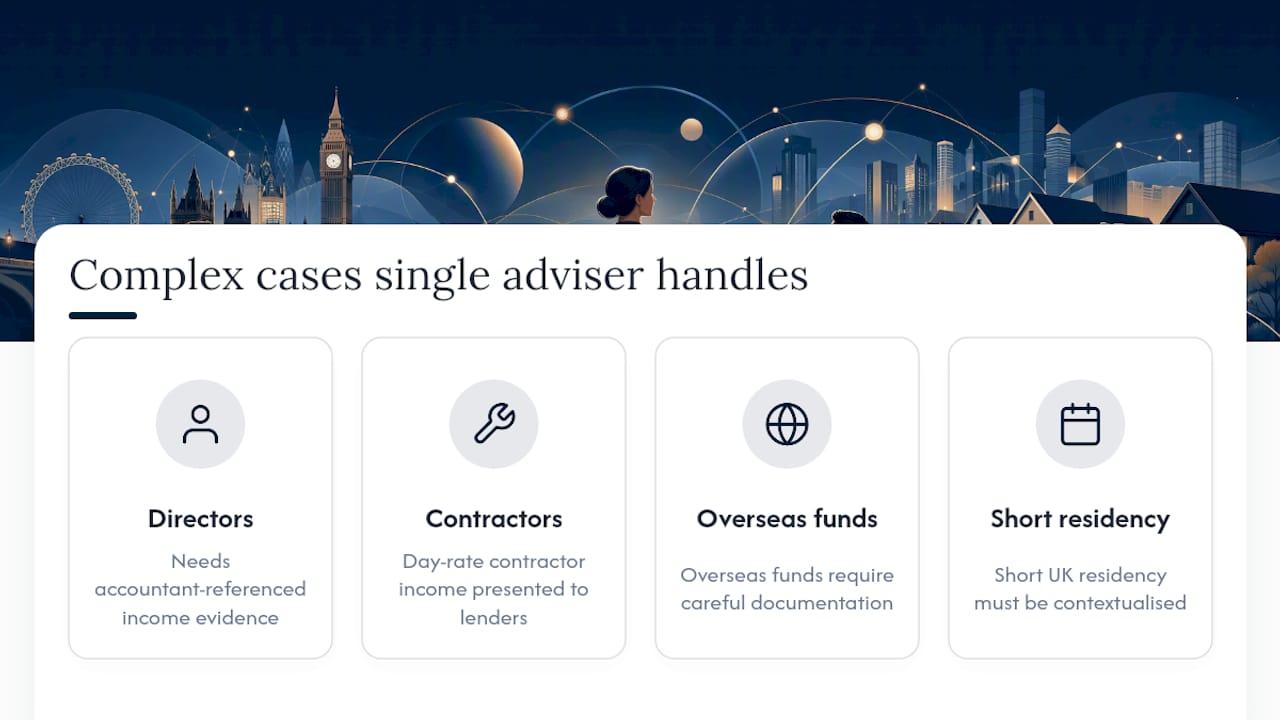
Complex visa cases rarely fit neatly into a single lender's standard criteria, which is exactly where a structured, single-adviser approach earns its keep. Haven Mark Advisers assigns one dedicated adviser to your case from the first conversation through to completion, rather than passing you between departments as your file moves through different stages.
That matters most for the kinds of cases that don't fit a simple template: limited company directors whose income needs proper accountant-referenced presentation, contractors working day rates, applicants with overseas funds requiring careful documentation, and those with shorter UK residency histories that need contextualising properly to the right lender.
A single point of contact who understands your full case, from visa runway to income structure, tends to catch the documentation issues that cause delays before a lender ever sees them.
Haven Mark Advisers operates on a transparent, fee-based model, with clients paying a set fee on completion of a purchase or remortgage; the firm may also receive commission from lenders. All advice is regulated, and the standard mortgage warning applies to every case: your home may be repossessed if you do not keep up repayments on your mortgage. No adviser can guarantee eligibility, acceptance, or the rate you'll be offered, and outcomes always depend on individual lender criteria at the time of application.
For company directors specifically, guidance on getting a mortgage as a limited company director sets out how that income evidence differs from standard PAYE cases.
Contact Haven Mark Advisers about your visa mortgage
If you've read this far, you already know that a skilled worker visa mortgage is genuinely achievable but rarely straightforward to navigate alone, particularly when your income, residency history, or deposit source doesn't fit a standard template. Where a mainstream bank branch might turn down a case for not fitting its narrow criteria, Haven Mark Advisers' dedicated adviser model means one person builds your evidence package properly from the start and matches it to lenders whose criteria actually fit your situation.
That single point of contact is particularly valuable if your case touches on overseas income, a shorter UK residency history, or self-employed or contractor earnings, all situations that tend to generate repeated queries when handled by generalist teams. Haven Mark Advisers works on a transparent, fee-based structure, with the fee payable on completion, and every case remains subject to individual lender assessment. Visit the dedicated UK visa and foreign national mortgages page to see how the process works for Skilled Worker Visa holders specifically, or get in touch to discuss your circumstances with an adviser directly.
Remember: your home may be repossessed if you do not keep up repayments on your mortgage, and no outcome, rate, or acceptance can ever be guaranteed in advance.
Sources
- Mortgages for foreign nationals who live in the UK — HSBC
- Skilled Worker Visa Mortgage: A 2026 Guide — Optivest
FAQ
Can I buy a house in the UK on a Skilled Worker Visa?
Yes, most Skilled Worker Visa holders can buy a house in the UK, subject to lender assessment of visa runway, deposit, credit footprint, and income, as outlined by Mortgage Bazaar.
Can I get a £300,000 mortgage on a £50,000 salary?
Borrowing potential depends on the lender's income multiple, commonly around four to four-and-a-half times salary for many mainstream lenders, and affordability checks, deposit size, and existing debts all affect the final figure.
How long do I need to live in the UK to get a mortgage?
There's no single legal minimum, but many lenders look for at least one to two years of UK residency and credit history to access mainstream rates, though specialist lenders sometimes work with shorter timeframes given strong supporting evidence.
Can I get a mortgage in the UK if I have foreign income?
Yes, but foreign income is usually assessed more cautiously than UK-based salary, often requiring two to three years of documented history, and Haven Mark Advisers' dedicated adviser model is designed to package this kind of evidence clearly for the right lender.
Recommended
- UK Visa & Foreign National Mortgages | Haven Mark Advisers
- Haven Mark Advisers - Who we help
- etting a mortgage as a limited company director
- Mortgages for the Self-Employed & Business Owners | Haven Ma
This article provides general information only and does not constitute personalised mortgage advice. Mortgage availability, affordability and lender criteria depend on individual circumstances and may change. Please seek advice tailored to your circumstances before acting on this information.