

IMPORTANT: YOUR HOME MAY BE REPOSSESSED IF YOU DO NOT KEEP UP REPAYMENTS ON YOUR MORTGAGE.
Yes, you can get a mortgage on a zero hours contract. It is harder than applying with a fixed salary, and some lenders will turn you away outright, but a growing number of building societies and specialist lenders assess zero-hours income every week and lend against it.
The outcome depends on evidence, not on the label your employer puts on your contract. Lenders want to see a track record of earnings that looks stable enough to survive a bad month, and they want it in black and white: payslips, bank statements, a P60, sometimes a letter from your employer confirming how long you have worked there. Get that evidence in order before you approach anyone, and the zero-hours label stops being the obstacle it first appears.
Typical acceptance scenarios:
- You have worked the same shifts for the same employer for 12 months or more, with earnings that barely move month to month.
- You have a second income, whether from a partner's salary or a part-time PAYE job, that supports the application.
- You can put down a deposit sufficient to widen the pool of lenders willing to consider you.
- You have a guarantor or a joint applicant with stable, provable income.
Typical rejection scenarios:
- Your contract started recently, without a substantial tenure in the role.
- Your bank statements show irregular, unpredictable credits with no clear pattern.
- You have missed payments, defaults or an unresolved credit issue in the last two years.
- You have no supporting income and are applying alone with a small deposit.
Do these five things today, and you will be in a stronger position within a week:
- Pull your last few months of payslips and put them in date order.
- Download as many months of bank statements as you have.
- Find your most recent P60 and check it matches your expected earnings.
- Add up your gross income over the last 12 months and work out a monthly average.
- Book an appointment with an FCA-regulated mortgage adviser who has handled zero-hours cases before.
Key Takeaways
Zero-hours workers can secure a mortgage when they present 12 to 18 months of consistent income evidence, a suitable deposit, and, where needed, regulated advice to navigate manual underwriting.
| Point | Details |
|---|---|
| Build your evidence file | Collect payslips, bank statements and your P60 covering at least the last 12 months. |
| Average your income honestly | Calculate your monthly average over 3, 6 and 12 months so you can match different lenders' methods. |
| Target a stronger deposit | Aim for a larger deposit where possible, since it widens your lender choice and can improve pricing. |
| Get regulated advice early | An FCA-regulated adviser tracks which lenders currently accept zero-hours income and at what terms. |
| Work with a specialist when income is complex | Haven Mark Advisers assigns one dedicated adviser to package zero-hours and mixed-income cases for manual underwrite. |
Table of Contents
- What lenders mean by a zero hours contract mortgage
- What lenders look for from zero hours contract lending
- Documents you need for a zero hours employment mortgage
- Deposit size and how it affects your options
- How to strengthen a zero hours contract mortgage application
- Should you use a broker for agency worker or zero hours mortgages?
- How Haven Mark Advisers supports zero hours contract lending
- The impact of zero hours contracts on mortgage interest rates and terms
- How lenders assess future income volatility
- Alternatives if a standard mortgage does not fit
- Common lender-specific policies to check
- How changing employment legislation could affect eligibility
- Adverse credit, fixed terms and buy-to-let considerations
- How self-employed and CIS income is treated differently
- What matters most when you actually apply
- Get regulated advice for your zero hours contract mortgage
- Frequently asked questions
- Sources
What lenders mean by a zero hours contract mortgage
A zero-hours contract means your employer has no obligation to offer you a minimum number of hours, and you have no obligation to accept the hours they do offer. That flexibility is exactly what makes lenders nervous. Underwriters are not judging your work ethic. They are trying to answer one question: if you lost every hour tomorrow, could you still make the repayments?
That question sits behind every mortgage decision, but it gets asked more forcefully when your payslip total changes every month. Lenders do not treat all non-standard employment the same way. Some fold zero-hours PAYE workers into ordinary affordability checks with a longer evidence window. Others send the case straight to a specialist underwriter, and a handful decline zero-hours income altogether unless there is a second income backing it up.
| Employment type | Typical evidence expected | Typical lender stance |
|---|---|---|
| PAYE, fixed hours | 3 months' payslips | Standard automated assessment |
| Zero-hours PAYE | 12 to 18 months' payslips, bank statements, P60 | Often manual underwrite, sometimes averaged at a reduced percentage of earnings |
| Agency or umbrella worker | Contract, remittance advices, bank statements | Treated similarly to zero-hours, evidence period varies by agency |
| Self-employed | 2 years' SA302s and tax overviews | Standard self-employed criteria, income averaged over 2 to 3 years |
| CIS subcontractor | CIS statements, remittances, tax returns | Assessed under self-employed rules, not zero-hours rules |
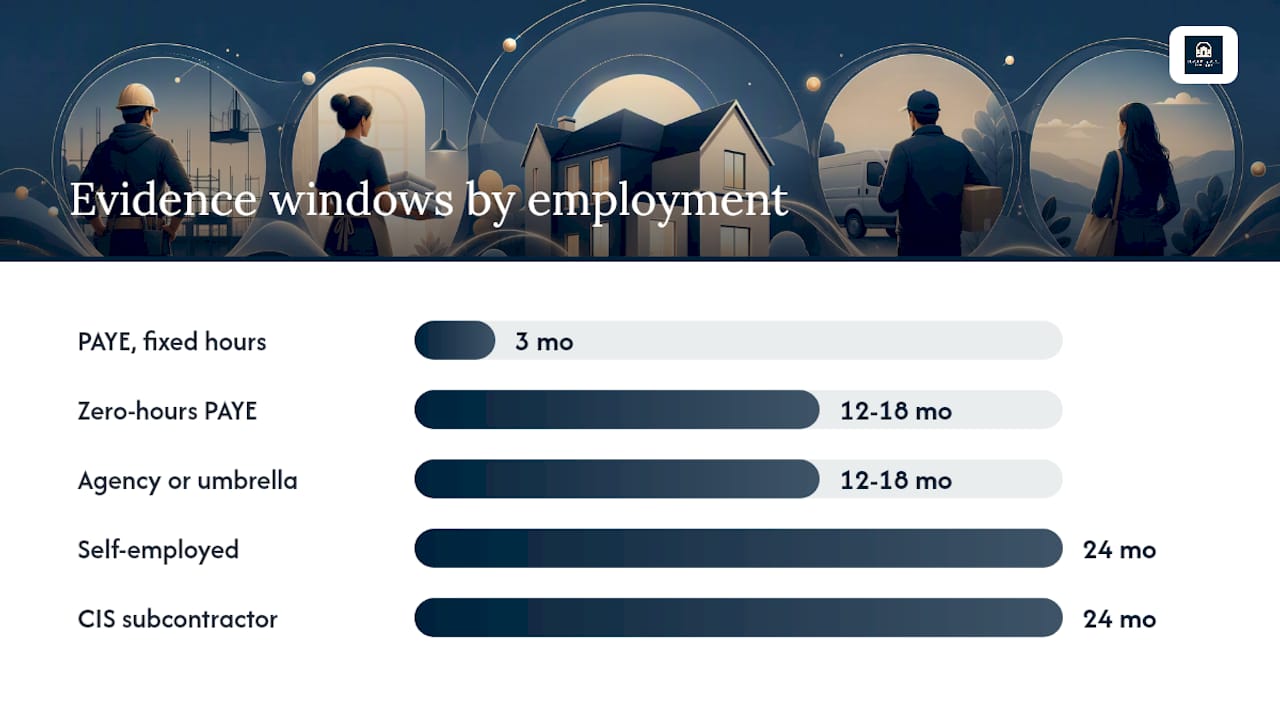
Employment law and mortgage underwriting are two different systems. Your contract might legally class you as an employee with full rights, but a lender's risk model does not care about your legal status. It cares about whether your bank statements show money landing reliably, month after month. That distinction trips up a lot of applicants who assume being "employed" on paper guarantees standard treatment.
What lenders look for from zero hours contract lending
Lenders will consider zero-hours income, but how they assess it varies enormously between providers. Some, like Accord, will accept it at a reduced percentage of gross earnings, commonly around 60%, for applicants in specified occupations such as NHS bank nurses, care workers, supply teachers or HGV drivers, provided there is at least 12 months of sustainable earning history. Others take a far more cautious line. Darlington Building Society's lending manual states it will only consider zero-hours income where there is another income source or a secondary applicant, and it demands continuous contracts for a full year plus at least three months in the current role.
Here is what most underwriters will check, in roughly the order they check it:
- Minimum evidence period: commonly 12 months, occasionally stretching to 18 months for the most cautious lenders.
- Income averaging method: earnings averaged over 3, 6 or 12 months depending on the lender and how consistent your pattern looks.
- Bank statement behaviour: regular credits, no returned direct debits, sensible spending relative to income.
- Credit record: missed payments, defaults or high existing debt will count against you regardless of employment type.
- Deposit size: a bigger deposit softens the risk picture and opens up more lenders.
- Employment continuity: how long you have been with the same employer, in the same role or industry.
Automated decisioning systems are built around predictable PAYE income, so they often flag zero-hours applications for manual review rather than approving or declining them instantly. That is not a bad thing. A manual underwriter can actually read your bank statements, spot the pattern in your shifts, and make a judgement call that a computer would miss. Mortgage Bridge notes that lenders commonly average earnings over windows of three to twelve months and lean heavily on bank statements when income is irregular.
Minimum evidence periods for zero-hours applicants typically sit between 12 and 18 months, with the shorter end reserved for applicants who have a long, unbroken history with the same employer.
Pro Tip: If a lender asks for 18 months' history rather than 12, do not read it as a rejection in waiting. A longer window actually works in your favour if your earnings have been broadly stable, because it gives the underwriter more data to smooth out one or two quiet months.
Documents you need for a zero hours employment mortgage
The primary documents almost every lender wants are payslips, bank statements and a P60. Beyond that baseline, what counts as acceptable evidence shifts depending on how you are paid.
| Employment type | Documents commonly accepted |
|---|---|
| Zero-hours PAYE | Payslips (3 to 12 months), P60, bank statements, employer confirmation letter |
| NHS bank or locum worker | Payslips, bank statements, timesheet history, trust confirmation letter |
| Agency worker | Contract, remittance advices, bank statements, agency confirmation |
| Self-employed or CIS | SA302s, tax year overviews, CIS statements, business bank statements |
When it comes to bank statements, underwriters are not just totting up totals. They are looking for regular credits that match your payslips, a visible shift pattern (weekly or fortnightly payments that vary but stay within a believable range), and evidence of overtime or extra shifts that boosts your average without looking like a one-off windfall. A single unexplained large deposit can raise more questions than it answers, so keep a note of where unusual credits came from.

Pro Tip: Write a short covering letter, no more than half a page, that explains your income pattern in plain terms. Say how long you have worked for your employer, roughly how many hours you get each week, and point the underwriter to the specific months in your bank statements that show the pattern. It takes ten minutes to write and can save weeks of back-and-forth queries.
If you are paid through CIS rather than PAYE, your evidence set looks completely different. You will need SA302s and tax year overviews instead of payslips, and Darlington's criteria treat subcontractors as self-employed for assessment purposes, not as zero-hours PAYE workers. Readers with mixed income streams often benefit from advice tailored to self-employed and business owner applications alongside their PAYE evidence.
Deposit size and how it affects your options
A bigger deposit improves your chances and widens your choice of lender, full stop. At 5% deposit you are relying on a small pool of lenders willing to take on higher-risk, higher-LTV cases with variable income. At a larger deposit, you start to look like a much safer bet on paper, even with the same zero-hours contract underneath.
Lenders convert your variable pay into a single affordability figure by averaging your income, usually over 3, 6 or 12 months, then applying an income multiple and a stress rate that tests whether you could cope if interest rates rose. If your contract states a small number of guaranteed hours, some lenders will use that guaranteed minimum as a floor and treat anything above it more cautiously.
Deposit size also shapes what interest rate and product range you are offered. Smaller deposits on non-standard income often mean higher rates and a shorter list of willing lenders, simply because the lender is taking on more risk at both ends: high loan-to-value and unpredictable income.
A few concrete actions shift the affordability maths in your favour:
- Raising your deposit can unlock a meaningfully wider lender panel.
- Clearing credit card balances or personal loans before applying reduces your monthly outgoings, which improves your affordability score.
- Correcting errors on your credit file, or simply waiting out a minor blip from a year ago, can move you into a better risk band.
- Registering on the electoral roll at your current address if you have not already, since some lenders flag this automatically.
How to strengthen a zero hours contract mortgage application
The fastest-impact actions are raising your deposit, proving a recent run of income showing consistency, cutting non-mortgage debt, and working with a regulated adviser who has handled cases like yours before. Order matters here, because each step builds on the last.
- Gather and order your evidence. Payslips oldest to newest, twelve months of bank statements, your P60, and your employment contract if you have one.
- Calculate your averaged income and run a rough affordability check. Work out your monthly average over 3, 6 and 12 months separately, since different lenders will use different windows.
- Fix anything on your credit file. Dispute errors, pay down small outstanding balances, and avoid opening new credit in the months before you apply.
- Consider a guarantor or a joint applicant. Darlington's policy explicitly notes zero-hours income is considered only where there is another income source or a secondary applicant, so this route can move you from decline to approval.
- Prepare a clear bank statement narrative. Highlight the months that best represent your typical pattern and be ready to explain any anomalies.
Underwriters watch for specific red flags: returned direct debits, sudden large one-off credits with no explanation, and short tenure with your current employer. Each of these can be mitigated with context. A bounced payment from eighteen months ago, explained in your covering letter, reads very differently to an underwriter than one from last month with no explanation attached.
Pro Tip: Timing matters more than most applicants realise. If you know the next three months will show a representative, steady run of shifts, it is often worth waiting to apply until that period is banked in your statements rather than applying mid-way through a quiet patch.

Should you use a broker for agency worker or zero hours mortgages?
An FCA-regulated mortgage adviser is worth using for zero-hours cases, because manual underwriting, lender access and case packaging are exactly where specialist knowledge pays off. A generalist high-street advisor might know two or three lenders that consider zero-hours income. A specialist adviser tracks which lenders currently accept it, at what percentage, and under what conditions, because those policies shift regularly.
A good adviser or broker typically provides:
- Lender matching based on your specific employment type and income pattern.
- Packaging your case and liaising directly with the underwriter on your behalf.
- Checking your documentation before submission, so gaps get fixed before they cause a delay.
- Bespoke affordability modelling that reflects how a particular lender will actually average your income.
Before you commit to anyone, ask a handful of direct questions:
That last question matters more than it sounds. A case that gets handed between three different advisers loses context every time it changes hands, and a zero-hours case depends heavily on context.
On fees: a set fee paid on completion can be genuinely cost-effective if it increases your chance of acceptance or gets you access to a rate you would not have found alone. The HomeOwners Alliance points to specialist advice as a practical route for zero-hours applicants precisely because lender criteria vary so much and change without much public notice.
How Haven Mark Advisers supports zero hours contract lending
Haven Mark Advisers works with professionals and applicants who have complex or non-standard income, and zero-hours cases fall squarely into that category. Every client is assigned one dedicated adviser from first enquiry through to completion, so your case history and the details of your employment do not have to be re-explained to a new person at every stage.
This service tends to suit applicants who fall into one of three groups: those with genuinely complex income (mixed PAYE and self-employed earnings, for instance), those whose case needs manual underwriting because automated systems keep flagging it, and those who simply want one point of contact rather than being shuffled between departments. Haven Mark Advisers' who-we-help page sets out the full range of client profiles the firm supports.
If you want to move forward, the next step is straightforward: get in touch to arrange a case review, bring the documents outlined earlier in this article, and your dedicated adviser will map out which lenders are realistically open to your circumstances. Fees are charged on completion, and the structure is explained upfront rather than buried in small print, as set out on the fees page. For London-based applicants specifically, the residential mortgages service is the natural starting point.
The impact of zero hours contracts on mortgage interest rates and terms
Zero-hours income does not automatically mean a worse rate, but it often means a narrower choice of products, and narrower choice tends to push the rate up. Lenders who accept zero-hours applicants frequently price that acceptance into the deal, either through a slightly higher rate than their best buy for standard PAYE applicants or through a requirement for a larger deposit to access their standard rates at all.
Terms can also differ in less obvious ways. Some lenders cap the loan-to-value they will offer zero-hours applicants even when they would go higher for conventional PAYE income. Others restrict the mortgage term length or insist on a repayment mortgage rather than interest-only. None of this is fixed across the market. It varies lender by lender, which is precisely why checking individual lender criteria before applying saves wasted credit searches.
How lenders assess future income volatility
Underwriters are not just looking backwards at what you have earned. They are trying to estimate how likely your income is to hold steady, or fall, over the life of the mortgage. That forward-looking judgement is why occupation matters almost as much as the contract type itself. A zero-hours NHS bank nurse or supply teacher, working in sectors with consistent demand, is generally viewed more favourably than someone in a sector prone to sudden hour cuts.
Lenders also weigh how long zero-hours arrangements have existed in your specific role or industry. A pattern stretching back several years, even with fluctuation, reads as more stable than six months of data, however strong those six months look. Some underwriters will also check whether your sector has had recent redundancies or hour reductions reported, folding wider economic context into an individual decision.
Alternatives if a standard mortgage does not fit
If a mainstream mortgage proves difficult, several structures are designed for exactly this kind of income uncertainty.
Guarantor mortgages let a family member (usually a parent) offer their income or property as security, which can offset the risk lenders associate with zero-hours income and often allows a smaller deposit. Joint applications with a partner or family member whose income is more predictable work on a similar principle, and Darlington's policy explicitly allows zero-hours income where a secondary applicant supports the case.
Shared ownership is worth considering too. You buy a percentage of a property, typically between 25% and 75%, and pay rent on the remainder to a housing association. Because you are borrowing against a smaller share, the mortgage itself is smaller, which softens the affordability pressure that variable income creates.
None of these routes are automatically better than a standard mortgage. They are options that widen the door when the door looks closed, and a regulated adviser can tell you quickly which one, if any, actually applies to your situation.
Common lender-specific policies to check
Every lender writes its own rulebook, and the differences between them are larger than most applicants expect. Some, like Accord, publish a specific percentage of earnings they will accept, alongside a defined list of occupations they view favourably for zero-hours applications. Others, including Darlington, require zero-hours income to be backed by a second income source before they will consider it at all, and separately demand a full year of continuous contracts plus three months in the current role.
A handful of building societies, such as Suffolk Building Society, publish dedicated guidance pages for zero-hours applicants, setting out exactly what evidence they expect. That level of transparency is not universal. Many lenders simply decline zero-hours applications by default unless a broker specifically flags a case for manual underwrite, which is one of the strongest arguments for working with an adviser who tracks these policies rather than applying cold to a random high-street name.
How changing employment legislation could affect eligibility
Zero-hours contracts have been the subject of ongoing government attention including proposals aimed at improving job security and predictability of hours for workers on flexible contracts. If future legislation requires employers to offer more predictable hours or guaranteed minimums after a qualifying period, that could gradually shift how lenders view this type of income, since more predictable hours generally mean more predictable pay.
Any such change would take time to filter through to lender policy. Underwriting criteria tend to lag behind employment law by months or years, because lenders build affordability models on historical evidence, not on how the law is expected to change. For now, treat your application on the basis of current lender criteria rather than anticipated reform, and revisit the picture with an adviser if your contract terms change.
Adverse credit, fixed terms and buy-to-let considerations
If you have adverse credit alongside a zero-hours contract, the two issues compound rather than simply add up. Lenders who might tolerate one on its own often decline when both appear together. That said, specialist lenders exist for adverse credit cases, and pairing that route with a larger deposit and a clean recent track record can still get you to approval.
Fixed-term contracts sit in a slightly different category to zero-hours arrangements. Lenders generally want to see the contract has been renewed at least once, or that there is a strong likelihood of renewal, before treating fixed-term income as reliable.
Buy-to-let applications add another layer, because many buy-to-let lenders assess affordability primarily against the property's rental income rather than your personal earnings. That can actually work in favour of some zero-hours applicants, since your own income becomes a secondary factor rather than the primary test, though a minimum personal income threshold usually still applies. For those weighing this route, a buy-to-let mortgage review with an adviser will clarify which lenders' rental coverage requirements you can realistically meet.
How self-employed and CIS income is treated differently
If you are paid through CIS or work as a subcontractor, lenders assess you under self-employed criteria, not zero-hours PAYE rules. That means SA302s and tax year overviews replace payslips as your core evidence, and most lenders want two to three years of accounts rather than 12 to 18 months of payslips.
This distinction catches people out. A CIS subcontractor might describe their work informally as "zero-hours" because their workload varies week to week, but the lender will never apply zero-hours PAYE criteria to that income. Day-rate contractors face a similar mismatch between how they describe their work and how a lender categorises it, which is exactly the kind of detail a specialist adviser catches early rather than discovering it after a declined application.
What matters most when you actually apply
The conventional advice on zero-hours mortgages tends to fixate on the wrong variable. Most guides tell you to focus on your deposit, and a bigger deposit genuinely helps, but deposit size is not the thing that gets a zero-hours application declined in the first place. Weak, inconsistent documentation is. I have seen the underlying research repeatedly point to bank statement behaviour and evidence quality as the deciding factor, not the raw percentage you put down.
Where the conventional advice really falls short is in treating "zero-hours" as a single category. It is not. An NHS bank nurse with three years in the same trust and a supply teacher who has worked four different agencies in eight months are both technically zero-hours, but no sensible underwriter treats them the same, and no sensible applicant should expect to be treated the same either. If your zero-hours history is genuinely erratic, the honest priority is not chasing a bigger deposit. It is building three to six months of the steadiest, best-documented earnings you can manage before you apply at all.
What should the reader prioritise first? Not the mortgage application itself. The paperwork. Get your payslips, bank statements and P60 in order, write the covering letter explaining your pattern, and only then start approaching lenders or an adviser. Applicants who do the documentation work first consistently move faster through underwriting than those who apply first and scramble to produce evidence afterwards.
Get regulated advice for your zero hours contract mortgage
Haven Mark Advisers is built for exactly the kind of case a standard high-street branch struggles with: one adviser, from first enquiry to completion, who understands how to package variable income so an underwriter can say yes with confidence.

Where a generic broker might run your details through a comparison tool and hand you a list of lenders, your Haven Mark Advisers adviser reviews your actual payslips and bank statements, identifies which lenders currently accept your specific pattern of zero-hours earnings, and manages the case through manual underwriting rather than leaving you to interpret a computer-generated decline. That single point of contact matters when your case needs context a form cannot capture. Fees are charged on completion and explained clearly from the outset, with no surprise costs partway through.
If you have at least a rough run of payslips and bank statements to hand, the next step is to book a case review through the residential mortgages page and let your dedicated adviser tell you, realistically, which lenders will consider your situation.
Frequently asked questions
Can you get a mortgage with a zero-hours contract in the UK? Yes. Lenders assess it as non-standard income and typically want 12 to 18 months of evidence, but specialist lenders and building societies accept it regularly.
How much deposit do I need for a zero hours contract mortgage?
Do all lenders treat agency worker mortgage applications the same way as zero-hours? No. Agency workers are often assessed similarly, but evidence requirements vary by agency and by lender, so check individual lender criteria before applying.
Will a guarantor help my mortgage options for zero hours applicants? Yes, in many cases. Some lenders, including Darlington, will only consider zero-hours income where a guarantor or secondary applicant supports the case.
Is it worth using a broker for zero hours contract lending? Generally yes, because specialist advisers track which lenders currently accept zero-hours income, at what percentage, and how to package the case for manual underwriting.
This article is general information, not a substitute for advice from a qualified financial advisor. Consult a qualified financial professional about your own circumstances before acting on anything here.
Sources
- Contractors Information | Accord Mortgages
- Lending manual 3.29
- Can You Get a Mortgage with Irregular Income or a Zero-Hour Contract? | Mortgage Bridge Explains - Welcome to Mortgage Bridge | Bad Credit and Low Credit Score Mortgages Specialist
- Zero Hour Contract Mortgages
- Zero Hour Contract Mortgages