

IMPORTANT: YOUR HOME MAY BE REPOSSESSED IF YOU DO NOT KEEP UP REPAYMENTS ON YOUR MORTGAGE.
A single late mortgage payment does not mean you will lose your home. Lenders must follow FCA rules under MCOB 13 and formal pre-action steps before any court action, which takes months, not days. The action that matters now is simple: contact your lender straight away and speak to a free debt adviser through MoneyHelper or Citizens Advice, or an FCA-regulated mortgage adviser if your situation is complex.
TL;DR:
- Lenders must provide written arrears information within 15 business days of a missed payment, including options and signposting to free debt advice.
- Contact your lender immediately, gather supporting documents, and make a partial payment if possible, to demonstrate willingness to resolve arrears.
- Forbearance options like term extension, interest-only payments, or capitalising arrears depend on individual circumstances and are not guaranteed.
- Breathing space offers up to 60 days of protection from enforcement if arranged through a qualified adviser, but does not stop arrears from increasing or court action.
- Usually, a late payment affects your credit report only if it exceeds 30 days, after which the record can stay for six years, highlighting the importance of timely action.
Table of Contents
- What your lender must do under FCA rules after a late payment mortgage issue
- What to do in the first 30 days after a missed mortgage payment
- Forbearance options a mortgage lender may offer
- Breathing space and the Pre-Action Protocol explained
- How a late mortgage payment affects your credit file
- How long does it take to go from missed payment to repossession?
- Preparing a repayment offer for your lender or a court hearing
- Where to get free debt and legal advice on mortgage arrears
- How Haven Mark Advisers supports clients through mortgage arrears
- Speak to Haven Mark Advisers about your mortgage situation
- Sources
- FAQ
What your lender must do under FCA rules after a late payment mortgage issue
Lenders are bound by MCOB 13, the FCA's rulebook covering arrears and repossessions. It requires firms to treat customers fairly and to explore forbearance before considering repossession, which the rules treat as a last resort.
Once a payment is missed, your lender must send written arrears information within 15 business days. That notice generally covers:
- The total arrears balance and any charges applied.
- Signposting to the free MoneyHelper "Problems paying your mortgage" information, which MCOB specifically requires.
- An explanation of the options available to you and how to get in touch.
Lenders also face limits on how often they can attempt to collect via direct debit, and firms are expected to send regular statements while arrears remain outstanding. None of this means action is imminent. It means the process is regulated, documented, and slower than most people fear.
What to do in the first 30 days after a missed mortgage payment
The early weeks after a mortgage payment delay shape how the rest of the case goes. Charities including Shelter consistently find that borrowers who act quickly get better outcomes than those who wait for the lender to chase them.
- Call your lender immediately. Explain what happened, ask what forbearance options exist, and request written confirmation of anything agreed.
- Build a simple budget. List income against essential outgoings so you know exactly what you can realistically offer.
- Gather your paperwork. Bank statements, payslips, and benefit correspondence all help your lender assess your case fairly.
- Pay something if you possibly can. Even a partial payment shows willingness and can shape how a lender records the arrears.
Pro Tip: Keep a written log of every call: date, time, who you spoke to, and what was agreed. If the case escalates, that log becomes evidence your lender has been engaging with you reasonably.
Avoid clearing arrears with high-cost credit or payday loans. Mortgage arrears are a priority debt, and swapping them for unsecured, high-interest borrowing usually makes your overall position worse.
Forbearance options a mortgage lender may offer
Once your lender has your full picture, several standard forbearance tools may come into play. Each buys breathing room, but each carries a different long-term cost.
- Term extension. Stretching the mortgage term lowers monthly payments but increases the total interest paid over the life of the loan.
- Temporary interest-only switch. Many lenders allow a fixed period where you pay interest only, which lowers outgoings without a formal remortgage.
- Capitalising the arrears. Adding missed payments to the mortgage balance clears the arrears but increases what you owe overall. MCOB requires lenders to check this will not cause material harm before agreeing it.
- Payment holidays. A short pause on payments can ease an immediate cash crisis, but the missed amounts still need repaying and the arrangement can affect your mortgage payment assistance record with the lender.
None of these are guaranteed. What a lender offers depends on your circumstances, the specific product, and its own lending criteria, so it is never safe to assume one option applies universally across the market.
Breathing space and the Pre-Action Protocol explained
Two legal protections sit behind these conversations, and few homeowners know about either until they need them.
- Breathing space gives you up to 60 days' protection from enforcement, freezing interest and fees on the arrears. You cannot apply for it yourself. A qualified debt adviser, such as one at StepChange or National Debtline, has to arrange it on your behalf.
- The Pre-Action Protocol for Possession Claims requires lenders to attempt to resolve arrears and disclose the steps they have taken before they can even issue court proceedings.
These protections have limits. Breathing space will not apply if you are already deep into court proceedings, and it will not stop the arrears growing. If a possession claim is issued despite these steps, you still have the right to attend the hearing and present a repayment plan.
How a late mortgage payment affects your credit file
Most lenders do not report a single short delay immediately. Common practice, according to guidance summarised by PocketWise, is that arrears get reported to credit reference agencies once they reach around 30 days late, with defaults and county court judgments remaining on file for six years.
In numbers: a payment that catches up within a few days rarely reaches your credit file at all. Once arrears pass the 30-day mark, the record can follow you for six years, so speed matters more than most people realise.
Lenders assessing a future mortgage application look at the size, recency, and reason for any arrears, not just whether one existed; understanding your mortgage options and obligations can help you plan effectively. A single isolated late payment mortgage entry from several years ago is unlikely to be fatal on its own. If you are planning to remortgage or apply for a new deal after arrears, clearing the balance, keeping evidence of consistent repayment since, and using an FCA-regulated adviser for anything involving negative equity or complex income all improve your position.
How long does it take to go from missed payment to repossession?
Repossession in England is a slow, procedural process, and that is by design.
- Weeks 1 to 2: the lender attempts contact and, under MCOB, must send formal written arrears information within 15 business days.
- Months 1 to 3: ongoing arrears letters, quarterly statements, and forbearance discussions continue.
- Months 3 and beyond: if no resolution is reached, the lender must follow the Pre-Action Protocol before issuing court proceedings.
- Court stage: even after a hearing, the long-standing Cheltenham & Gloucester v Norgan precedent allows courts to consider the whole remaining mortgage term, not just current arrears, when deciding whether a repayment plan is realistic.
Offers to pay, or evidence that the property is actively being marketed for sale, can pause proceedings at almost any stage under the protocol.
Preparing a repayment offer for your lender or a court hearing
A credible offer beats an ambitious one every time. Courts and lenders respond to numbers that hold up over months, not one-off gestures.
- Compile income evidence, a full list of outgoings, recent bank statements, and proof of any benefit claims in progress.
- Calculate a baseline figure: divide your total arrears by the number of months remaining on your mortgage term to find a minimum sustainable monthly contribution.
- Bring this budget to any hearing and use the court duty adviser on the day if you have not already had independent advice.
Pro Tip: Never fund a lump-sum offer with a high-cost loan just to look better on paper. Courts and lenders both prefer a modest, provable, sustained payment plan over a single unaffordable gesture.
Where to get free debt and legal advice on mortgage arrears
Several organisations offer free, independent support, and knowing which one to call first saves time.
- MoneyHelper gives general guidance on mortgage arrears and where to turn next.
- Citizens Advice and National Debtline offer detailed casework support and can arrange breathing space through a qualified adviser.
- StepChange and local housing charities can provide ongoing debt management help and, in some cases, court representation.
- A paid, FCA-regulated mortgage adviser becomes the right call when your income is complex, you are self-employed, or you need help negotiating a remortgage rather than just managing arrears.
Before calling anyone, have your mortgage account number, recent statements, and a rough budget ready. It speeds up every conversation that follows.
How Haven Mark Advisers supports clients through mortgage arrears
Some mortgage advisers work with professionals and business owners whose income situations are rarely straightforward, and arrears cases are no exception. Each client may keep one dedicated adviser throughout, rather than being passed between different contacts at each stage.
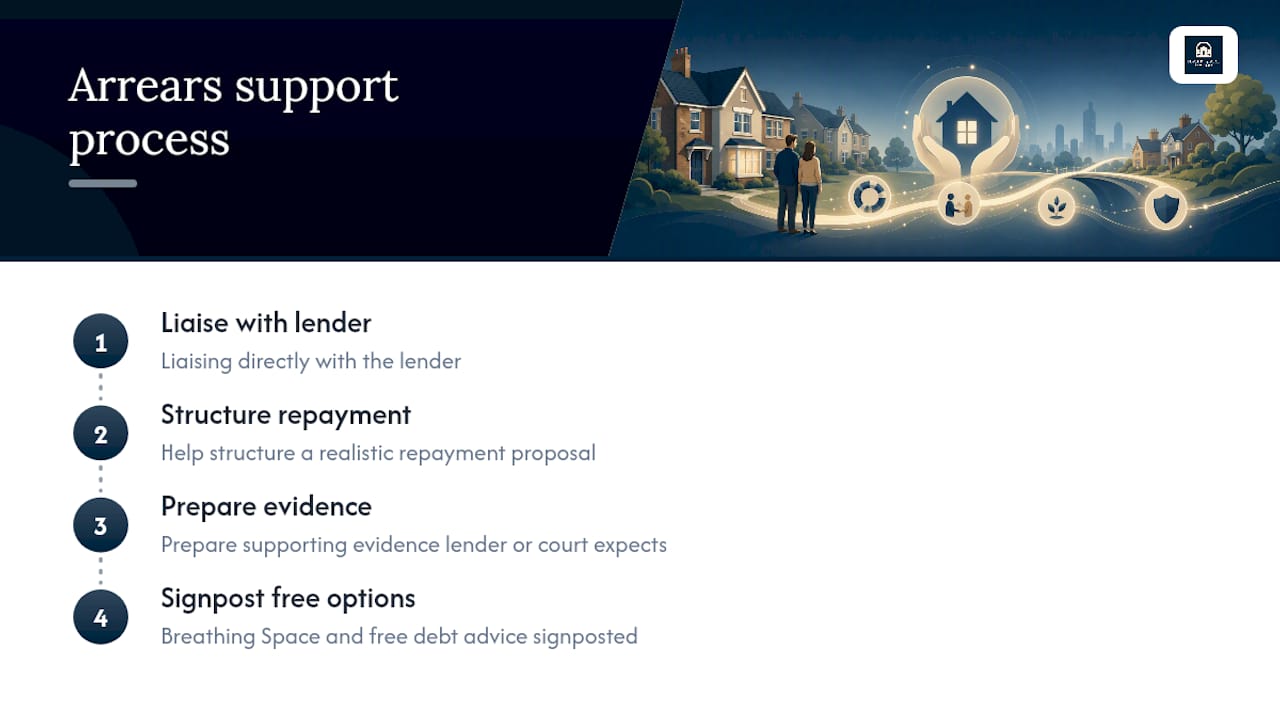
In an arrears case, that adviser typically helps by liaising directly with the lender, helping structure a realistic repayment proposal, preparing the supporting evidence a lender or court will expect, and signposting free options like breathing space where free debt advice is the more appropriate first step. Haven Mark Advisers is transparent about fees, and paid advice makes most sense once your case involves complex income, a pending remortgage, or lender negotiations beyond basic budgeting support.
Speak to Haven Mark Advisers about your mortgage situation
If you are behind on payments and need someone to help structure your next move rather than just explain the rules, some firms give busy professionals and business owners one dedicated adviser who understands complex income and works the case through to a resolution.

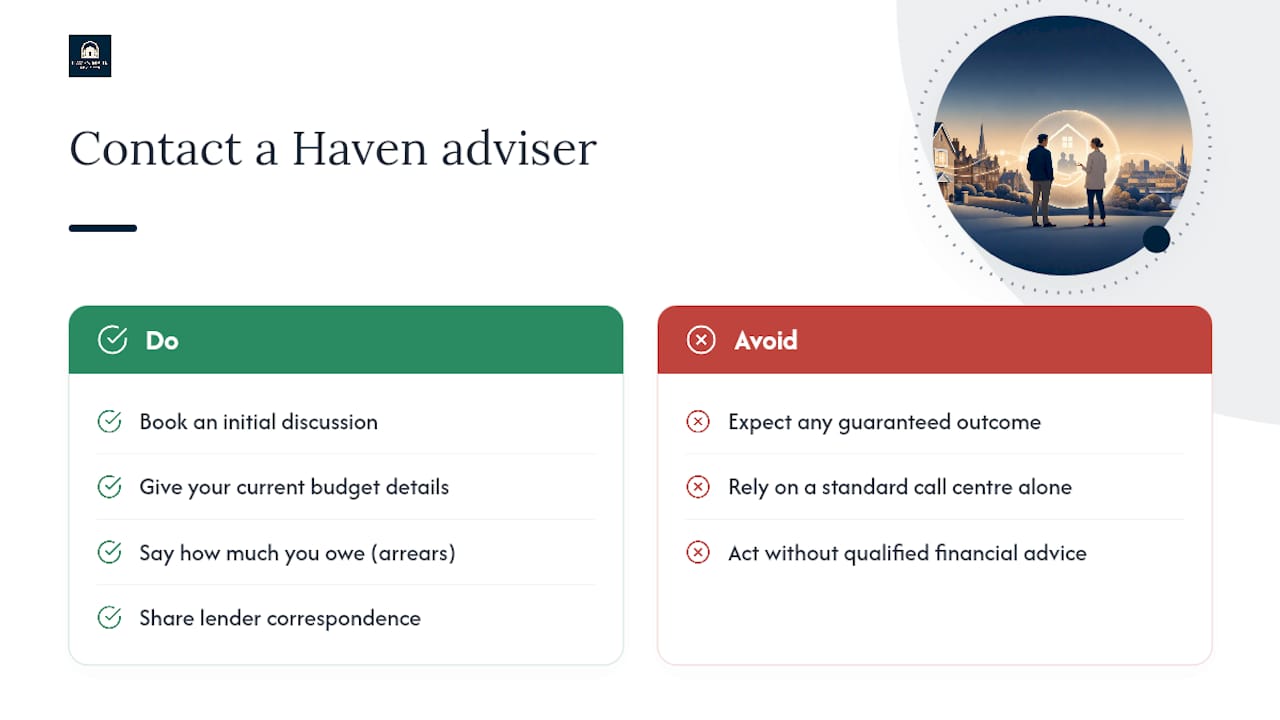
An initial conversation is straightforward. An adviser will want to understand your current budget, the size of the arrears, and any correspondence you have already had with your lender, so having recent statements and payslips to hand speeds things along considerably. No outcome, acceptance, or lending decision can ever be guaranteed. What you can expect is regulated, personalised guidance and clear, upfront fees before any work begins.
If your situation involves a remortgage, a complex income structure, or lender negotiations that feel beyond a standard call centre conversation, visit the residential mortgages page to arrange an initial discussion with a dedicated adviser.
This article is general information, not a substitute for advice from a qualified financial advisor. Consult a qualified financial professional about your own circumstances before acting on anything here.
Sources
- FCA Handbook — MCOB 13
- Gov
- Shelter — How to deal with missed mortgage payments
- Pre-Action Protocol for Possession Claims
FAQ
How many days late can a mortgage payment be before action starts?
There is no fixed cut-off. Lenders must send written arrears information within 15 business days under MCOB 13, but court action typically only follows months of unresolved arrears and completed pre-action steps.
What happens if I miss a mortgage payment in England?
Your lender will contact you, apply any late fees set out in your mortgage terms, and must send a formal written notice within 15 business days explaining the arrears and your options, including signposting to MoneyHelper.
Does a payment that's a week late affect my credit score?
Usually not immediately. Common industry practice is to report arrears to credit reference agencies once they reach around 30 days late, so a payment corrected within a week rarely shows up at all.
Should I use a paid adviser or free debt advice first?
Free services like MoneyHelper or Citizens Advice are the right first step for budgeting and basic arrears support; a regulated adviser such as Haven Mark Advisers becomes useful once you need help structuring a remortgage or negotiating around complex income.
Recommended
- 4–8-week remortgage timeline in England: why one adviser speeds complex cases
- Can you remortgage with negative equity in England?
- Remortgage Advice
This article provides general information only and does not constitute personalised mortgage advice. Mortgage availability, affordability and lender criteria depend on individual circumstances and may change. Please seek advice tailored to your circumstances before acting on this information.