

IMPORTANT: YOUR HOME MAY BE REPOSSESSED IF YOU DO NOT KEEP UP REPAYMENTS ON YOUR MORTGAGE.
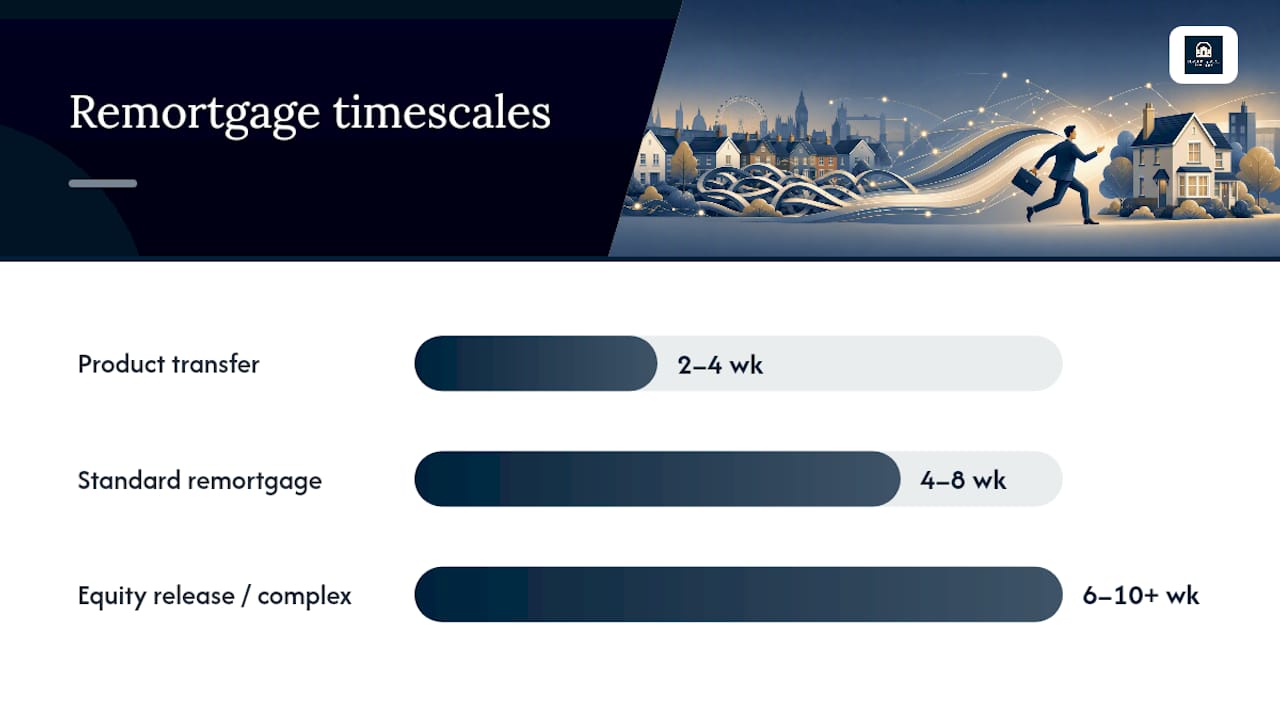
A standard remortgage to a new lender takes roughly 4 to 8 weeks from application to completion. A product transfer with your existing lender can complete in 2 to 4 weeks because it skips the legal work, while equity release or complex income cases often run to 6 to 10 weeks or more. Timings depend on your lender, the valuation method used, and how quickly your solicitor works, so speak to a qualified mortgage adviser before making any decisions about your borrowing.
TL;DR:
- A product transfer typically takes 2 to 4 weeks as it skips valuation and conveyancing steps, making it the fastest remortgage option.
- Standard remortgages to new lenders generally require 4 to 8 weeks, depending on application complexity, valuation method, and legal processing speed.
- Equity release or complex income cases often extend to 6 to 10 weeks or more because of additional underwriting and solicitor checks.
- Starting your remortgage process at least three months before your current deal expires helps ensure completion before reverting to a higher variable interest rate.
- Preparing all income, identification, and mortgage documents in advance can significantly reduce processing delays, especially in cases involving non-standard income.
Table of Contents
- Remortgage timescales at a glance
- The step-by-step remortgage application timeline
- The six-month rule: when to start your remortgage
- What makes a remortgage faster or slower
- How to speed up your remortgage: checklist and actions
- Why conveyancing affects your remortgage completion time
- Three example remortgage timelines
- How Haven Mark Advisers keeps your remortgage on track
- Sources
- FAQ
Remortgage timescales at a glance
Your remortgage timeline depends almost entirely on which route you're taking. Before comparing deals, it helps to know which category you fall into, because the gap between the fastest and slowest routes is substantial.
- Product transfer (staying with your current lender): typically 2 to 4 weeks, since these switches often complete within a fortnight when the lender's systems are efficient, and no conveyancing is required.
- Standard remortgage to a new lender: typically 4 to 8 weeks, covering application, valuation, underwriting, legal work, and completion.
- Equity release or complex income cases: typically 6 to 10 weeks or longer, particularly where self-employed income, multiple properties, or a buy-to-let element adds extra underwriting checks.
A product transfer usually omits the valuation survey and the conveyancing stage entirely, because you're not changing lender and the property's title doesn't need re-registering. That's the main reason it's so much quicker.
If you're switching lender, expect all the usual stages: agreement in principle, full application, valuation, underwriting, formal offer, legal conveyancing, and completion. Any one of those stages running long can push you towards the 8 to 10 week mark, particularly if you're releasing equity, have irregular income, or your solicitor is dealing with a backlog. Professionals with day-rate contracts, partnership income, or a mix of PAYE and dividends tend to sit in this bracket more often than straightforward salaried applicants, simply because underwriters ask more questions of non-standard income.
The step-by-step remortgage application timeline
Each stage of a remortgage carries its own typical duration, and knowing where delays usually creep in helps you keep the process moving.
- Agreement in principle (1 to 2 days). A lender gives you an indicative decision based on a credit check and basic income details. It's not a formal offer, but it lets you shop with confidence and shows estate agents or your current lender that you're a serious applicant.
- Full application (a few days to submit, 1 to 2 weeks for an initial decision). You'll need to supply proof of income, identification, and bank statements. Banks including Barclays list this stage, alongside valuation and legal work, as one of the three main components of remortgage timing.
- Valuation (3 to 14 days). Lenders now often use a desktop or automated valuation model rather than sending a surveyor to the property, which is faster. A drive-by or full physical survey, more common on older or unusual properties, adds time.
- Underwriting (1 to 3 weeks). An underwriter checks your income, affordability, and credit history against the lender's criteria. Missing documents, self-employed accounts that don't add up cleanly, or unexplained bank transactions are the most common causes of delay here.
- Mortgage offer (a few days after underwriting clears). Once the underwriter is satisfied, the formal offer is issued, usually valid for three to six months depending on the lender.
- Legal conveyancing (2 to 4 weeks). Your solicitor checks the property title, requests a redemption statement from your current lender, and prepares the paperwork to register the new mortgage. This stage is mandatory for a full remortgage.
- Completion. Funds transfer between lenders and your new mortgage payments begin, usually on an agreed date that lines up with the end of your existing deal.
Pro Tip: Ask your current lender for a redemption statement as soon as you start the process. It can take a week or more to arrive, and your solicitor can't finalise completion figures without it.
The six-month rule: when to start your remortgage
Most lenders let you secure a new deal up to six months before your current fixed term ends, which gives you enough runway to compare products, apply, and complete before reverting to a lender's standard variable rate. Some lenders will also let you switch to a cheaper deal later if one appears, though non-refundable arrangement fees and cancellation terms vary, so check the small print before you lock a rate.
- Six months out: start researching and speaking to an adviser, especially if your income is complex.
- Three months out: begin the formal application so a standard remortgage has time to complete before your current deal expires.
- Cancellation windows: many locked-in deals allow a change of mind within a set period, often around 14 days, but this isn't universal, so confirm it with your lender.
Leaving it until your existing deal has already expired means you'll likely default to the lender's standard variable rate, which is almost always more expensive than a remortgage.
What makes a remortgage faster or slower
Some delays are entirely outside your control; others you can influence directly by how prepared you are.
- Lender processing speed. Some lenders process applications in days, others take weeks during busy periods, and this varies by product complexity too.
- Valuation method. A desktop valuation adds days; a physical survey, especially during a busy season for surveyors, can add one to two weeks.
- Solicitor availability and Land Registry timing. Conveyancers with heavy caseloads, or a Land Registry backlog on title updates, can slow the legal stage regardless of how quickly you respond to requests.
- Case complexity. Releasing equity, buy-to-let elements, or non-standard income (self-employed, contract, or mixed PAYE and dividend earnings) invites closer underwriting scrutiny.
- Extra requests. Asking for a second valuation, a further advance, or additional product changes mid-application will add time on top of the base timescale.
How to speed up your remortgage: checklist and actions
Preparation shaves real time off underwriting and legal work, which are the two stages most likely to stall.
- Identification: passport or driving licence for everyone on the mortgage.
- Income proof: recent payslips and your latest P60 if employed.
- Bank statements: typically the last three to six months, across all relevant accounts.
- Self-employed or contractor income: up to three years of accounts or tax returns, ready before you apply rather than assembled after an underwriter asks.
- Existing mortgage statement: shows your current balance and lender details.
A dedicated mortgage broker checklist can help you gather everything in one pass rather than responding to repeated requests. Having a single adviser manage your case, rather than juggling different points of contact, tends to reduce the back-and-forth that stretches underwriting timescales, particularly where income documentation is more layered than a standard payslip. Pay valuation and arrangement fees promptly once agreed, since unpaid fees are a common, avoidable cause of administrative holds.
Pro Tip: If you're self-employed or work on day-rate contracts, prepare one clean, well-ordered pack of accounts rather than sending documents as they're requested. It prevents the underwriter from raising the same query twice.
Why conveyancing affects your remortgage completion time
A product transfer with your existing lender usually needs no conveyancing at all, since the property isn't changing hands and the title doesn't need updating. A full remortgage to a new lender is different: legal conveyancing is a mandatory stage and typically adds 2 to 4 weeks on its own.
- Title checks: confirming ownership and any restrictions on the property.
- Redemption statement: the figure needed to pay off your current mortgage in full.
- Land Registry updates: registering the new lender's interest once completion happens.
Lenders often offer a panel solicitor at reduced or no cost, which can be quicker for straightforward cases. Instructing your own solicitor gives you more control and transparency over pacing, though it may cost more and isn't always faster for routine remortgages.
Three example remortgage timelines
- Product transfer: week 1, request new rate from current lender; week 2, sign and return offer; complete within 2 to 4 weeks, no valuation or solicitor involved.
- Switching lender: month 6 before deal ends, start comparing rates and lock one; month 3, submit full application; weeks 4 to 8, valuation, underwriting, legal work, and completion.
- Complex income case: month 6, engage an adviser and prepare three years of accounts; weeks 6 to 10, extended underwriting and solicitor checks before completion.
How Haven Mark Advisers keeps your remortgage on track
Comparing rates yourself or relying on a call centre that hands you between different case handlers both leave gaps where delays creep in. Haven Mark Advisers takes a different approach: one dedicated adviser manages your case from the agreement in principle through to completion, so nothing gets lost between departments.

With over ten years of experience, Haven Mark Advisers works with a broader panel of UK lenders and has particular strength in handling complex income, whether that's day-rate contracting, partnership income, or a mix of PAYE and dividends that a standard underwriter might query twice. A single point of contact also means your document pack is only assembled once, not re-requested at every stage, which tends to keep cases moving through underwriting rather than stalling on paperwork. Fees are set out transparently before you commit, so there are no surprises once your case is under way.
If you're a lawyer, finance professional, contractor, or self-employed business owner in London or elsewhere in England planning a remortgage, Haven Mark Advisers' residential mortgage service can talk you through your options and timescales before you start comparing rates.
Sources
- Getting ready to remortgage: how to get the best rates - MoneySavingExpert
- How long does a remortgage take in England and Wales? - Muve
- How does remortgaging work? | Remortgage process | Barclays
- Remortgage conveyancing UK legal guide - Connaught Law
- How long does it take to remortgage? - Experian
This article is general information, not a substitute for advice from a qualified financial advisor. Consult a qualified financial professional about your own circumstances before acting on anything here.
FAQ
How far in advance should you start a remortgage?
Most lenders allow you to secure a new deal up to six months before your current fixed term ends, and starting around then gives a standard remortgage enough time to complete without reverting to a standard variable rate.
What is the six-month rule for remortgages?
It refers to the window most lenders allow for arranging a new deal before your existing rate expires, giving you time to compare products, apply, and complete without a gap on a lender's standard variable rate.
Is remortgaging as hard as getting a mortgage?
The underwriting and document checks are broadly similar to a purchase, though a remortgage usually avoids house-hunting and chain delays; complex income cases still face the same scrutiny as a first-time application.
How long does a remortgage take in England?
A standard remortgage to a new lender typically takes 4 to 8 weeks, a product transfer often completes in 2 to 4 weeks, and complex or equity release cases can take 6 to 10 weeks or more.
What does Martin Lewis say about remortgaging?
MoneySavingExpert, founded by Martin Lewis, advises starting the comparison process around six months before your deal ends and checking fee and cancellation terms before locking a new rate.
Recommended
- Remortgage Advice
- Remortgaging your home to fund improvements
- Contractor Remortgage: A Practical Guide for UK Contractors
- Remortgage help to buy: a practical guide for homeowners
This article provides general information only and does not constitute personalised mortgage advice. Mortgage availability, affordability and lender criteria depend on individual circumstances and may change. Please seek advice tailored to your circumstances before acting on this information.