
IMPORTANT: YOUR HOME MAY BE REPOSSESSED IF YOU DO NOT KEEP UP REPAYMENTS ON YOUR MORTGAGE.
Yes, mortgages on non-standard construction properties are achievable in England, but the path is narrower and usually pricier than for a standard brick house with a tiled roof. The outcome depends on the construction type, what your survey uncovers, the deposit you can put down, and which lenders are willing to underwrite the risk. Start by confirming exactly what your property is built from, then speak to a specialist adviser before you commit to a purchase.
TL;DR:
- Obtaining a mortgage on a non-standard construction property often requires a full structural survey and specific evidence, increasing the time and cost compared to standard homes.
- Lenders' acceptance varies significantly based on construction type, age, and condition, with older precast concrete and steel-framed homes facing more restrictions.
- Certification of repairs or remedial works can improve mortgage eligibility for properties with defective systems like post-war concrete panels.
- Expect larger deposits, higher interest rates, and additional fees when financing non-standard properties, with some lenders requiring specialist approval.
- Using a dedicated, experienced mortgage broker can streamline the process by accurately matching your property to suitable lenders and managing paperwork efficiently.
Table of Contents
- What is a non-standard construction mortgage?
- Which construction types worry lenders and why?
- Why do lenders treat these properties so cautiously?
- How do you actually get a mortgage on a non-standard property?
- What surveys and reports will you need?
- What deposit and rate should you expect?
- Can repairs and certification improve your mortgage options?
- What about insurance and resale value?
- When should you use a specialist mortgage broker?
- What should you prepare before applying?
- What legal and regulatory issues apply to non-standard properties?
- How is the non-standard property market trending over the long term?
- What does a successful non-standard application actually look like?
- How Haven Mark Advisers helps with non-standard cases
- Where to check the facts yourself
- Sources
- FAQ
What is a non-standard construction mortgage?
England's mortgage industry treats brick or stone walls with a pitched slate or tile roof as the baseline. Anything that departs from that, whether it is concrete panels, steel framing, timber cladding, or a flat roof, is commonly classed as non-standard and triggers extra underwriting checks. A non standard construction mortgage is simply the lending product arranged for a property that falls outside that brick-and-tile norm, and it usually involves additional survey evidence before an offer is made.
Before you fall in love with a property or pay for a full structural survey, check the basics yourself. The Property Passport service pulls EPC data for properties in England and Wales, including wall type and construction age band, which gives you a fast first read on whether you are dealing with a standard or non-standard build.
Two things worth checking early:
- Wall construction listed on the EPC or Property Passport record, since concrete, timber frame, and steel systems are flagged differently to solid brick
- Construction age band, because many of the most problematic precast concrete systems date from specific post-war building programmes
Lender definitions of "non-standard" are not identical. One building society might happily lend on a timber-frame new build that another treats with suspicion. Verifying construction type before you instruct surveys and valuations saves you paying twice for reports that a lender was never going to accept anyway.
Which construction types worry lenders and why?
Lender appetite varies enormously by construction system, and it is worth knowing roughly where your property sits before you start comparing rates. Some types are routinely accepted with the right paperwork; others are refused outright by most of the high street.
- Precast Reinforced Concrete (PRC), including Wimpey No-Fines and Laing Easi-Form: many pre-1960s examples were formally designated as defective, and several high-street lenders still refuse them without a recognised repair certificate.
- Steel-framed houses, such as BISF properties: acceptance depends heavily on the condition of the steel frame and evidence of corrosion protection.
- Older timber frame (pre-1920s or poorly maintained): treated cautiously due to rot and movement risk.
- Modern timber frame built to current Building Regulations: increasingly acceptable to mainstream lenders when backed by a full survey.
- Prefabricated concrete or asbestos-panel homes: often restricted to specialist lenders only.
- Thatched roofs: generally mortgageable, but insurance cost and availability matter more than lending itself.
- Flat roofs: rarely a problem alone, though extensive flat roof coverage can affect valuation.
- Listed buildings and unusual conversions: lending is possible, but planning constraints add a layer of complexity.
- High-rise leasehold flats: construction risk interacts with building-safety requirements, which can restrict lender panels further.
Every lender assesses individual cases on their own facts, so two houses of the same PRC type in the same street can get different decisions depending on repair history.
Why do lenders treat these properties so cautiously?
Two commercial concerns sit behind every non-standard decision: how expensive the property would be to reinstate after damage, and how easily it could be resold if the lender ever needed to repossess. Both feed directly into the interest rate and deposit a lender will ask for.
Specific risks that worry underwriters include:
- Concrete deterioration in PRC panels, which can affect structural integrity over decades
- Corrosion in steel-framed systems where protective coatings have failed
- Timber rot or insect damage in older frame constructions
- Gaps in buildings insurance cover for unusual construction types, which weakens the security a lender holds
Building-safety concerns add another layer for taller properties. Where EWS1 external wall system assessments or similar building-safety evidence apply to high-rise flats, that risk sits alongside, rather than instead of, standard construction risk. A lender looking at a converted PRC bungalow and a leasehold flat in a tower block is weighing different versions of the same underlying question: what does this building cost to fix, and who would want to buy it if we had to sell.
How do you actually get a mortgage on a non-standard property?
Getting from viewing to offer takes longer than a standard purchase, and skipping steps tends to cost you time later rather than saving it.
- Confirm the construction type first. Use the EPC or Property Passport record, and ask the seller directly about wall and roof construction, any past PRC designation, and any repair history.
- Commission the right survey early. A RICS Level 3 building survey is the usual minimum for anything non-standard, and a chartered structural engineer's report is often needed for PRC or complex conversions. Booking survey work at offer stage rather than waiting for a valuation condition tends to speed things up, since the evidence is ready before an underwriter asks for it.
- Choose your lender route. Mainstream banks will consider some non-standard types with full reports; building societies often have more flexible local underwriting; specialist lenders and broker-only panels cover the cases the high street won't touch.
- Prepare for manual underwriting. Non-standard cases rarely go through automated decisioning, so expect an underwriter to read the survey personally and possibly request further evidence.
Realistically, budget 4 to 8 weeks from a full application to a mortgage offer on a straightforward non-standard case. Where remedial works, PRC certification, or additional specialist tests are needed, that timeline can stretch considerably, so build slack into your purchase timetable rather than assuming a standard conveyancing schedule.
What surveys and reports will you need?
Not every non-standard case needs the same paperwork, but understanding the survey hierarchy helps you avoid paying for the wrong report.
- Mortgage valuation: the lender's own basic check, sufficient only for low-risk cases and never a substitute for an independent survey.
- RICS Level 2 (homebuyers report): adequate for many conventional properties but rarely enough on its own for non-standard construction.
- RICS Level 3 full structural survey: the standard expectation for non-standard properties, giving a detailed condition assessment that underwriters weigh heavily.
- Chartered structural engineer report (CEng, MIStructE): recommended, and sometimes required, for PRC properties, unusual conversions, or where the Level 3 survey flags structural concern. A clear engineer's report can carry more weight with an underwriter than a lower-level survey, and for borderline cases it can be the difference between acceptance and refusal.
- Specialist tests: timber and damp surveys, PRC panel testing, and asbestos checks where relevant, usually arranged through the surveyor or a specialist contractor.
What deposit and rate should you expect?
Non-standard construction mortgages typically demand a larger deposit than a standard purchase, reflecting the lender's higher perceived risk.
- Deposits of a larger amount than standard are common for non-standard cases, and a higher deposit often opens up more lenders and better pricing.
- Mainstream banks tend to offer the lowest loan-to-value limits for anything outside brick and tile; building societies are sometimes more flexible on a case-by-case basis; specialist lenders will go further but usually at a cost.
- Beyond the headline rate, expect additional survey fees, possible valuation conditions requiring further evidence before completion, and a contingency for remedial works if the survey identifies issues.
The current guidance from Moneyfactscompare confirms that this deposit and pricing gap is a consistent feature of the non-standard market, not an occasional exception.
Can repairs and certification improve your mortgage options?
For PRC and other formally designated defective systems, remediation is often the single most effective route back into the mainstream lending market.
- Designated Defective status applies to specific PRC house types built under post-war programmes, and it is this designation, rather than the concrete itself, that most lenders react to.
- A Certificate of Structural Adequacy, or documented evidence of approved panel replacement, can reopen lender panels that would otherwise refuse the property outright.
- Remedial works are worth pursuing where the property's value justifies the cost; on lower-value properties, the repair bill can outweigh any gain in mortgageability.
- Keep every piece of documentation: contractor invoices, warranties, and any inspection sign-offs, since underwriters want to see a clear paper trail rather than a verbal assurance that work was done.
What about insurance and resale value?
Buildings insurance for non-standard properties is often harder to arrange and more expensive, particularly for PRC, steel-framed, or thatched properties, so get quotes before you exchange rather than after.
- Specialist insurers, sometimes found through a broker rather than a price comparison site, are frequently the only realistic route to adequate cover for unusual construction types.
- Resale value is directly linked to the pool of buyers who can get a mortgage on the property, so a house that only a handful of specialist lenders will touch tends to sell more slowly and can attract lower offers.
- Budget a maintenance contingency, keep a shortlist of contractors experienced with your specific construction type, and check for any listed building or conservation area restrictions that could limit future alterations.
When should you use a specialist mortgage broker?
A specialist broker earns their fee on non-standard cases by doing the work most buyers cannot do themselves: matching your specific property to the handful of lenders who will actually consider it, structuring the case file so an underwriter can say yes quickly, and chasing queries as they arise rather than leaving you to field them.
A specialist broker typically assigns one adviser to manage the entire process, which matters on a non-standard case because continuity helps with underwriter queries. Experienced firms provide proactive case management and transparency on fees, rather than leaving clients to chase progress themselves.
Pro Tip: Ask any adviser, before you instruct a survey, which lenders on their panel have actually placed your specific construction type recently. A broad panel is only useful if it includes lenders who understand your property.
What a good specialist broker delivers on a non-standard case:
- A realistic lender shortlist based on your exact construction type and condition
- Coordination of survey timing so reports land before, not after, the application stalls
- A structured case file presented to the underwriter with supporting evidence attached
- Clear, upfront fee information before you commit to any work
What should you prepare before applying?
A complete file the first time round avoids the back-and-forth that stretches a non-standard case from weeks into months.
- Documents: proof of income, identification, an EPC or Property Passport extract for the property, and any planning or maintenance records held by the seller.
- Surveys: a RICS Level 3 report as standard, a structural engineer's report where the construction type warrants it, and any specialist timber, damp, or PRC panel tests flagged by the surveyor.
- Finances: proof of deposit funds, a contingency reserve for any remedial work the survey identifies, and a clean credit record checked well ahead of application.
Gathering all three categories before you submit a full application, rather than assembling them piecemeal after a lender asks, is the single biggest lever you have over how long the process takes.
What legal and regulatory issues apply to non-standard properties?
Non-standard construction brings legal considerations beyond the mortgage itself, and these can affect both your purchase timetable and your long-term ownership costs. Listed buildings carry statutory protection under planning law, meaning alterations, including some repairs, may need listed building consent before work starts. Skipping this step can create problems at resale even if the original mortgage completed without issue.
Properties with a history of Designated Defective status under PRC schemes sit within a specific regulatory framework: the designation itself is a formal classification, and removing its practical effect on lending normally requires a recognised repair scheme certificate rather than informal reassurance from a seller. Buyers should ask their conveyancing solicitor to confirm whether any such designation, or any historic repair certificate, is registered against the property.
For flats in taller buildings, building-safety regulation introduced since the Grenfell Tower fire means some properties require an EWS1 form or equivalent fire-safety evidence before certain lenders will proceed. This sits alongside, not instead of, any construction-type assessment, and both should be checked early rather than assumed away.
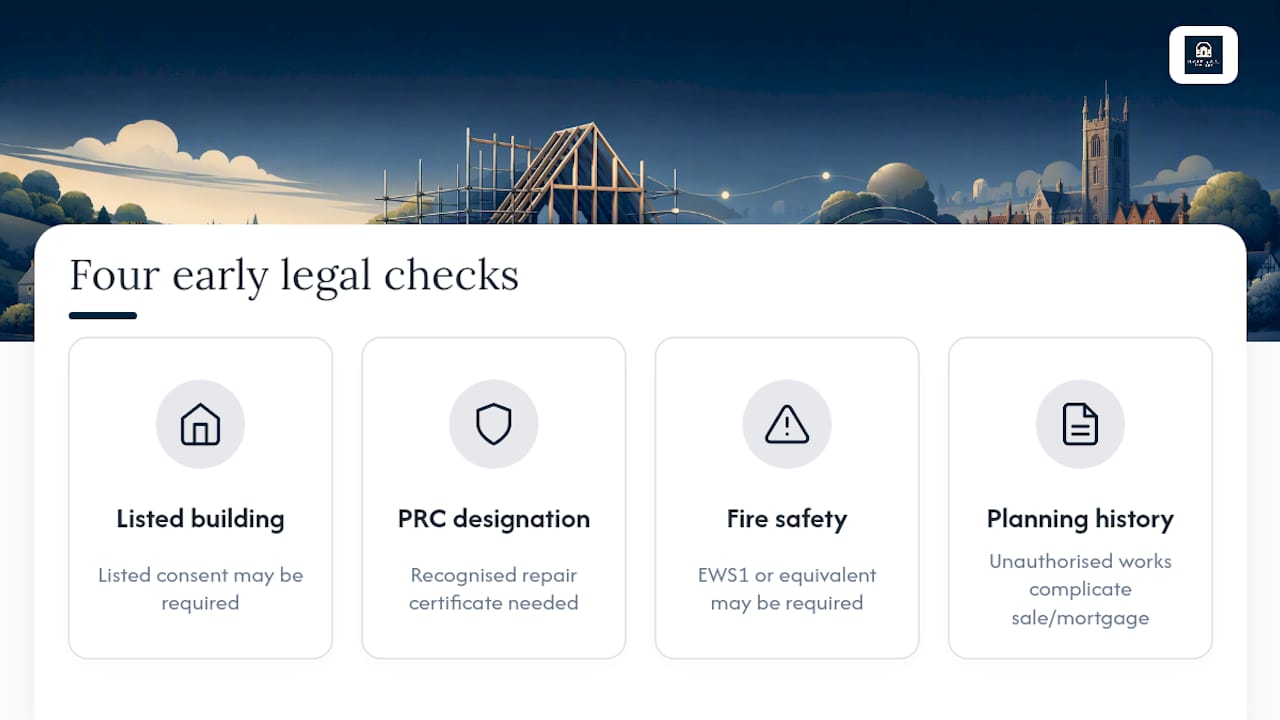
Finally, planning history matters more for non-standard properties than for conventional ones. Unauthorised alterations to a listed conversion, or undocumented panel replacement on a PRC property, can complicate both your mortgage application and any future sale. A solicitor experienced with non-standard cases, rather than a general conveyancer, is worth the extra scrutiny at the outset.
How is the non-standard property market trending over the long term?
Valuation trends for non-standard construction have shifted meaningfully over the past two decades, largely driven by two forces: improved building standards for new-build systems, and growing lender comfort with certain non-traditional types that were once treated with blanket suspicion.
Modern timber frame is the clearest example. Built to current Building Regulations and increasingly backed by long-term warranties, it has moved from a niche concern to something mainstream lenders will generally accept given a satisfactory survey. That shift matters for anyone buying a newer timber-frame new build, since lender caution there is far lower than for an older system-built house.
At the other end of the scale, older PRC and steel-framed properties without repair certification have seen the opposite trend: as more mainstream lenders formalise their exclusion lists, these properties increasingly rely on a shrinking pool of specialist lenders, which puts downward pressure on both resale speed and achievable price. This divergence means a rough label of "non-standard" tells you very little on its own; the specific system, its age, and its repair history now matter far more to long-term value than they did when blanket refusals were more common across the board.
For buyers, the practical implication is that a non-standard property with clean documentation and, where relevant, formal certification, tends to hold its lending eligibility and resale value considerably better than an equivalent property with no paper trail at all.
What does a successful non-standard application actually look like?
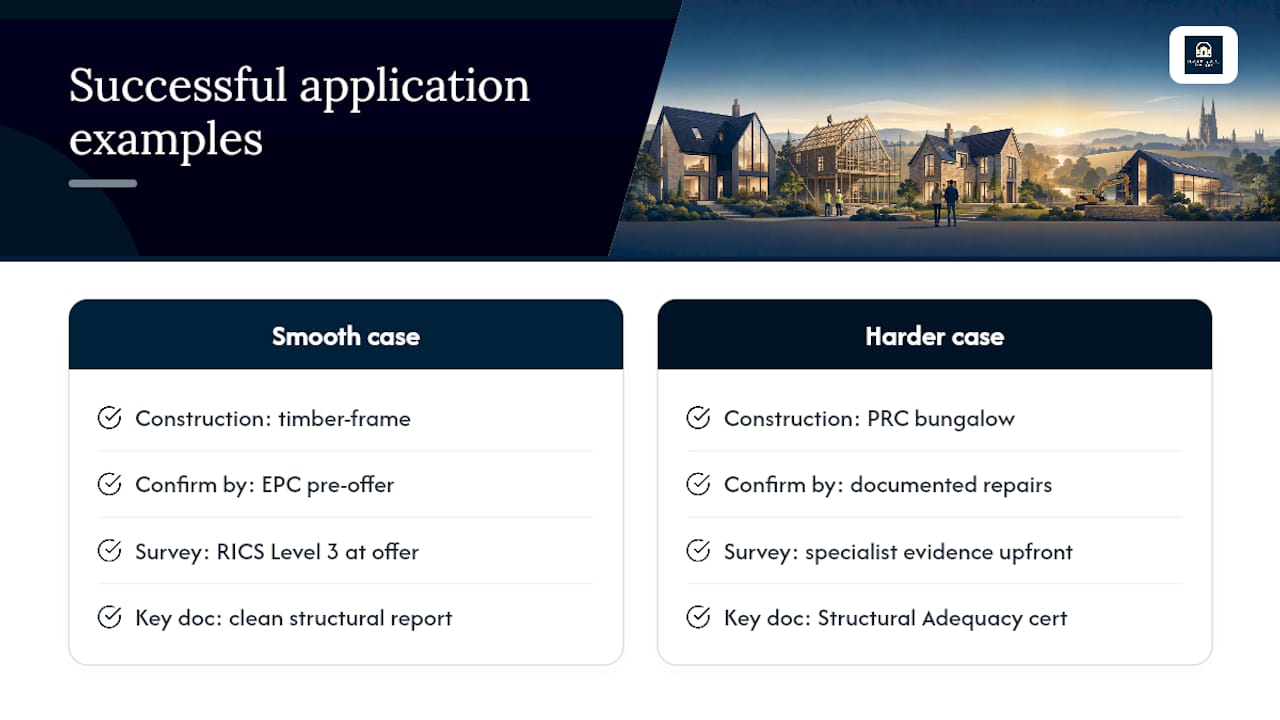
The applications that go smoothly share a common pattern regardless of construction type: early identification, the right survey commissioned promptly, and a complete file presented to the lender in one go rather than piecemeal.
A typical smooth case might involve a modern timber-frame new build, where the buyer confirms construction type via the EPC before offering, commissions a RICS Level 3 survey at offer stage rather than waiting for the mortgage valuation, and presents a mainstream lender with a clean structural report. Because the construction system is well understood and the paperwork is complete from the outset, this kind of case can move through underwriting close to a standard purchase timetable.
A harder case, such as a PRC bungalow with a documented repair history, tends to succeed when the seller can produce a Certificate of Structural Adequacy or equivalent approved repair evidence upfront. Rather than the buyer discovering the PRC designation mid-transaction and scrambling for paperwork, having that certificate ready from the first viewing lets a broker approach the right specialist lender immediately, with the structural evidence already in hand.
What both examples share is preparation before commitment, not after. Buyers who wait until a lender raises a query to start gathering survey evidence or certification consistently see longer timelines and, in some cases, declined applications that better-prepared cases with the same underlying property would have cleared. The construction type sets the ceiling on what is possible; the quality and timing of your paperwork determines whether you reach it.
How Haven Mark Advisers helps with non-standard cases
Once you know roughly where your property sits, whether that is a modern timber-frame new build or a PRC bungalow with a repair certificate in hand, the harder part is matching that specific case to the right lender and getting the paperwork in front of them in the right order.

Haven Mark Advisers works with professionals and homebuyers facing exactly this kind of complexity, assigning one dedicated adviser to your case from the first conversation through to completion, rather than passing you between different contacts at each stage. That single point of contact matters most on non-standard cases, where survey timing, lender selection, and underwriter queries all need to be tracked by someone who already understands the property.
On first contact, your adviser will talk through the construction type, what survey evidence you already have, and which lenders on the panel are realistic for your case. Fees are agreed upfront and set out clearly on the fees and how we're paid page, so there are no surprises once the case is underway. For a straightforward residential purchase, Haven Mark Advisers' residential mortgage service covers the same structured, single-adviser approach.
If your case involves a newer timber-frame build, the new build mortgages page sets out how that process typically works. Book an initial conversation to talk through your specific property and what evidence you will need before you commit to a purchase.
Where to check the facts yourself
Verify construction details directly through the Property Passport service before instructing surveys. RICS publishes guidance on survey levels and standards, and the FCA register lets you confirm any mortgage adviser's regulatory status before you engage them. GOV.UK carries wider guidance on building safety and planning where those issues apply.
This article is general information, not a substitute for advice from a qualified financial advisor. Consult a qualified financial professional about your own circumstances before acting on anything here.
Sources
- Non-standard construction mortgage: guidance (Property Passport UK)
- What does a RICS Level 3 survey include? (AG Surveyors)
- Mortgages for non-standard constructions (Moneyfacts)
- What is non-standard construction? (Elite Dwellings)
FAQ
Can I get a mortgage on a non-standard construction property?
Yes, mortgages on non-standard construction are available, though your choice of lender narrows and deposit requirements typically rise. The exact outcome depends on the specific construction type, your survey findings, and how much deposit you can put down, so a RICS Level 3 survey is usually the first practical step.
Is it worth buying a non-standard construction house?
It can be, particularly if the property is well-documented, has any required repair certification, and suits your budget for a larger deposit. Weigh the lower purchase price often seen on non-standard properties against higher insurance costs, a smaller resale pool, and the deposit premium most lenders apply.
Can I get a Santander mortgage for a non-standard construction home?
Santander, like other high-street lenders, sets its own criteria for non-standard construction, and acceptance depends on the specific build type and survey evidence rather than a blanket policy. A specialist adviser can check current lender criteria against your exact property before you apply, rather than assuming any one bank's stance in advance.
Can I get a Halifax mortgage for a non-standard construction property?
Halifax assesses non-standard cases individually against its own lending criteria, and some construction types are accepted with a satisfactory survey while others are not. Rather than relying on general assumptions, check the lender's published criteria for your specific construction type or ask a broker to confirm current appetite.
What does Haven Mark Advisers charge for mortgage advice?
Haven Mark Advisers charges a one-off fee of £495 for a purchase mortgage service and £195 for a remortgage service, both payable on completion, as set out on the fees page. Other services, including protection advice and product transfers, are priced on request.
Recommended
- Mortgages for Day-Rate Contractors
- Contractor Mortgage for UK Contractors: How to Qualify
- New Build Mortgages | Clear, Structured Advice
- Fixed term contract mortgage: what England lenders expect
This article provides general information only and does not constitute personalised mortgage advice. Mortgage availability, affordability and lender criteria depend on individual circumstances and may change. Please seek advice tailored to your circumstances before acting on this information.