
IMPORTANT: YOUR HOME MAY BE REPOSSESSED IF YOU DO NOT KEEP UP REPAYMENTS ON YOUR MORTGAGE.
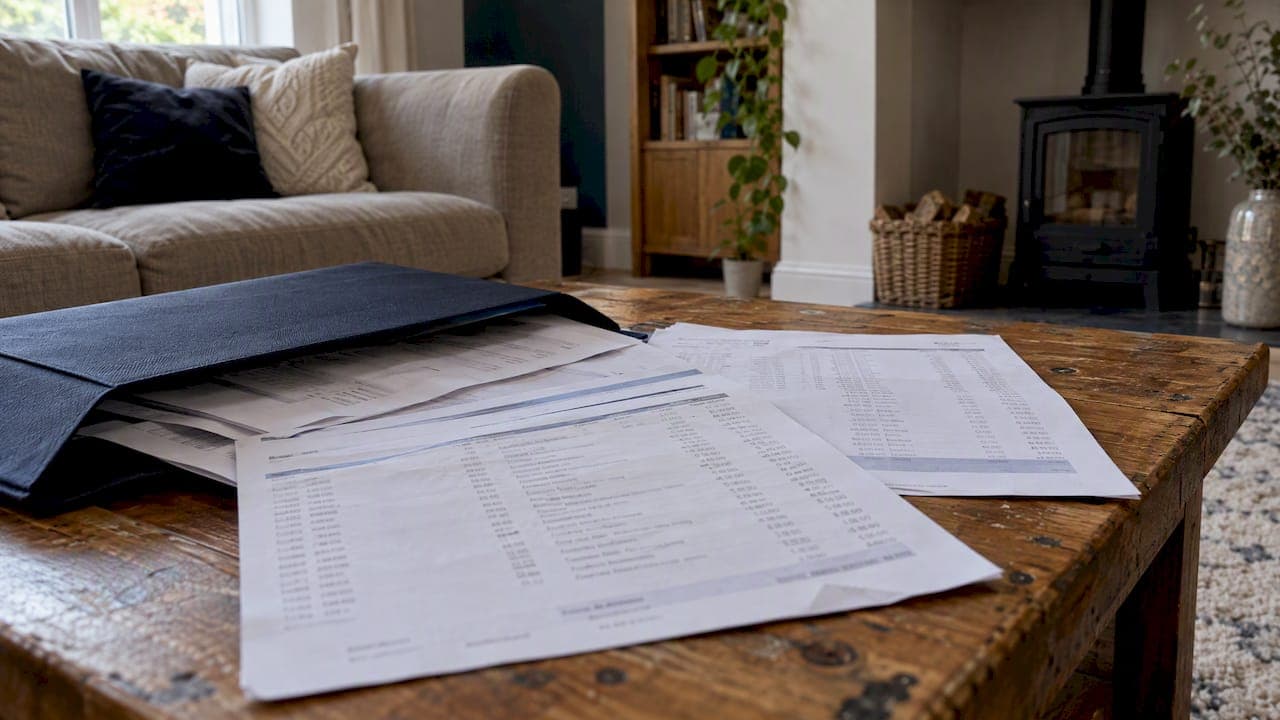
Most UK lenders ask for between one and six months of recent bank statements. Experian puts the usual request at the last three to six months. The exact period depends on the lender, your employment type, the size of the loan and whether the statements are personal or business. Lenders use them to see your income, your spending, your debts and your regular commitments. They are not a pass or fail test on their own, and no adviser or lender can promise an outcome before a full assessment.
This guide sets out how far back lenders look, what they are checking, what makes a statement acceptable and what to prepare if you are self-employed, a contractor or paid from overseas.
TL;DR
- Expect to provide one to six months of statements. The period is set by each lender and varies with your circumstances.
- Statements must usually be complete, legible and unamended, and show your name, address, debits and a running balance.
- Lenders may ask you to explain unusual credits, unpaid items and large or irregular payments. Explain them accurately and in writing.
- Self-employed applicants may need personal and business statements, and the requirement can change with how long you have traded.
- Disclose any known change in your circumstances to your adviser and lender. Do not leave it out.
Table of Contents
- How many months of bank statements lenders ask for
- What lenders look for in your bank statements
- What makes a statement acceptable
- Transactions you may be asked to explain
- Self-employed applicants and contractors
- Overseas income and non-UK accounts
- When a lender may not ask for statements
- A checklist before you apply
- How Haven Mark Advisers can help
- FAQ
- Sources
How many months of bank statements lenders ask for
There is no single UK rule. Each lender sets its own requirement, and it can differ between employed and self-employed applicants, and between products. The published criteria below show how wide the range is.
| Lender | Published requirement |
|---|---|
| Swansea Building Society | Three full consecutive months of the most recent personal statements, for all current and savings accounts |
| Dudley Building Society | Typically the last one month for employed, retired or private income applicants. Three months of personal and business statements for self-employed applicants |
| first direct | Generally one month |
| Nationwide | May ask for up to six months, depending on circumstances |
| HSBC UK | Does not need statements in most cases. May ask for the latest month for some non-HSBC or international accounts |
The table shows one lender's criteria each. It is not a market-wide rule, and lenders change their criteria, so check the current requirement before you gather documents. Your adviser will confirm the requirement for the lender you are applying to.
Why six months is sometimes required
A longer period is usually tied to a less established income or a higher-risk profile. Dudley, for example, ordinarily expects six months of personal and business statements from self-employed applicants who are basing their mortgage on proof of income for less than two years. Payments that arrive less often than monthly can also lead a lender to look at a longer period, as HSBC notes in its application documents guidance.
If you receive bonuses, quarterly dividends or annual payments, tell your adviser early. A short statement period may not show them.
What lenders look for in your bank statements
A lender wants to confirm that the application matches the account. Experian says lenders may review statements to understand income, spending and debts, including repayments that no longer appear on a credit report. In practice, the review covers four areas.
- Income. Regular credits should be consistent with the income you declared on the application and with your supporting documents, such as payslips or tax records.
- Outgoings. Rent, existing loans, credit cards, childcare, subscriptions and other commitments feed into the affordability calculation.
- Conduct of the account. Unpaid items, returned direct debits and use of an overdraft are the kind of entries lenders may query. Swansea Building Society requires an application to be referred to a manager, with a written explanation of how the unpaid item occurred, where unpaid items or excesses are identified.
- Source of funds. Deposits and other large credits may need to be traced to their origin.
The figures on the statements and the figures on the application should agree. A mismatch does not always end an application, but it normally leads to questions and delay.
What makes a statement acceptable
Lenders set formal rules for the document itself. A statement that fails them can be rejected even when the account is in good order.
The requirements published by lenders include the following:
- Online statements can be accepted. Santander accepts online statements that are unamended and legible, and that show your name, address, debits and running balance.
- The statement must be recent. Santander requires the most recent statement to be dated within two months of the application date. HSBC requires the latest statement for self-employed customers trading for less than two years to be dated within 35 days of the application start date.
- A running balance must appear. Nationwide requires a running balance and, for current accounts, payments leaving the account to be clearly shown.
- Details must be complete. Aldermore lists missing details as a cause of statement queries, including a missing bank logo on some statements, the account number and sort code, a running balance, or evidence of regular credits.
Aldermore also states that questions from underwriters or fraud teams about statements frequently delay applications, and it encourages checking statements for issues before submission.
Open Banking as an alternative
Some lenders let you share account data electronically instead of uploading PDFs. Swansea Building Society says applicants may choose to provide statements through Open Banking. Availability is a decision for each lender, so ask your adviser whether it applies to your case.
Getting the statements from your bank
Most UK banks let you download PDF statements from online or mobile banking. Download them for every current and savings account the lender asks about, not only your main account. Check that each page is present, that your name and address appear on them and that nothing has been edited, cropped or annotated. If you need paper statements stamped by a branch, ask your bank how long that takes and whether it charges for it.

Transactions you may be asked to explain
A query is not a refusal. Lenders ask about items that do not fit the picture of income and spending on the application. Typical examples are:
- Credits that are not salary or declared income. Aldermore flags undisclosed credits, such as income support or unusual third-party credits.
- Unpaid items, returned direct debits or overdraft excesses. See the Swansea requirement above.
- Large one-off payments in or out. These may be linked to a deposit, a gift, a loan or a sale of an asset.
- Gambling, payday lending or regular payments to unfamiliar accounts. Lenders generally consider these when assessing affordability and conduct. Policies differ between lenders.
Where a deposit is gifted, Nationwide may require the donor to provide statements proving the funds came from their account. The number of months depends on where the donor's account is held.
If you receive a query, give a short, accurate and consistent explanation, with evidence where you have it. Do not alter statements, and do not leave out a known commitment. An inaccurate or incomplete application can lead to a declined application or more serious consequences. Tell your adviser about any known change coming up, such as a career break, a change in employment type, a new loan or a change in household income, so that it can be assessed properly.
Self-employed applicants and contractors
For self-employed applicants, the statements sit alongside tax documents. Lenders commonly rely on tax calculations and tax year overviews for income, and use statements to check the account activity against them. Our guides on SA302s for mortgages and on the self-employed mortgage process cover the tax side in detail.
The statement requirement can change with your circumstances. Published examples:
- HSBC UK requires the latest three months of business statements for self-employed customers trading for less than two years.
- Coventry Building Society requires three months of personal statements from self-employed applicants if their tax documents are more than 12 months old, or if the mortgage is £200,000 or more with a loan to value of 65% or more.
- Dudley Building Society asks for three months of personal and business statements from self-employed applicants, and six months where income is evidenced for less than two years.
These are three lenders' rules, and others differ. Keep personal and business accounts separate where you can. Mixed transactions make the income harder to read and are more likely to prompt questions.
If you are a limited company director, how you pay yourself affects what the lender looks at. See our guide to company director mortgages. Contractors paid a day rate should expect the lender to look at the contract as well as the account, and our page for day rate contractors explains how we approach these cases.

Overseas income and non-UK accounts
If you are paid from abroad or hold an account outside the UK, lenders may want extra evidence, such as statements for the overseas account or evidence of conversion into sterling. Criteria vary considerably between lenders. HSBC, for instance, says it may ask for the latest month's statements for international accounts and expat accounts. Our guide to a mortgage with foreign income explains how UK lenders assess it.
When a lender may not ask for statements
Some lenders do not ask for statements in every case. HSBC says it does not need bank statements in most cases, although it may request them in the situations noted above. Others rely on payslips, tax documents or an employer reference and request statements only when a case needs it.
Do not assume that statements will not be needed. Have the last three to six months ready for every account, even if the lender does not ask for them at the outset. A request that arrives mid-application and cannot be met quickly is a common cause of delay.
A checklist before you apply
- Confirm the lender's requirement. Ask your adviser how many months, which accounts and whether personal, business or both.
- Download complete statements. Every page, every account named, in the format the lender accepts.
- Check the details. Name, address, account number, sort code, running balance, and no edits.
- Read your own statements first. Look for unpaid items, unusual credits, large transfers and regular payments you may be asked to explain.
- Prepare explanations in writing. Keep them short, accurate and supported by documents.
- Mind the dates. Statements dated outside a lender's window, such as the two months or 35 days noted above, may need replacing, so download fresh ones close to submission.
- Tell your adviser about known changes. This includes new commitments, a change in employment type and a move to part-time hours or leave.
Our page on how we get you ready to offer describes how we organise documents before a case goes to a lender.
How Haven Mark Advisers can help
Haven Mark Advisers provides regulated mortgage and protection advice to professionals, the self-employed, contractors, first-time buyers and foreign nationals. Each client works with one dedicated adviser from start to finish, so your document list, your explanations and your lender choice are handled in one place.

Our fee for a purchase mortgage service is £495 one-off and our fee for a remortgage service is £195 one-off. Fees are agreed upfront, and the fees page explains how we are paid. For a purchase, see our residential mortgage advice. For an existing mortgage, see our remortgage advice. We cannot guarantee acceptance, borrowing amounts or rates, and every case is assessed on its own facts.
FAQ
How far back do mortgage lenders look at bank statements?
Usually between one and six months, according to the lender's criteria. Published examples range from one month at some lenders to three months at others, with up to six months where circumstances require it. Your adviser will confirm the period for your chosen lender.
Do I need business bank statements as well as personal ones?
Often, if you are self-employed. Some lenders ask for both personal and business statements, particularly where you have traded for less than two years. Others ask for personal statements only, depending on the age of your tax documents and the size of the loan.
Can I send online or PDF statements?
Many lenders accept online statements if they are unamended, legible and show your name, address, debits and a running balance. Some also accept Open Banking. Each lender sets its own rules, so check before you submit.
What if my statements show an unpaid item or an overdraft?
The lender may ask for a written explanation and may refer the case for a manager's review. Tell your adviser before you apply so that the explanation is ready and a suitable lender can be considered. Outcomes depend on the lender's criteria and your wider circumstances.
Do I need statements if I am remortgaging or switching rate?
It depends on the route. A remortgage to a new lender is a new application and is likely to need documents. A product transfer with your existing lender may need fewer. Ask your adviser which route applies. Our pages on remortgages and rate switches and product transfers explain the difference.
Sources
- Experian: How to get a mortgage
- Swansea Building Society: Mortgage application checklist
- Dudley Building Society: Criteria
- first direct: Mortgage documents
- Nationwide: Mortgage application proofs
- HSBC UK: Documents needed for a mortgage application
- Santander UK: Mortgage application documents
- Aldermore: How to spot issues with bank statements
- Coventry for Intermediaries: Application submission guidelines
Recommended
- Mortgage with Foreign Income: How UK Lenders Assess It
- Company director mortgage: how lenders assess your income
- Commission Income on a Mortgage in England: What Proof Counts?
- Foreign National Mortgage in the UK: A Complete Guide
This article provides general information only and does not constitute personalised mortgage advice. Mortgage availability, affordability and lender criteria depend on individual circumstances and may change. Please seek advice tailored to your circumstances before acting on this information.