

IMPORTANT: YOUR HOME MAY BE REPOSSESSED IF YOU DO NOT KEEP UP REPAYMENTS ON YOUR MORTGAGE.
Buy-to-let can still work in England, but only if the numbers, ownership structure and compliance are right. Before anything else, check your rental yield against the lender's interest cover ratio, decide whether to buy personally or through a limited company, and confirm the property can meet EPC, gas and electrical rules from day one. Get those three checks wrong and the rest of this buy to let guide won't save the deal.
TL;DR:
- You must ensure the property's rental yield exceeds lender stress test thresholds, typically requiring at least 125% to 145% interest cover at a stressed rate.
- Buying through a limited company can fully deduct mortgage interest, especially benefiting higher-rate taxpayers, but involves higher upfront costs and administrative requirements.
- Meeting compliance standards such as EPC rating E or above, gas safety, and electrical checks is non-negotiable before letting, with costs adding to initial investment.
- Lenders focus on the property's ability to generate rental income rather than your personal income, with deposit minimums generally around 25%.
- Regulations in 2026 eliminate Section 21 no-fault evictions and introduce detailed tenancy information obligations from May 2026, increasing compliance responsibilities.
Table of Contents
- Is buy-to-let right for you in 2026? Strategies and when each makes sense
- Finance and mortgages: what lenders test and how to pass the application
- Tax, costs and ownership structure: SDLT, income tax and running costs to budget
- Legal responsibilities and compliance in England: the essential landlord checklist
- Finding, buying and preparing the property: underwriting, leasehold traps and works
- Managing tenants and operations: agents, records and retention
- Practical checklist and a worked example for a buy-to-let purchase
- Why choose Haven Mark Advisers for buy-to-let mortgage advice
- Primary sources and useful calculators to consult
- Sources
- FAQ
Is buy-to-let right for you in 2026? Strategies and when each makes sense
Buy-to-let remains viable where gross yields comfortably clear lender stress tests and where the owner has picked a structure suited to their tax position, not just the cheapest one to set up. Industry commentary on the 2026 market points to a split: passive single-let landlords are increasingly squeezed by financing costs, while investors running active strategies (HMOs, serviced accommodation) or holding through an SPV tend to hold better margins.
An HMO on the same street can often produce a meaningfully higher yield, but it comes with licensing duties, higher management overhead and, in many areas, planning constraints. Serviced accommodation can outperform both, though it behaves more like running a small hospitality business than letting a home, with occupancy risk that a standard tenancy doesn't carry.
The strategy that fits depends on three things: how much capital you're deploying, how much time you can give to management, and your marginal tax rate.
- Single-let, personal name: simplest to run, suits lower-rate taxpayers or a first rental property, but exposed fully to Section 24 restrictions on mortgage interest relief.
- Single-let via SPV: more admin and typically a slightly higher mortgage rate, but restores full deductibility of finance costs, which matters most to higher-rate taxpayers.
- HMO: higher yield potential, but needs licensing, fire safety upgrades and closer day-to-day management.
- Serviced accommodation: highest income ceiling, but the most operationally demanding and the most exposed to demand swings.
- BRRRR (buy, refurbish, refinance, rent, repeat): useful for building a portfolio quickly, but only works when refurbishment costs and post-works valuations are conservatively estimated.
As a rule of thumb, walk away from a deal where projected rent barely scrapes the lender's minimum interest cover ratio, where the EPC rating sits below E with no realistic upgrade path, or where the only route to profit depends on rents rising faster than the local market has actually been moving. If a property only works on optimistic assumptions, it doesn't work.
Finance and mortgages: what lenders test and how to pass the application
A buy-to-let mortgage is underwritten differently from a residential one because the lender is betting on rental income rather than your salary to service the debt. Most residential affordability models start from your earnings; buy-to-let lenders start from the property's ability to pay for itself, which changes almost every part of the application.
Deposit expectations are the first filter. Most lenders want a minimum deposit for a standard buy-to-let purchase, and that figure often rises for SPV applications, houses in multiple occupation, or new-build flats, where valuation risk is higher. Rates for limited company borrowing also tend to sit slightly above personal-name pricing, reflecting the lender's view of added complexity, not necessarily added risk.
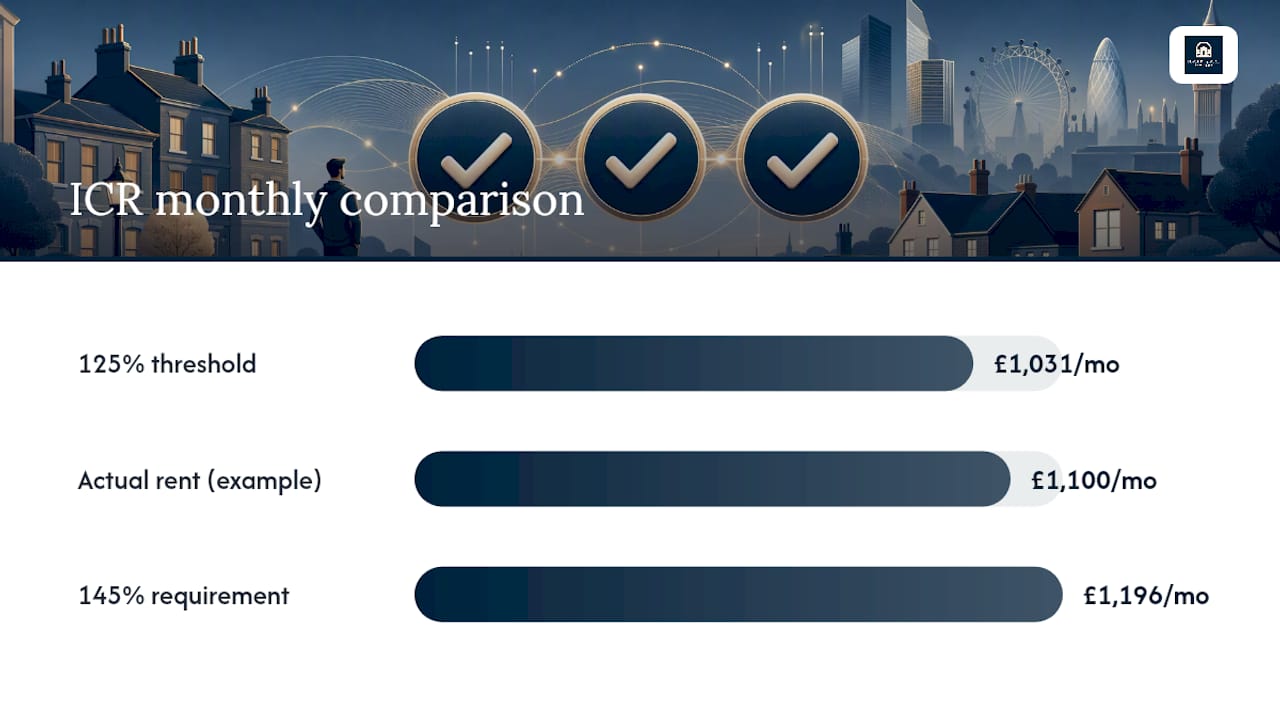
The interest cover ratio (ICR) is where most applications succeed or fail. Lenders want projected rental income to cover the mortgage interest by a set margin, commonly in the 125% to 145% range, and they typically test that cover at a stressed interest rate well above whatever pay rate you're actually being offered, often around 5% to 5.5%. That stress test exists precisely so the deal still holds up if rates climb after completion.
Here's a simplified version of the maths. Rent needs to reach £9,900 multiplied by 1.45, or roughly £14,355 a year, which works out at about £1,196 a month, before the lender is satisfied. A property renting for £1,100 a month would fall short on that particular lender's criteria, even though it might comfortably cover the real pay-rate interest.
Pro Tip: Run your own ICR sums against the stressed rate before you view a single property. It takes ten minutes and stops you falling for a flat that "should work on paper" but fails every lender's stress test.
Whether you take interest-only or capital repayment changes the monthly figure but not the ICR logic; most landlords use interest-only to maximise cashflow and rely on capital growth or eventual sale to repay the loan, though that carries its own long-term risk. Which? notes that buy-to-let mortgages also tend to carry higher upfront arrangement fees, often around £2,000, which needs factoring into your first-year cashflow rather than treated as a minor detail.
Documentation gets more involved when your income is anything other than a single PAYE salary. Contractors, company directors, and professionals paid through a mix of salary and dividends often find that lenders want:
- Two to three years of accounts or SA302s rather than payslips.
- Evidence of existing portfolio performance if you already hold other rental properties.
- A clear explanation of deposit source, particularly for larger sums or gifted funds.
- Confirmation of any consent-to-let arrangement if the property was previously your own home.
That last point matters more than people expect. Converting an existing residential mortgage into a let requires the lender's consent to let rather than jumping straight to a full buy-to-let product, and the two routes carry different rules and pricing. Complex income doesn't have to mean a weaker application, but it does mean the case needs building carefully and matched to a lender whose criteria actually fit that income shape, rather than the first product a comparison site surfaces.
Tax, costs and ownership structure: SDLT, income tax and running costs to budget
Ownership structure is the decision that most changes the long-term economics of a buy-to-let purchase, and it needs settling before you make an offer, not after. Two tax rules dominate this choice.
The first is the Stamp Duty Land Tax surcharge on additional residential properties, which applies on top of standard SDLT bands and adds a meaningful sum to the upfront cost of any buy-to-let purchase. On a £250,000 property, that surcharge alone can add several thousand pounds to completion costs, so it needs to be built into your deposit-plus-costs figure from the outset rather than treated as a rounding error.
The second is Section 24, introduced in 2017, which stopped individual landlords deducting mortgage interest as a business expense. Instead, they receive a basic-rate tax credit on that interest, which can push higher-rate taxpayers into paying tax on income they haven't actually kept. This is the main reason limited company ownership has become the default choice for many new buy-to-let purchases: an SPV can still deduct mortgage interest in full against rental profits, which materially improves net yield for anyone paying tax above the basic rate or building a multi-property portfolio.
That doesn't make an SPV automatically the right answer. Running a company means annual accounts, corporation tax returns, and a mortgage market with fewer lenders and typically higher rates than the personal-name equivalent. For a single low-yield property held by a basic-rate taxpayer, the extra admin can outweigh the tax saving.
Running costs beyond the mortgage itself are where many first-time landlords underestimate the real net yield:
- Landlord insurance, covering buildings and often loss of rent, typically renewed annually.
- Letting agent fees, if used, usually a percentage of monthly rent for management or a flat fee for tenant-find only.
- Repairs and maintenance, budgeted as an ongoing percentage of rent rather than an occasional surprise.
- Accountancy fees, particularly where an SPV structure is involved.
- Voids, the periods with no tenant and no rent, which every cashflow model should assume will happen at some point.
Net yield, not gross yield, is the number that actually tells you whether a deal works once these costs are stripped out. A property that looks strong on a gross yield calculation can turn mediocre once insurance, management fees, and a realistic void allowance are subtracted. Before committing to a structure, it's worth asking an accountant specifically how Section 24, the SDLT surcharge and corporation tax rates interact for your particular income level and portfolio size, because the right answer for a higher-rate taxpayer with three properties is rarely the right answer for someone buying their first rental home.
Legal responsibilities and compliance in England: the essential landlord checklist
Compliance failures are the fastest way to turn a profitable buy-to-let into an expensive problem, and the rules tightened again with the Renters' Rights Act. Every landlord letting a property in England needs to work through this checklist, in roughly this order:
- Protect the deposit in a government-approved tenancy deposit scheme and give the tenant the required prescribed information within the statutory timeframe.
- Obtain an Energy Performance Certificate rated E or above before marketing the property to let, as Gov confirms is a minimum requirement.
- Arrange an annual gas safety check by a Gas Safe registered engineer and provide the tenant with a copy of the record within 28 days, per government safety guidance.
- Complete an electrical safety inspection at least every five years and fit smoke alarms on each floor, plus carbon monoxide alarms in rooms with a fixed combustion appliance.
- Provide written tenancy information covering the landlord's name and address, tenancy start date, rent amount and the process for rent increases. This becomes a legal duty for new tenancies from 1 May 2026 under the Renters' Rights Act, with some existing tenancies needing the official information sheet by 31 May 2026.
- Understand the abolition of Section 21. No-fault evictions are gone; landlords now need a valid ground under the new tenancy framework to end a tenancy, and rent increases follow a different, more structured process than before.
- Check licensing requirements. HMOs above certain occupancy thresholds need mandatory licensing, and many local authorities also run selective licensing schemes covering ordinary single-lets in specific areas. Letting without a required licence can bring substantial fines and restrict a landlord's ability to serve certain notices.
None of these steps are optional extras bolted onto "the real business" of letting a property. A government campaign resource summarising the Renters' Rights Act is a useful starting point if you want the practical version of what's changed, alongside the fuller GOV.UK guidance. Treat compliance as part of the purchase decision itself: a property that needs £8,000 of electrical remediation before it can legally be let isn't a bargain just because the asking price looked low.
Finding, buying and preparing the property: underwriting, leasehold traps and works
The property search and underwriting stage is where good buy-to-let deals get separated from ones that only look good on the estate agent's listing. A disciplined checklist here saves far more money than chasing the lowest possible purchase price.
Before making an offer, work through:
- Gross and net yield, calculated against the actual achievable rent for that property type in that specific street, not an optimistic average pulled from a portal.
- ICR headroom, checked against the lender's stressed rate, with a margin of safety rather than a figure that just scrapes the threshold.
- Refurbishment budget, priced realistically rather than guessed, particularly for anything affecting the EPC rating or electrical safety.
- Void allowance, built into the first-year cashflow rather than assumed away.
Leasehold flats bring their own set of traps. Service charges can rise sharply, ground rent terms vary enormously, and a short remaining lease can make a property difficult to mortgage or resell later. New builds carry a different caution: developer incentives and slightly inflated valuations can mean the property is worth less on completion than the purchase price implied, which matters directly for loan-to-value calculations. A close look at new-build deposit requirements before committing is worth the time it takes.
Once a purchase completes, the minimum works needed to let legally usually cover EPC improvements, any outstanding electrical remediation, and basic safety items like alarms. It's tempting to over-specify a refurbishment for a rental property; a reasonable capex schedule fixes what compliance and tenant demand actually require, then stops.

Timeline-wise, a straightforward buy-to-let purchase from offer to completion typically runs eight to twelve weeks, with mortgage valuation, conveyancing searches and any survey findings the most common sources of delay. Add another two to four weeks if remedial works are needed before the property can legally go to market for tenants.
Managing tenants and operations: agents, records and retention
The decision between a letting agent and self-management shapes both your time commitment and your actual net return, and it deserves more scrutiny than most landlords give it. Compare agent fees on a like-for-like basis: a full management fee typically covers rent collection, maintenance coordination and compliance chasing, while a tenant-find-only fee leaves the ongoing admin, including the legal duties above, entirely with you.
Self-management can work well for a landlord with one or two properties and the time to respond to tenant issues promptly, but it removes any buffer between you and the tenant during difficult conversations, including rent arrears or repair disputes.
- Compare like-for-like fee structures, not headline percentages, since some agents bundle inspections and certificate renewals while others charge separately for each.
- Budget proactively for maintenance rather than reactively, since small repairs left unresolved are the single biggest driver of tenant turnover.
- Keep every safety certificate and communication on file, because the Renters' Rights Act era leans heavily on documented compliance if a dispute ever reaches a tribunal.
- Consider rent-protection insurance alongside standard landlord cover, particularly where the tenant's income situation is less predictable.
Tenant retention has become a genuinely strategic metric rather than a soft consideration, largely because the end of no-fault eviction makes turning over a tenancy slower and more procedurally demanding than it used to be. A landlord who treats letting as an ongoing service, responding to repairs quickly and communicating clearly, tends to see fewer voids and far less legal friction than one who only engages when something goes wrong.
Pro Tip: Keep a single digital folder per property with every certificate, tenancy document and repair record dated and named consistently. If a dispute ever reaches a tribunal, being able to produce the full compliance history in minutes rather than days changes the outcome.
Protection planning deserves a mention too. Landlord insurance covers the property; it doesn't cover you if illness or injury stops you working and servicing the mortgage. Income protection or life cover, arranged alongside the mortgage itself, is worth discussing at the same time as the property purchase, not as an afterthought once the keys are handed over.
Practical checklist and a worked example for a buy-to-let purchase
A regulated adviser working through a buy-to-let case typically checks the same items in the same order: deposit source and amount, ICR against the specific lender's stressed rate, EPC rating and any remedial cost, existing consent-to-let or portfolio exposure, and the documentation trail for self-employed or complex income. Getting that document pack ready before applying, rather than assembling it under pressure once an offer's accepted, is usually what separates a smooth completion from a stressful one.
A simplified worked example, using the ICR mechanics already outlined, illustrates how the numbers interact:
The immediate post-completion actions are the same compliance list already covered: deposit protection, EPC confirmation, gas safety booking and, from May 2026, the written tenancy information pack.
Complex documentation is exactly where a single dedicated adviser earns their place in this process. Rather than a case moving between several people who each need re-briefing on your income structure, one adviser holding the full picture from first enquiry to completion tends to spot lender-fit issues early and keep the file moving.
Why choose Haven Mark Advisers for buy-to-let mortgage advice
This guide is aimed at buyers whose income doesn't fit neatly onto a standard application form, and who don't have weeks to spare chasing paperwork between departments.

Every client works with one dedicated adviser from first enquiry through to completion, whether the case is a buy-to-let mortgage advice application, a new build mortgage, a remortgage, or a product transfer and rate switch. That continuity matters most for professionals with contractor income, dividend-heavy earnings or an existing portfolio, because it means one person understands the full picture rather than three people each seeing a slice of it. Fees are agreed upfront and charged on completion: a purchase mortgage service is £495 one-off, and a remortgage service is £195 one-off, with full detail on how fees work set out on the fees page.
First contact typically starts with a short conversation about your income structure, the property or purchase you're considering, and the ownership route you're weighing up, whether personal name or a limited company structure. From there, cases are matched to lenders with criteria suitable for the client's situation, rather than a generic shortlist. Potential buyers should consider consulting with advisers to discuss numbers before making an offer on a buy-to-let purchase.
Primary sources and useful calculators to consult
Before committing to a purchase, check the primary sources directly rather than relying on secondhand summaries. GOV.UK's landlord responsibilities page sets out deposit protection, EPC and safety-check duties in full. The Renters' Rights Act overview covers the abolition of Section 21 and the new written tenancy information duty. For tax questions, speak to HMRC or an accountant directly about SDLT and Section 24 as they apply to your circumstances, and use a mortgage calculator or ICR guide to stress-test any deal before you offer.
This article is general information, not a substitute for advice from a qualified financial advisor. Consult a qualified financial professional about your own circumstances before acting on anything here.
Sources
- Gov
- Gov
- Buy-to-Let Mortgages Explained (UK, 2026) — Mortgage Notes
- Buy-to-let mortgages explained - Which?
FAQ
What is the 2% rule for renting?
The "2% rule" is a rough US-originated benchmark suggesting monthly rent should equal about 2% of the purchase price. It doesn't map cleanly onto England's market, where lenders test deals against the interest cover ratio, typically 125% to 145%, rather than a fixed rent-to-price percentage.
Is buy-to-let still worth doing in the UK?
It can be, but only where rental yield clears the lender's stress-tested ICR, the ownership structure suits your tax position, and the property already meets or can affordably reach EPC and safety standards. Commentary on the 2026 market suggests active strategies and SPV ownership tend to hold margins better than passive single-lets bought purely on hope of capital growth.
What will happen to buy-to-let in 2026?
The main shift is regulatory rather than financial: the Renters' Rights Act has abolished Section 21 no-fault evictions and introduced a written tenancy information duty from 1 May 2026. Lender criteria and ICR thresholds continue applying broadly as before, though individual lenders set their own exact figures.
What are the new rules for landlords in 2026?
Landlords must now provide written tenancy information covering rent, tenancy start date and rent-increase process for new tenancies, alongside the existing duties to protect deposits, maintain an EPC of E or above, and complete annual gas and five-yearly electrical safety checks, as set out on GOV.UK. No-fault evictions under Section 21 are no longer available.
How much deposit do I need for a buy-to-let mortgage?
Most buy-to-let lenders expect a minimum deposit of around 25% of the purchase price, sometimes higher for limited company applications or HMOs. Haven Mark Advisers can talk through deposit and lender options for your specific case via its buy-to-let mortgage advice service.
Recommended
- 25% Deposit on New Build Buy to Let: Worth It for England Landlords?
- 125% ICR: England Landlords' Rental Income Mortgage Rules
- Consent to let mortgage: what homeowners need to know
- FCA Rules for Guarantor Mortgages in England: Adviser Checklist
This article provides general information only and does not constitute personalised mortgage advice. Mortgage availability, affordability and lender criteria depend on individual circumstances and may change. Please seek advice tailored to your circumstances before acting on this information.