

IMPORTANT: YOUR HOME MAY BE REPOSSESSED IF YOU DO NOT KEEP UP REPAYMENTS ON YOUR MORTGAGE.
Yes, most buy-to-let lenders in the UK accept rental income as the basis for borrowing, but they test it through an interest coverage ratio (ICR) at a stressed notional rate, not the actual pay rate on offer. Typical ICR bands run from 125% for basic-rate taxpayers and limited companies through to 175% for HMOs, and stress rates commonly range between about 5.5% and 8%, per UK Finance. Tax band and ownership structure both change the outcome, which is why the same property can support very different loan sizes depending on who owns it. Gov and specialist advisers can help you interpret the maths for your own case.
TL;DR:
- Lenders test rental income against a higher stress rate, usually between 5.5% and 8%, and require rent to cover 125% to 175% of mortgage interest, depending on the property and borrower type.
- The maximum loan is calculated by dividing annual rent by the ICR percentage and stress rate, meaning lower interest coverage or higher stress rates significantly reduce borrowing capacity.
- Tax changes since April 2020 mean higher-rate taxpayers can face tighter affordability, as mortgage interest is now credited at 20% instead of fully deductible, influencing lender ICR expectations.
- Using a longer fixed rate can sometimes lower stress rates applied by lenders, increasing mortgage support, but the ICR test remains essential regardless of fixed-term length.
- A specialist mortgage adviser can navigate complex cases, such as limited company ownership or portfolio management, to find lenders with criteria aligned to individual circumstances.
Table of Contents
- How lenders test rental income mortgage affordability
- How tax band and ownership structure shape lender expectations
- What documents do lenders ask for when assessing rental income?
- Practical ways to increase what a rental property will support
- What happens to rental affordability at remortgage?
- When a specialist adviser makes the difference for landlord cases
- Get tailored rental income mortgage advice from Haven Mark Advisers
- Sources
- FAQ
How lenders test rental income mortgage affordability
Lenders don't just check whether your rent covers your mortgage payment. They check whether it covers a payment calculated at a higher, hypothetical rate, known as the stress rate, and by a comfortable margin above 100%, known as the interest coverage ratio.
The logic is straightforward once you see it. A five-year fix at 4.5% might look affordable today, but if rates rise sharply by the time you remortgage, an underwater loan is bad for both you and the lender. Stress-testing at a notional rate, usually well above whatever you're actually paying, builds in a buffer so the rent still needs to comfortably exceed the interest cost even in a worse-case scenario.
ICR requirements vary by borrower type and property type. According to UK Finance, lenders commonly apply:
- 125% for basic-rate taxpayers and for properties held in a limited company.
- 145% to 160% for higher-rate or additional-rate taxpayers, reflecting their reduced tax relief on finance costs.
- Up to 175% for HMOs, where void periods and management complexity carry more risk.
Stress rates typically fall between 5.5% and 8%, though the exact figure depends on the lender's own criteria and, in some cases, on how long you fix for. MoneyHelper frames this slightly differently, noting that rent should typically cover 125% to 145% of the mortgage repayment, with a buffer built in for periods when the property sits empty.
Pro Tip: Always ask a lender or your adviser which stress rate they're using before you offer on a property. A one-point difference in the stress rate can shrink your maximum loan by tens of thousands of pounds on an average buy-to-let purchase.
The maximum loan formula. Rearranged, the standard calculation lenders use looks like this:
Maximum loan = (Annual rent ÷ ICR) ÷ Stress rate
Say a property achieves £1,200 a month in rent, giving an annual figure of £14,400.
£14,400 ÷ 1.25 = £11,520 £11,520 ÷ 0.055 = £209,454
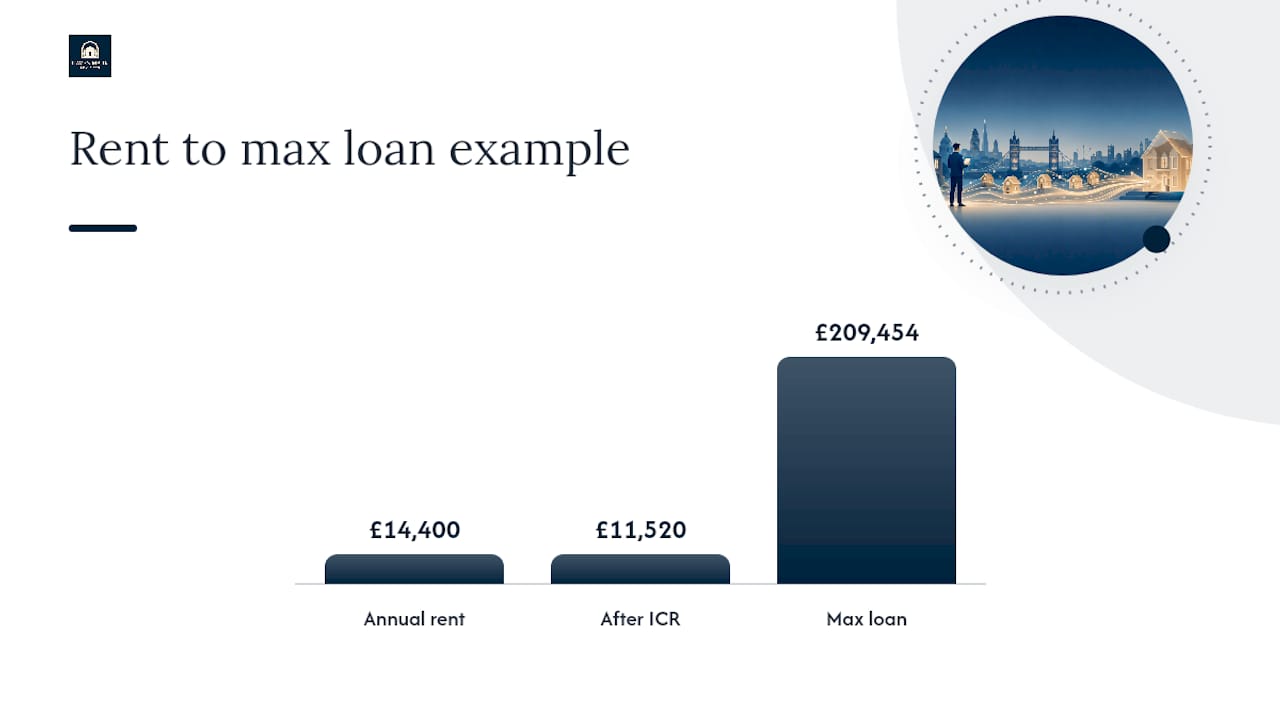
That's the rough ceiling on borrowing for that rent, regardless of deposit size, subject to the lender's own loan-to-value limits and full underwriting. Using the same rent and a higher ICR typical for higher-rate taxpayers, the maximum loan amount is noticeably lower, reflecting the impact of tax status.
Longer fixes sometimes get gentler treatment. Some lenders assess five-year fixed-rate products against the actual pay rate rather than a stressed rate, since the borrower is protected from rate rises for longer, according to MortgageAffordability.co.uk. Where that applies, it can materially increase what a property will support, though it never removes the underlying ICR test entirely.
How tax band and ownership structure shape lender expectations
The rules changed for individual landlords in April 2020, and the effects are still shaping mortgage decisions today. Before that date, landlords could deduct mortgage interest in full as a business expense before calculating tax. Since then, individual landlords receive only a 20% tax credit on finance costs rather than full deduction, according to GOV.UK.

For a basic-rate taxpayer, the practical difference is often modest. For a higher-rate or additional-rate taxpayer, it can be significant, because you're now taxed on the gross rental profit before finance costs are relieved, then given a credit worth only 20% regardless of your actual tax band.
Limited company ownership is treated differently by many lenders for exactly this reason. A company pays corporation tax on profits and can still deduct mortgage interest as a genuine business expense, which is why many portfolio landlords review their ownership vehicle once they move into higher-rate territory.
That said, a few practical realities apply:
- Limited company buy-to-let mortgages typically come with a narrower panel of lenders and, in some cases, different rate pricing.
- Moving an existing personally-owned property into a company structure usually counts as a sale and purchase for tax purposes, which can trigger capital gains tax and stamp duty land tax.
- Company accounts, longer trading history, and director guarantees are often required, adding to the paperwork burden compared with personal ownership.
Pro Tip: Never restructure ownership purely to satisfy a mortgage calculation. Speak to a qualified tax adviser first. Haven Mark Advisers can advise on the mortgage implications, but the tax and legal consequences of moving a property into a limited company need specialist tax input alongside mortgage advice.
What documents do lenders ask for when assessing rental income?
Preparing the right paperwork before you apply saves weeks of back-and-forth with underwriters. Requirements vary between lenders, but most will ask for a similar core set of evidence.
- A signed tenancy agreement, or, for a purchase, an independent rental valuation from a RICS surveyor or a letting agent's market appraisal.
- Recent bank statements showing rental receipts landing regularly, usually covering the last three to six months for an existing let.
- SA302s or HMRC tax year overviews for self-employed applicants, alongside two to three years of certified accounts where income is complex.
- Company accounts and director's loan account statements where the property is held through, or the applicant's income comes from, a limited company.
- For portfolio landlords, a full schedule of existing properties, their rents, mortgage balances, and outstanding terms, since lenders assess overall portfolio exposure as well as the individual loan.
- For HMO landlords, additional documents such as the HMO licence, management contracts if a letting agent runs the property, and evidence of room-by-room rental income rather than a single tenancy figure.
Where a property doesn't yet have a tenant, lenders rely on projected rather than historic income. A letting agent's written market rent estimate, or a formal valuer's rental assessment as part of the mortgage valuation, is usually acceptable evidence. Be realistic here: an over-optimistic rent estimate from an agent keen to win your business can lead to a lower-than-expected mortgage offer once the surveyor's own figure comes in, so it's worth getting more than one opinion before you commit to an offer on a property.
Practical ways to increase what a rental property will support
None of these levers guarantee a bigger mortgage, since every lender applies its own criteria and no outcome can be promised in advance. They do, however, reflect the mechanics most lenders use, so they're worth understanding before you make an offer.
- Put down a larger deposit. A smaller loan means a smaller interest bill at the stress rate, which is the single most direct way to pass an ICR test on a lower-yielding property.
- Consider a longer fixed-rate product. Some lenders assess five-year fixes more gently than shorter deals, which can widen your borrowing headroom where that policy applies.
- Prioritise yield over capital growth potential when the numbers are tight. A property returning £1,400 a month will clear most ICR tests far more comfortably than one returning £950, even at a similar purchase price.
- Run the ICR maths before you offer, not after. Landbay suggests testing achievable rent against both a 125% and a 145% ICR at roughly a 5.5% stress rate, so you know your realistic ceiling before you're emotionally committed to a purchase.
- Get the rent figure verified professionally. A written market appraisal from a local letting agent, backed by comparable lettings nearby, carries more weight with an underwriter than a rough guess.
Pro Tip: If a property fails the ICR test at your first-choice lender, don't assume it's unmortgageable. Criteria differ meaningfully between lenders, and a broader lender search, of the kind an adviser with wide market access can carry out, sometimes turns up a lender whose stress rate or ICR band fits the deal.
Only consider a limited company structure after taking dedicated tax advice, since the mortgage treatment is only one part of a much bigger decision involving corporation tax, stamp duty, and the cost of running a company.
What happens to rental affordability at remortgage?
A mortgage that passed comfortably at outset can fail its own ICR test years later, and this catches out more landlords than it should. The pay rate you've been enjoying on a fixed deal is not the rate a lender will use to reassess you at renewal. Stress rates move with market conditions, and if rates have risen since you first borrowed, the same rent may no longer clear the same ICR threshold on the same loan.

This is the gap between the pay rate and the stress rate that catches landlords off guard, according to commentary from LandlordZone and the NRLA.
Practical steps to reduce that risk include:
- Re-running your own ICR calculation six months before your current deal expires, using current stress-rate assumptions rather than your existing pay rate.
- Paying down capital where possible in the run-up to renewal, since a smaller loan needs less rent to clear the same ratio.
- Gathering updated rental evidence, bank statements and, if self-employed, recent SA302s well ahead of the renewal date, so a remortgage application isn't delayed by missing paperwork.
- Speaking to a broker with access to multiple lenders early, since criteria and stress rates differ enough between lenders that a deal refused by one may still work with another.
If your circumstances have genuinely changed, whether that's a rent increase, a void period, or a shift in your tax position, factor that into your planning honestly rather than hoping it goes unnoticed at renewal.
When a specialist adviser makes the difference for landlord cases
Rental income mortgage decisions get complicated fast once you're a higher-rate taxpayer, own through a limited company, run an HMO, or hold several mortgaged properties at once. That's precisely the territory where a regulated, adviser-led approach earns its fee.
Some specialist advisers assign one dedicated adviser to a case from start to finish, rather than passing you between different points of contact as your application moves through processing. For a landlord juggling ICR calculations across a portfolio, or trying to work out how a limited company purchase compares with personal ownership, having one person who knows the full picture throughout tends to move things faster and with fewer repeated conversations. Working with a broad range of UK lenders matters given how much lender criteria vary on stress rates and ICR bands for exactly the scenarios covered above.
A specialist adviser is worth consulting when:
- Your income comes from self-employment, contracting, or a mix of salaried and rental income that doesn't fit a standard affordability calculator.
- You're weighing up personal versus limited company ownership and need the mortgage implications explained alongside your accountant's tax advice.
- You're managing an HMO or a portfolio of several properties and need someone tracking overall exposure across multiple lenders.
- You're approaching a remortgage and want your ICR position checked against current stress rates before your existing deal expires.
Fees are set out transparently before any work begins, and protection advice, covering life cover, income protection, family income benefit and critical illness cover, sits alongside the mortgage advice itself for landlords who want their borrowing properly protected.
Get tailored rental income mortgage advice from Haven Mark Advisers
The calculations above give you a realistic starting point, but they're deliberately generic, because every lender's actual criteria differ, and no article can tell you what a specific lender will offer against your specific case. That's the gap Haven Mark Advisers is built to close.

Whether you're buying your first buy-to-let, adding to an existing portfolio, or trying to work out whether a limited company structure genuinely helps before you remortgage, Haven Mark Advisers assigns you a single dedicated adviser who manages the whole case, rather than handing you between different contacts as the file moves through underwriting. That matters most for landlords with non-standard income: self-employed business owners, contractors on day rates, and professionals in law or finance whose income doesn't map neatly onto a standard affordability calculator. Haven Mark Advisers works across a wide panel of UK lenders, each with its own ICR bands and stress rates, and can match your case to lenders whose criteria genuinely fit your circumstances rather than a one-size-fits-all approach. Fees are explained clearly before any work starts, so there are no surprises at completion.
If you're weighing up a buy-to-let purchase or remortgage, or want to understand how your professional income affects your borrowing, get in touch with specialist advisers to talk through your rental income mortgage options with a dedicated adviser.
This article is general information, not a substitute for advice from a qualified financial advisor. Consult a qualified financial professional about your own circumstances before acting on anything here.
Sources
The figures and rules in this guide draw on a small number of primary sources worth bookmarking if you want to check anything directly.
GOV.UK's guidance on rental income and tax sets out what counts as rental income, what expenses can be claimed, and the detail of the 20% finance cost tax credit that replaced full mortgage interest relief in April 2020.
UK Finance's buy-to-let lending data covers ICR bands and stress-rate ranges across the mortgage market and is the closest thing to an industry-wide reference point on how lenders approach affordability.
MoneyHelper's buy-to-let explainer translates the same rules into plain consumer guidance, including the advice to plan for void periods rather than assume full occupancy year-round.
The National Residential Landlords Association publishes landlord-focused guidance on stress-testing and HMO-specific requirements, useful if you're managing a licensed HMO rather than a standard single-let.
FAQ
How can I reduce tax on my rental income legally?
Since April 2020, individual landlords receive a 20% tax credit on mortgage interest rather than full deduction, per GOV.UK. Some higher-rate taxpayers review ownership through a limited company, where interest can still be treated as a business expense, but this carries its own tax and legal consequences and needs specialist tax advice before any restructuring, not just mortgage advice.
Is mortgage interest still deductible from UK rental income?
Not in full for individual landlords. Since April 2020, the deduction has been replaced with a 20% tax credit on finance costs, which is why higher-rate taxpayers often face tighter lender ICR requirements than basic-rate taxpayers or limited companies, as GOV.UK confirms.
What is the 28% mortgage rule?
UK landlord borrowing is assessed through ICR and stress-rate testing, with typical ICR bands of 125% for basic-rate taxpayers and limited companies, rising to 145% to 175% for higher-rate taxpayers and HMOs, according to UK Finance.
Recommended
- 25% Deposit on New Build Buy to Let: Worth It for England Landlords?
- Top Slicing Mortgages in England: Lender Thresholds and Adviser Help
- Company director mortgage: how lenders assess your income
- Fixed term contract mortgage: what England lenders expect
This article provides general information only and does not constitute personalised mortgage advice. Mortgage availability, affordability and lender criteria depend on individual circumstances and may change. Please seek advice tailored to your circumstances before acting on this information.