

IMPORTANT: YOUR HOME MAY BE REPOSSESSED IF YOU DO NOT KEEP UP REPAYMENTS ON YOUR MORTGAGE.
A top slicing mortgage lets a landlord use verified personal income to cover a shortfall between rental income and a lender's affordability requirement, rather than relying on rent alone to pass the test. It typically suits experienced or higher earning landlords buying in higher value, lower yield areas such as London or the South East. It is not a shortcut, and every lender applies different thresholds, so check individual criteria or speak to an adviser before assuming you qualify.
TL;DR:
- Top slicing allows lenders to use verified personal income to cover rental shortfalls, making higher-value or lower-yield properties more accessible for qualified landlords.
- Lenders generally require stable, well-documented income above specific thresholds, often around £40,000 to £50,000, with additional exclusions for new builds or capital raises.
- The process involves detailed documentation, and application times are longer due to the need to verify both rental and personal income thoroughly.
- Risks include over-leveraging if personal income drops, so conservative financial planning and stress-testing are crucial when relying on top slicing.
- Options are limited to lenders with specific criteria, making it essential to match each case carefully and consider professional advice for complex income situations.
Table of Contents
- How top slicing works in buy-to-let affordability calculations
- Who can use top slicing: borrower profiles and common eligibility rules
- Lender criteria and typical thresholds you will see in England
- Benefits and the principal risks of using top slicing
- Application process: documents lenders will ask for and realistic timescales
- How to decide whether to use top slicing and practical next steps
- How Haven Mark Advisers helps with top-slicing cases
- Sources
- FAQ
How top slicing works in buy-to-let affordability calculations
Every buy-to-let application is assessed against an interest coverage ratio, or ICR. This measures whether the rent a property generates covers the mortgage interest in a comfortable margin, usually calculated at a stressed rate rather than the actual pay rate, so lenders can see the loan would still hold up if rates rose. Stress rates commonly sit around 5.5%, or the pay rate plus 2%, whichever a given lender applies.
When rental income alone fails that stress test, top slicing allows lenders to draw on the applicant's verified personal income to bridge the gap. Lenders call this "surplus personal income": what remains of your salary, dividends, or other accepted income once your own living costs, debts, and commitments have been deducted.
A simplified example shows the logic:
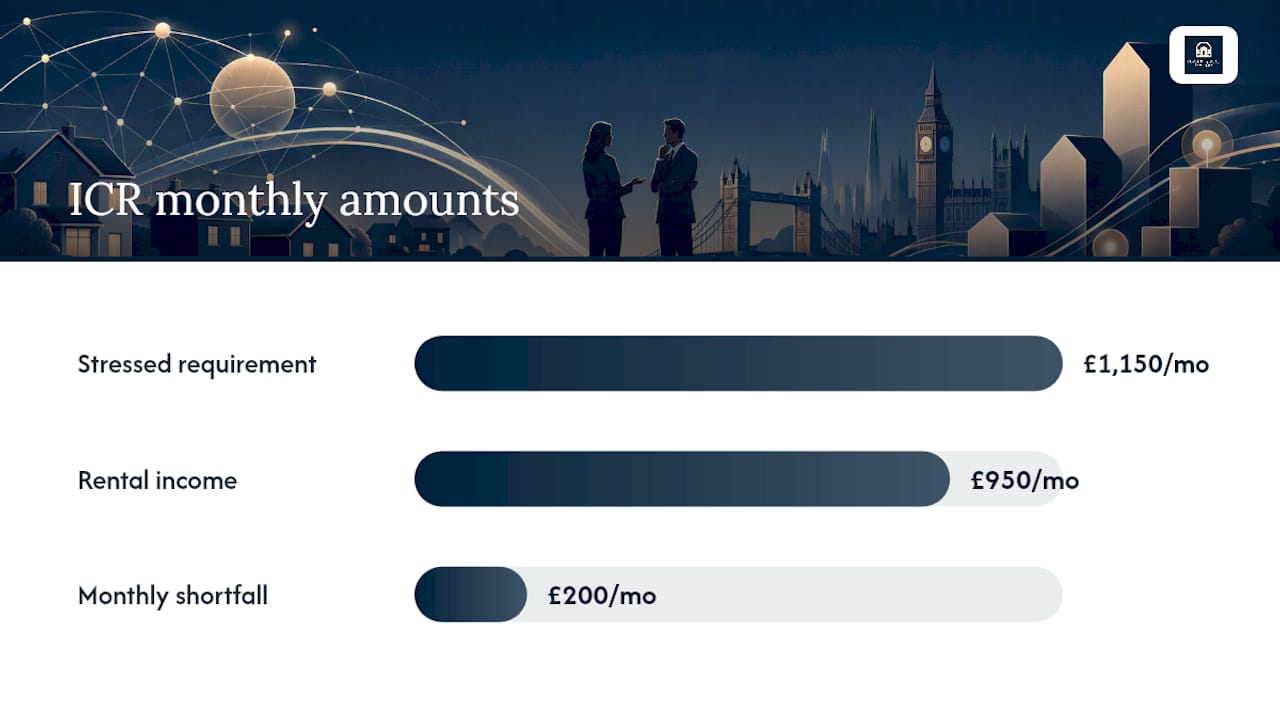
- A property lets for £950 a month, but the lender's stressed ICR calculation requires rental cover equivalent to £1,150 a month.
- That leaves a shortfall of £200 a month, or £2,400 a year.
- If the applicant has verified surplus personal income comfortably above that figure once outgoings are accounted for, the lender may allow the shortfall to be "topped up" by that income.
- The mortgage can then proceed at the amount originally sought, rather than being reduced to fit rental income alone.
The exact mechanics, minimum surplus, and which income types count vary significantly between lenders.
Who can use top slicing: borrower profiles and common eligibility rules
Lenders generally reserve top slicing for landlords who can prove stable, well-documented income beyond the rental property itself. Experienced landlords with existing portfolios are usually treated more favourably than first-time landlords, some of whom find top slicing unavailable to them altogether under certain lenders' rules.
Typical eligibility patterns include:
- Minimum combined personal income thresholds that vary by lender, for example £40,000 for experienced landlords under some criteria, with higher thresholds often applying to first-time landlords.
- Some lenders, such as Virgin Money, publish a minimum income requirement around £50,000 for single applicants using top slicing.
- Common exclusions covering new build properties, let-to-buy applications, and capital raising for purposes such as debt consolidation or personal spending.
- Portfolio landlords may face separate limits on the number of mortgaged properties or overall borrowing a lender will support.
- Residency status matters too, with some lenders restricting top slicing to UK residents or applying different evidence rules to expatriates.
Because rules differ so widely, checking a specific lender's published criteria before applying saves wasted time.
Lender criteria and typical thresholds you will see in England
Primary lender criteria pages are the most reliable place to check real numbers, and they vary more than many landlords expect. Accord's criteria set out minimum personal income thresholds alongside a clear list of exclusions. Virgin Money's intermediary guidance confirms its own income floor and explains how spare personal income boosts borrowing capacity. Metro Bank's buy-to-let lending criteria sets out operational limits including maximum loan-to-value, minimum income examples, and portfolio rules.
Top slicing is often capped at a maximum loan-to-value commonly near 75%, with an ICR stress test applied on top, frequently at 5.5% or pay rate plus 2%, according to HSBC's published criteria.
Broader patterns worth noting:
- Age and term limits often apply more strictly to top slicing cases than standard buy-to-let, since lenders want assurance the borrower's income will support the shortfall for the loan's full duration.
- Income types accepted for top slicing differ by lender. Virgin Money's guidance notes that not every lender accepts pension income, dividends, or business draws equally, so evidence has to match each lender's own acceptance list.
- Because fewer lenders offer top slicing at all, product choice narrows considerably, which can mean fewer rate options than a straightforward rental-only assessment would offer.
That narrower lender pool is precisely why matching the right case to the right lender's criteria, rather than applying speculatively, matters so much here.
Benefits and the principal risks of using top slicing
Top slicing opens doors that a rental-only calculation keeps shut. It can make properties in higher value, lower yield areas viable, ease a remortgage where rents have not kept pace with the loan, or support portfolio expansion without forcing a landlord to raise a larger deposit.
The risk sits on the other side of that same coin. Once personal income is factored into affordability, your mortgage no longer stands purely on the property's own performance. It becomes partly dependent on your salary, dividends, or other earnings continuing at the same level. That raises the chance of over-leveraging, and it leaves less resilience if personal income drops, whether through redundancy, illness, or a change in self-employed trading conditions.
Sensible mitigations include stress-testing your finances more conservatively than the lender requires, keeping a cash buffer for months where rent underperforms, and treating top slicing as a long-term commitment rather than a one-off fix. Considering the financial risk involved in leveraging personal income against an investment property is worth doing properly before signing anything.

If that scenario would force you to miss a mortgage payment, the mortgage is more leveraged than the numbers on the application form suggest.*
Application process: documents lenders will ask for and realistic timescales
Top-slicing applications carry a heavier documentary burden than a standard buy-to-let case, because lenders need to verify both the rental income and the personal income covering the shortfall.
Expect to provide most of the following:
- Recent payslips and a P60, or SA302 tax calculations and three years of accounts if you are self-employed.
- Bank statements showing income landing and outgoings being met consistently.
- Proof of residence and identity documents.
- Tenancy agreements or a letting agent's rental valuation for the property in question.
- Evidence of existing property commitments if you already hold a portfolio.
Self-employed applicants and contractors often face the longest verification steps, since accounts can be harder to summarise into a single income figure a lender recognises. Missing years, inconsistent drawings, or unclear dividend patterns are common reasons cases stall.
Top-slicing cases typically take longer to underwrite than standard buy-to-let applications, given the extra income evidence involved. A dedicated adviser managing the case from the outset can reduce delays by sequencing the right documents the first time, rather than responding to repeated lender requests. Self-employed applicants in particular benefit from preparing accounts and evidence in the format lenders expect before submission.
How to decide whether to use top slicing and practical next steps
Before pursuing top slicing, work through a short checklist: does your personal income clear the lender's minimum threshold, how large is the rental shortfall you need bridged, how stable is that personal income likely to remain, and does the property or purpose fall under any common exclusion.
Questions worth putting to a lender or adviser directly:
- What ICR stress rate applies to this case, and at what pay rate?
- What is the maximum LTV permitted when top slicing is used?
- Which exclusions apply, such as new build, let-to-buy, or capital raising?
- What evidence list does this specific lender require for my income type?
| Decision factor | When top slicing fits | When to consider alternatives |
|---|---|---|
| Personal income stability | Consistent, well-documented income above lender minimums | Variable or recently changed income |
| Rental shortfall size | Modest gap covered comfortably by surplus income | Large shortfall requiring heavy reliance on personal income |
| Property type | Standard existing buy-to-let stock | New build, let-to-buy, or capital-raising purpose |
| Risk appetite | Comfortable carrying some personal exposure | Prefer a larger deposit, limited company structure, or different property |
How Haven Mark Advisers helps with top-slicing cases
Complex-income cases like top slicing rarely fit a single lender's box, which is exactly the problem Haven Mark Advisers was built to solve. With over ten years' experience arranging mortgages for professionals with non-standard income, Haven Mark Advisers assigns one dedicated adviser to manage your case from first enquiry to completion, rather than passing you between departments.

That single adviser carries out an initial affordability check, sets out a document checklist tailored to your income type, matches your case against lenders whose top-slicing criteria you actually meet, and manages the case proactively through underwriting so evidence requests do not stall progress. Access to a broader range of UK lenders matters here, given how few lenders offer top slicing at all and how much their thresholds differ. Whether you are an experienced landlord expanding a London portfolio or self-employed and preparing accounts for the first time, Haven Mark Advisers structures the process around your income, not a generic template.
Fees are set out clearly upfront, with a fixed advice fee payable on completion of a purchase or remortgage, and no outcome, rate, or acceptance can ever be guaranteed. If top slicing looks relevant to your situation, get in touch to discuss your residential or buy-to-let mortgage options and find out which lenders' criteria you are likely to meet.
This article is general information, not a substitute for advice from a qualified financial advisor. Consult a qualified financial professional about your own circumstances before acting on anything here.
Sources
- Top Slicing Mortgage: How It Works for BTL Landlords
- Income and top slicing Buy To Let criteria | Accord Mortgages
- Top slicing | Virgin Money UK
- Mortgage lending criteria - buy to let (Metro Bank)
FAQ
What is top slicing on a buy-to-let mortgage?
Top slicing lets a lender count verified personal income towards a rental shortfall so an application can meet its ICR affordability requirement, rather than relying on rent alone.
Which lenders offer top slicing mortgages?
Several UK lenders offer top slicing, including Accord, Virgin Money, and Metro Bank, though criteria and minimum income thresholds differ between each, so checking published criteria or asking an adviser to match your case is worthwhile.
What is the 28% mortgage rule?
The 28% rule is a general residential affordability guideline suggesting mortgage repayments should not exceed a set portion of gross income; it is not the test used for buy-to-let top slicing, which relies on ICR stress testing instead.
Which lenders will lend five times salary?
Some residential lenders offer income multiples up to five times salary or more for certain borrower profiles, but this varies by lender, income type, and deposit size, so speaking with an adviser about your specific circumstances is the only reliable way to find out.
How can I cut years off a mortgage term?
Overpaying regularly, switching to a shorter term at remortgage, or increasing monthly payments when your income allows can all reduce a mortgage term, though any change should be checked against your lender's overpayment allowances first.
Does top slicing apply to remortgages as well as purchases?
Top slicing can apply to some remortgage cases, but rules vary by lender and it is commonly excluded for capital raising purposes, so check the specific lender's criteria for your circumstances.
Recommended
- High net worth mortgage for professionals: what to prepare
- Mortgage for Professionals: What Lawyers, Doctors and Self-Employed Need to Know
- Large loan mortgage advice: your route to a large residential loan
- Foreign National Mortgage in the UK: A Complete Guide
This article provides general information only and does not constitute personalised mortgage advice. Mortgage availability, affordability and lender criteria depend on individual circumstances and may change. Please seek advice tailored to your circumstances before acting on this information.