

IMPORTANT: YOUR HOME MAY BE REPOSSESSED IF YOU DO NOT KEEP UP REPAYMENTS ON YOUR MORTGAGE.
A guarantor mortgage is a home loan where a family member agrees to cover your repayments if you cannot, letting you borrow with a small deposit or none at all. It suits buyers with limited credit history, low savings, or income a lender views as too thin on its own. The trade off is real: the guarantor can become liable for missed payments and, in some structures, put their own property at risk.
TL;DR:
- Up to 100% loan-to-value mortgages may be possible with a guarantor, but eligibility and limits vary widely by lender and scheme.
- Savings-backed guarantor arrangements cap the guarantor's loss at their deposited sum, typically around 10% to 20% of the property price.
- Charge-backed guarantees expose the guarantor's property to repossession if the borrower defaults and cannot cover the debt.
- Lenders require full affordability, credit checks, and proof of income from both the borrower and guarantor, following FCA rules.
- Alternatives such as gifted deposits or family offset accounts often carry less long-term risk for the guarantor.
Table of Contents
- How does a guarantor mortgage work?
- Who can act as a guarantor and what do lenders check?
- What are the risks and legal responsibilities for guarantors?
- How do lenders assess guarantor mortgage deals?
- What are the alternatives to a guarantor mortgage?
- What should you ask a mortgage adviser before applying?
- Is a guarantor mortgage the right choice for you?
- How Haven Mark Advisers can help with a guarantor mortgage
- Sources
- FAQ
How does a guarantor mortgage work?
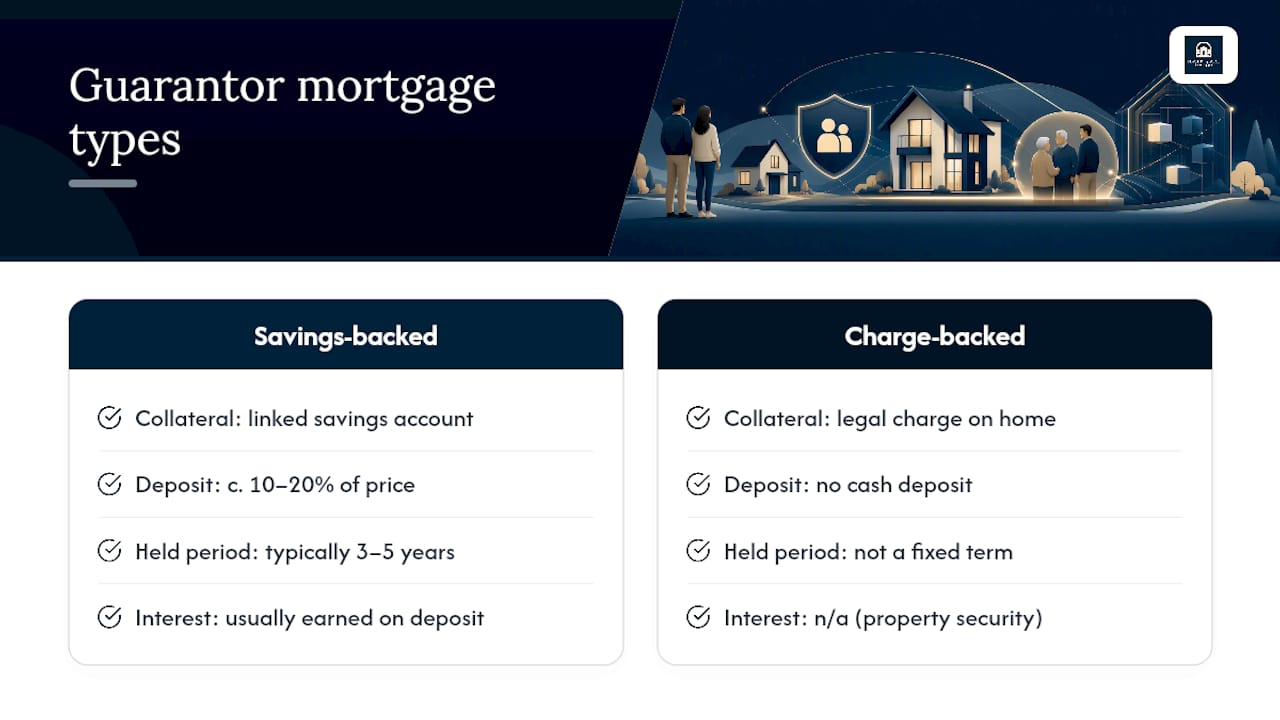
Lenders build guarantor deals around two main structures, and the difference matters enormously to the guarantor's exposure.
Savings-backed arrangements ask the guarantor to deposit a lump sum, often around 10% to 20% of the property price, into a linked savings account held by the lender for a set period, typically three to five years. The money usually earns interest and is released once the borrower has built enough equity or made payments reliably. If the borrower defaults, the lender can draw on that account, but the guarantor's loss is capped at whatever sits in it.
Charge-backed or property-secured guarantees work differently. The guarantor offers their own home as additional security, via a legal charge, rather than cash. This exposes their property to repossession if the borrower stops paying and the debt cannot be recovered another way. It is a far heavier commitment than a capped savings pot.
Separately, Joint Borrower Sole Proprietor (JBSP) arrangements and standard joint mortgages add the family member's income to the application without putting them on the title (JBSP) or by making them a co-owner with full liability (joint mortgage). JBSP can also carry different stamp duty consequences depending on the family member's existing property ownership, so this needs checking case by case.
Who can act as a guarantor and what do lenders check?
Most lenders want a close family member, typically a parent, though some accept grandparents or siblings. Common eligibility patterns include:
- UK residency and a sterling-denominated income
- An upper age limit at the end of the mortgage term, often around 70 to 75
- Sufficient equity or savings to support the guarantee
- A clean credit history with no recent defaults or missed payments
Lenders run full affordability and credit checks on the guarantor as well as the borrower, because FCA rules under MCOB 11.6 require this before approving the deal. Retired guarantors are usually accepted if pension income or assets meet the lender's threshold, but non-homeowners are often ruled out of charge-backed products since there's no property to secure against.
Expect to provide proof of income, three to six months of bank statements, ID and proof of address, and, for property-secured guarantees, a mortgage statement or title deed for the guarantor's own home.
What are the risks and legal responsibilities for guarantors?
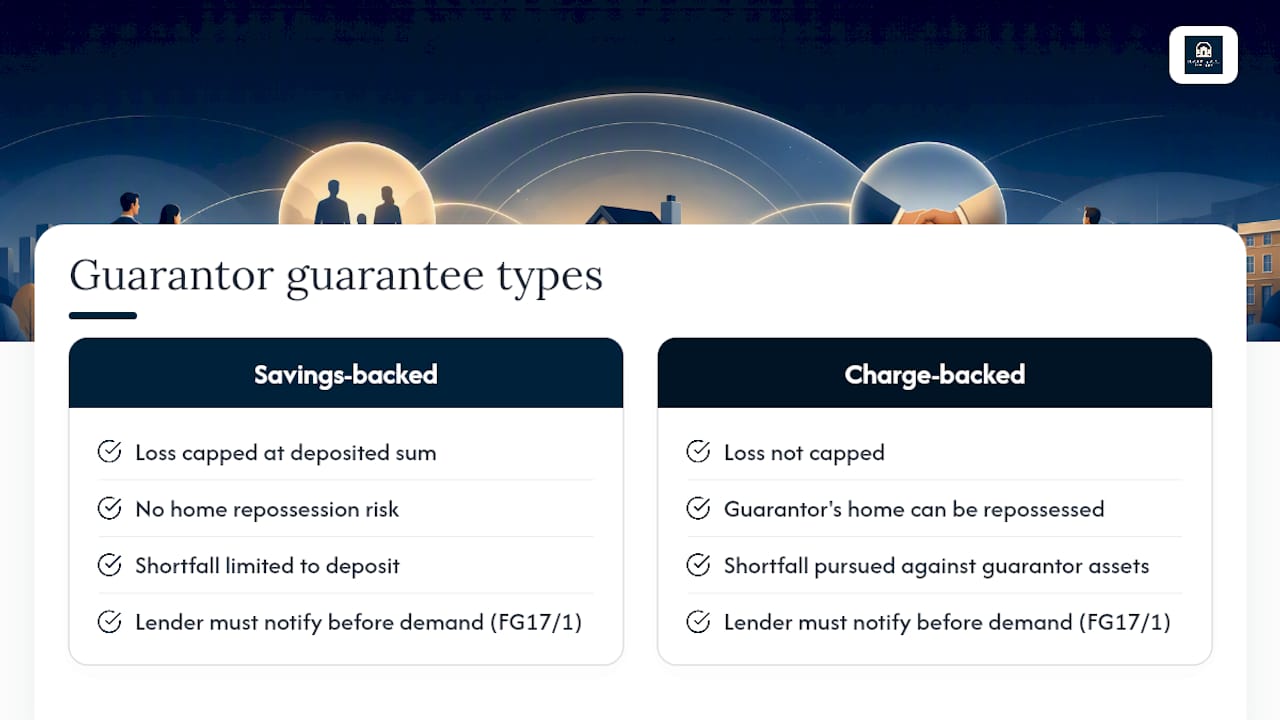
The scale of the risk depends entirely on which structure you sign up to. Savings-backed guarantees cap the loss at the deposited sum. Charge-backed guarantees do not; the guarantor's own home can, in the worst case, be repossessed if the borrower defaults and the shortfall cannot otherwise be recovered.
Pro Tip: Ask the lender exactly how any shortfall after repossession would be pursued, and whether the guarantee sits alongside or on top of your existing mortgage debt. Get this in writing before you sign anything.
FCA guidance FG17/1 sets out default-notice expectations, meaning lenders must notify a guarantor before demanding payment rather than acting without warning. Missed payments a guarantor is called on to cover can also appear on their own credit file, and Experian warns this can damage their ability to borrow in future.
Independent legal advice is not a box-ticking exercise here. A solicitor acting for the guarantor should confirm exactly what liability they are accepting, how and when it ends, and what happens if the relationship with the borrower breaks down.
How do lenders assess guarantor mortgage deals?
Lenders apply the same MCOB affordability rules to the guarantor's finances as they do to the borrower's, stress-testing both incomes against future rate rises rather than taking either at face value.
Some lenders, often through schemes referenced on Gov, offer up to 100% loan-to-value when a guarantor is in place, though the exact limit and criteria vary considerably by lender and are never guaranteed for any individual case.
Guarantor deals often carry higher interest rates than a standard mortgage with a substantial deposit, reflecting the lender's added underwriting complexity rather than the guarantor's presence alone. Release from the guarantee typically depends on:
- The borrower reaching a set equity threshold, often 80% to 90% loan-to-value
- A minimum period of consistent, on-time payments
- A formal remortgage once the borrower qualifies independently
Pro Tip: Ask upfront what specific loan-to-value figure triggers release, and get the lender to confirm it applies automatically rather than needing a fresh application.
What are the alternatives to a guarantor mortgage?
Guarantor deals aren't the only route into a property when savings or income fall short.
- Joint mortgages put both parties on the title with shared ownership and liability, which suits family members happy to co-own but adds complexity if one party later wants out.
- Gifted deposits hand over a lump sum with no ongoing liability once the gift is made, often the cleanest option for family members who don't want long-term exposure.
- Family offset accounts let a relative's savings reduce the interest charged on the mortgage without transferring ownership or risking their capital.
- Specialist high-LTV lenders, reached through a broker, can sometimes solve low-deposit or complex-income cases without any guarantor at all.
A gifted deposit or offset account tends to suit families uncomfortable with open-ended liability; a guarantor structure suits those willing to accept it in exchange for a stronger mortgage offer.
What should you ask a mortgage adviser before applying?
Before applying, both borrower and guarantor should run credit checks, gather evidence of savings or property ownership, and use free mortgage calculators & tools to estimate affordability before booking independent legal advice.
Worth asking any adviser directly:
- What are this lender's exact release conditions, and how are they confirmed in writing?
- Does this lender's policy allow removing a guarantor later without a full remortgage?
- Should the guarantor consider life or income protection cover given the exposure?
Pro Tip: If your income comes from contracting, self-employment, or overseas sources, a fixed-term contract mortgage guide is worth reading before you approach any lender, since standard affordability calculators often undervalue non-standard income.
Mortgage advice from a dedicated adviser throughout the case tends to catch lender-specific quirks before they derail an offer.
Is a guarantor mortgage the right choice for you?
Guarantor mortgages suit first-time buyers with a stable income but a thin deposit or short credit history, provided the guarantor fully understands and accepts the liability. They're a poor fit where the guarantor cannot comfortably absorb the worst-case outcome, or where a gifted deposit would achieve the same result with none of the ongoing risk.
Next steps: compare structures across lenders, arrange advice from an FCA-authorised adviser, and get independent legal review for the guarantor before signing. Remember that a guarantor's commitment can run for years and may limit their own future borrowing.
How Haven Mark Advisers can help with a guarantor mortgage
Guarantor arrangements involve two credit files, two affordability assessments, and lender criteria that shift constantly. Haven Mark Advisers assigns each client a single dedicated adviser for the entire process, rather than passing the case between different contacts, which matters when a deal depends on getting both the borrower's and the guarantor's paperwork aligned first time.

Mortgage advisers with experience supporting clients with non-standard income can help identify lenders more likely to accept a given guarantor structure and suitable release strategies. The firm's protection advice also covers income protection and life cover, relevant for any guarantor weighing up personal exposure. If you're weighing a guarantor mortgage against other routes, explore residential mortgage advice or check the fee structure before booking a first conversation.
Sources
For official rules, see GOV.UK on mortgage guarantee schemes, FCA MCOB 11.6, and consumer guidance from Which? and Experian.
This article is general information, not a substitute for advice from a qualified financial advisor. Consult a qualified financial professional about your own circumstances before acting on anything here.
FAQ
Are guarantor mortgages still available?
Yes, several lenders continue to offer them, though product ranges shift regularly, so availability and terms should always be confirmed directly with the lender or through an adviser.
Which banks offer guarantor mortgages?
Availability varies by lender and changes over time; a mortgage adviser can check current lender criteria against your specific circumstances rather than relying on a fixed list.
Can I get a 100% mortgage with a guarantor?
Some lenders offer up to 100% loan-to-value where a guarantor is in place, often through savings-backed or scheme-linked products, though limits and eligibility vary and are never guaranteed for any individual case.
Do banks accept guarantors for mortgages?
Many lenders accept guarantors, but each sets its own rules on relationship, residency, age, and income, and affordability checks under MCOB apply to the guarantor as well as the borrower.
Recommended
- Foreign National Mortgage in the UK: A Complete Guide
- Fixed term contract mortgage: what England lenders expect
- Avoid Completion Delays: 6 Step Gifted Deposit Rules for England Buyers
- Mortgage for Professionals: What Lawyers, Doctors and Self-Employed Need to Know
This article provides general information only and does not constitute personalised mortgage advice. Mortgage availability, affordability and lender criteria depend on individual circumstances and may change. Please seek advice tailored to your circumstances before acting on this information.