

IMPORTANT: YOUR HOME MAY BE REPOSSESSED IF YOU DO NOT KEEP UP REPAYMENTS ON YOUR MORTGAGE.
Most UK mortgage offers can be extended, but no lender is obliged to grant one. Extensions are discretionary, so the immediate action is simple: check the expiry date printed on your offer letter, then contact your adviser or broker and your lender straight away to flag the risk before the clock runs out.
TL;DR:
- Mortgage offer validity usually ranges from 3 to 6 months for existing homes and up to 270 days for some new builds, depending on the lender.
- Requests for extension should be made three to four weeks before the expiry date, with timing being critical to avoid rejection.
- Lenders re-verify income, employment, and credit details before granting extensions and may require updated documents or a fresh valuation if circumstances have changed.
- An extension is often reissued rather than requiring a full reapplication, but this depends on why the original offer lapse occurred and whether circumstances are unchanged.
- Using a dedicated adviser helps ensure timely extension requests, proper document preparation, and can prevent offers from lapsing due to conveyancing delays.
Table of Contents
- What is a mortgage offer extension, and how long does an offer last?
- How do you actually request an extension?
- What will lenders re-check, and what documents do you need?
- What happens if the extension is refused?
- How does a dedicated adviser reduce the risk of expiry?
- Do extensions cost anything?
- Why does conveyancing speed matter so much for your offer window?
- Does an extension change anything else in the purchase process?
- Get help before your offer expires
- Sources
- FAQ
What is a mortgage offer extension, and how long does an offer last?
A mortgage offer extension is a lender's agreement to push back the expiry date on an existing offer, rather than making you start a fresh application. Most UK lenders issue offers valid for a period that generally ranges from a few to several months on existing homes, though the exact duration varies by lender and product.
New builds work differently. Because construction delays are common, several lenders build in longer windows or separate extension rules for new-build purchases.
- Existing homes: typically 3 to 6 months from the date the offer is issued, according to guidance from Habito and other lender sources.
- New builds: some lenders allow up to 9 months, with 1 to 3 month extensions available in certain cases, per MortgageNotes.
- Nationwide's new-build rule: a standard 180-day offer with a 45-day extension for older offers, while offers issued after 26 June 2025 may run for 270 days with different extension terms attached.
Pro Tip: Never assume your offer follows the "standard" 6-month rule. Read the front sheet of your offer document. The expiry date is stated in black and white, and it's the only figure that matters for your case.
How do you actually request an extension?
Timing decides whether your request succeeds or gets rejected outright. Lenders often won't touch an extension request until you're inside a specific window before expiry, so acting too early can be just as unproductive as acting too late.
- Diarise the expiry date the day you receive the offer. Set a reminder for three to four weeks before that date, not the week before.
- Notify your adviser or broker at the three to four week mark. Practitioners advise this lead time because it gives lenders enough runway to process the request within their own internal deadlines.
- Check the lender's specific window. Some lenders, such as NatWest, offer a one-month extension and ask brokers to make contact directly to discuss the options available.
- Prepare your case summary before you call. Have your mortgage account or case number, current exchange or chain status, the reason for the delay, and confirmation of whether anything material has changed in your finances.
- Submit the request through your adviser where possible. A broker who already holds your file can move faster than a fresh call to a general enquiries line.
Getting the timing wrong is the single most common reason extensions stall. Contact too soon and the lender may simply tell you to call back later; contact too late and there may be no processing window left at all.
What will lenders re-check, and what documents do you need?
An extension is never automatic. Lenders use the request as a natural checkpoint to confirm nothing about your circumstances has shifted, and that check focuses squarely on income, employment and credit.
Have these ready before you ask:
- Your most recent payslips, or self-employed accounts if your income situation is non-standard.
- Up-to-date bank statements covering the last two to three months.
- Written confirmation of your exchange or chain status from your solicitor.
- Valid photo ID and proof of address, in case the lender's compliance checks have refreshed since your original application.
- Be prepared for a fresh valuation if the property or local market has moved since the offer was first issued.
Some lenders will not even open a case for review outside their permitted window, commonly a set number of days before expiry, so submitting documents too early can be as wasted an effort as submitting them too late.
What happens if the extension is refused?
A refusal is not the end of the purchase. It usually means one of three routes, and picking the right one quickly matters more than which one you eventually choose.
- Reissued offer: many lenders will reissue an offer rather than demand a completely fresh application, provided your circumstances are unchanged. This route can preserve much of the original underwriting, though the interest rate will reflect current market pricing at the point of reissue rather than the rate you originally locked in.
- Full reapplication: expect fresh affordability checks, a possible new valuation, and a new product rate. This is the slower option and should be treated as the fallback rather than the default.
- Renegotiating with the seller: reopening the price is generally a last resort, and most timing problems are solved through an extension or reissue long before price needs to enter the conversation.
Which route applies depends on why the offer lapsed. A short administrative delay usually gets a reissue; a genuine change in your income or credit position is more likely to trigger a full reapplication.
How does a dedicated adviser reduce the risk of expiry?
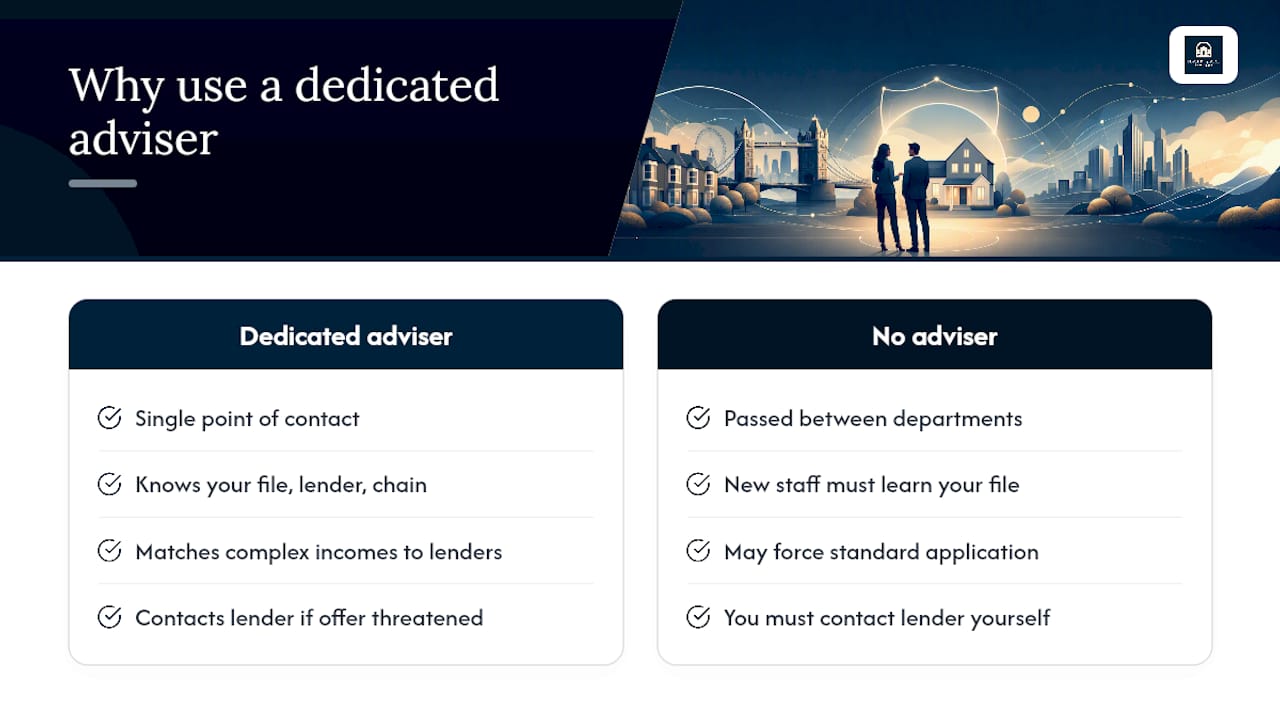
Case management is where most offers are saved or lost, and it happens quietly in the background long before the expiry date becomes urgent. Each client typically works with one dedicated adviser from application through to completion, which means no handovers between different people at tight timeline points.
That single point of contact typically covers:
- Diarising your offer's expiry date at the outset and checking conveyancing progress against it at regular intervals, rather than waiting for a crisis point.
- Liaising directly with lender operations teams so extension requests land inside the correct processing window instead of arriving too early or too late.
- Collating and submitting updated payslips, bank statements or chain confirmations quickly, so a lender can make a decision without unnecessary back-and-forth.
For clients with layered income, such as directors balancing salary and dividends, having documentation ready in the right format before a lender asks for it often makes the difference between a smooth extension and a stalled one.
Do extensions cost anything?
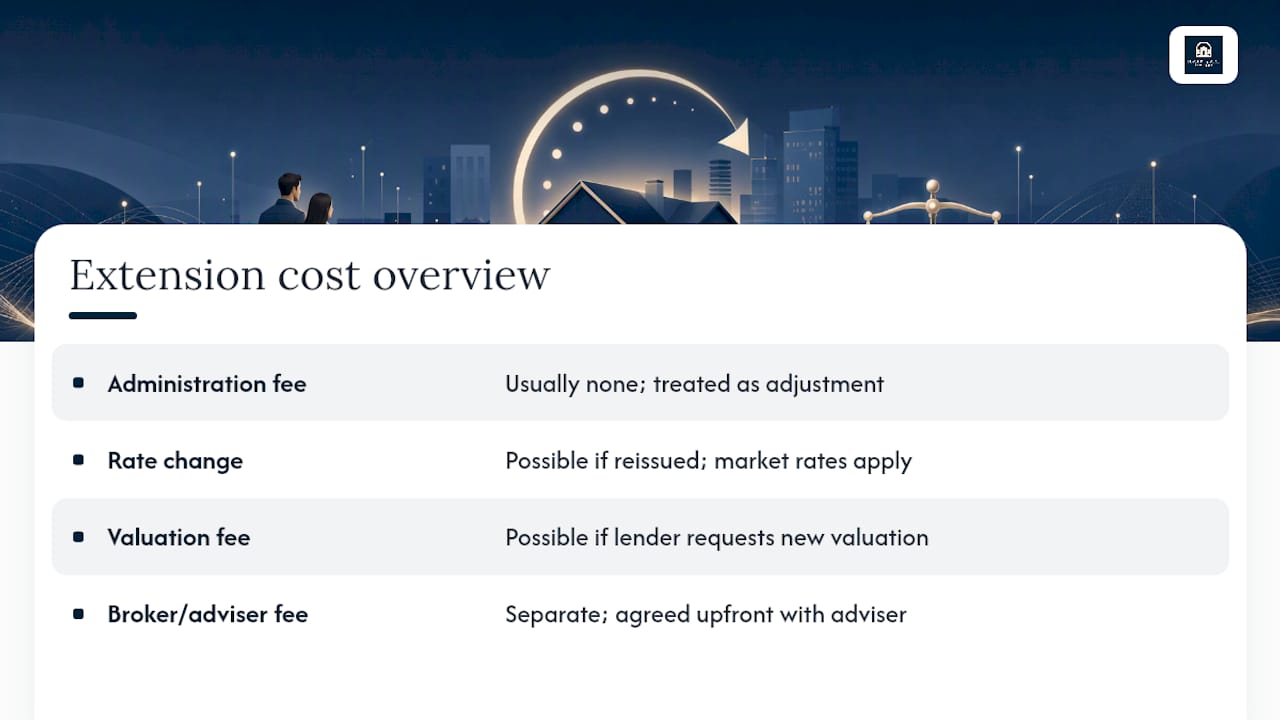
Lenders typically don't charge a separate administration fee for granting a straightforward extension on an existing offer, since it's usually treated as an operational adjustment rather than a new product application. Where a cost does appear, it tends to come from one of two sources rather than the extension itself.
The first is a rate change. If your offer is reissued rather than simply extended, the interest rate applied will generally reflect market pricing at the point of reissue, not the rate you originally secured. Given how much rates can move over several months, this is often the real financial impact of a lapsed offer, not a headline fee.
The second is a fresh valuation fee, which some lenders require if the extension request falls outside their normal window or if enough time has passed that they want an updated property assessment. This isn't universal, and whether it applies depends entirely on the lender's own policy and how far past the original timeline you are.
Broker or adviser fees are a separate matter entirely. If you're working through Haven Mark Advisers, the fee structure is agreed upfront as part of the original engagement, and requesting an extension on an existing case doesn't typically trigger a new charge. It's worth confirming the specifics with your own lender and adviser, since terms vary and a market-wide rule doesn't exist here.
Why does conveyancing speed matter so much for your offer window?
Conveyancing eats into your offer window faster than most buyers expect, which is exactly why extensions become necessary in the first place. Freehold purchases typically take 12 to 16 weeks from offer to completion, while leasehold purchases often run to 16 to 20 weeks, and that's assuming nothing goes wrong along the way.
Compare that against a standard six-month mortgage offer, and the maths gets tight quickly. A leasehold purchase running at the slower end of 20 weeks leaves less than six weeks of buffer inside a 26-week offer, and that buffer disappears fast if searches come back slowly, a chain link stalls, or a management pack takes longer than expected to arrive from a freeholder.
This is why monitoring conveyancing progress against your offer's expiry date isn't a nice-to-have, it's the mechanism that actually prevents a lapse. A solicitor working through searches at a normal pace on a straightforward freehold sale may comfortably beat the clock. A leasehold purchase with a slow-moving management company, or a chain involving multiple linked sales, is far more likely to run the offer close to its limit. Knowing which category your purchase falls into early on tells you how urgently to start planning for a possible extension request.
Does an extension change anything else in the purchase process?
An extension itself doesn't reopen your survey or restart your legal work, but it does interact with both in practical ways. Your solicitor's conveyancing timeline is usually the reason an extension becomes necessary in the first place, so keeping them updated on your offer's expiry date, and asking them to flag any slippage early, is one of the most useful things you can do as a buyer.
Surveys are a slightly different story. If a significant amount of time has passed since your original survey or valuation, particularly if the offer lapses entirely and needs reissuing, some lenders will want a fresh valuation to confirm the property's value hasn't shifted. This is more likely on a full reapplication than on a simple extension of an existing offer.
Your solicitor also plays a quiet but important role in supplying the evidence a lender wants for an extension request, particularly written confirmation of your chain or exchange status. Keeping that communication open between your adviser, your solicitor and your lender is often what separates a request that sails through from one that gets bounced back for missing information. This is exactly where a single adviser managing a remortgage or purchase case from start to finish earns its keep: nobody has to relay information between three separate parties who aren't talking to each other directly.
Get help before your offer expires
Clients usually have one dedicated adviser managing their case from application to completion, which can be important when an offer is at risk of lapsing. Instead of being passed between departments while your expiry date creeps closer, you have a single point of contact who already knows your file, your lender, and your chain status.

If your purchase involves a complex income picture, whether that's a legal partnership draw, a mix of salary and dividends, contractor day rates, or self-employed accounts, a specialist adviser can match your case to lenders whose criteria actually fit your circumstances, rather than forcing a standard application through a lender unlikely to say yes. Should your offer come under threat, your adviser contacts the lender directly, collates the documentation the lender needs, and submits the extension request inside the correct window, rather than leaving you to work out the lender's rules alone.
Haven Mark Advisers charges a purchase mortgage service fee of £495 one off, agreed upfront and set out in full on the fees page, so there are no surprises if your case needs extra attention closer to completion. If your offer is approaching its expiry date, or you're starting a purchase and want proactive case management from day one, get in touch through the residential mortgages page to speak with a dedicated adviser.
This article is general information, not a substitute for advice from a qualified financial advisor. Consult a qualified financial professional about your own circumstances before acting on anything here.
Sources
- How long do mortgage offers last? — MoneyHelper
- New build mortgage offer extension — Nationwide
- My cheap mortgage offer is about to expire — can I get it extended? — iNews
- Apply for a mortgage — NatWest
FAQ
Can I get an extension on my mortgage offer?
Often, yes, but it's never guaranteed. Extensions are discretionary and lenders will typically check that your income, employment and credit position haven't changed materially since the original offer.
How long does a mortgage offer extension take?
There's no single fixed processing time across all lenders. Some lenders only accept requests within a set window before expiry, commonly around 30 days, so timing your request correctly matters more than any universal turnaround figure.
How long are mortgage offers valid for in the UK?
Most existing-home offers run for around three to six months, while new-build offers can extend to 180 days or, for some lenders' newer offers, up to 270 days. Always check the exact expiry date printed on your own offer letter, since this varies by lender.
What happens if my mortgage offer expires?
If your offer lapses, most lenders will either reissue it, generally at the current market rate rather than your original one, or require a full new application with fresh affordability checks. A dedicated adviser can help you identify which route applies and move quickly to avoid unnecessary delay.
Recommended
- Remortgage Advice
- Fixed term contract mortgage: what England lenders expect
- 4–8-week remortgage timeline in England: why one adviser speeds complex cases
- Foreign National Mortgage in the UK: A Complete Guide
This article provides general information only and does not constitute personalised mortgage advice. Mortgage availability, affordability and lender criteria depend on individual circumstances and may change. Please seek advice tailored to your circumstances before acting on this information.