

IMPORTANT: YOUR HOME MAY BE REPOSSESSED IF YOU DO NOT KEEP UP REPAYMENTS ON YOUR MORTGAGE.
Getting a short lease mortgage is possible in England, but it depends entirely on how many years remain on the lease at completion and at the end of your mortgage term. Lenders set their own minimum unexpired terms, so a flat that one bank rejects outright may satisfy another's criteria. The 80 year mark matters most, since anything below it triggers marriage value and pushes up extension costs. The sections below cover thresholds, lender behaviour, and the practical steps that improve your chances.
TL;DR:
- Mortgages on short leases are primarily influenced by the number of unexpired years at both purchase and mortgage end, with firms often requiring more than 80 years remaining.
- Lenders vary greatly in their minimum lease length requirements, with some accepting as low as 40 years, while others reject anything below 80.
- Lease features such as escalating ground rent, RPI-linked reviews, or restrictive clauses can disqualify a property regardless of its remaining lease years.
- Extending a lease below 80 years incurs marriage value costs, which can significantly increase extension premiums and affect mortgage feasibility.
- A pre-application lender criteria review before making an offer helps identify potential mortgage hurdles specific to lease terms and property details.
Table of Contents
- What counts as a short lease and which lease lengths matter to lenders
- Why short leases complicate mortgages for lenders and valuers
- Practical routes: mainstream, specialist and short-term lending options
- Lease extension, marriage value and the 2024–2026 reforms
- Practical pre-application checklist for a short-lease mortgage
- Timing and likely costs: valuers, solicitors and extension premiums
- How a dedicated mortgage adviser supports short-lease mortgage cases
- Get a pre-application criteria review before you offer
- Sources
- FAQ
What counts as a short lease and which lease lengths matter to lenders
A short lease is generally anything under 90 years remaining, and lenders start paying close attention once the term drops toward 80 years. MoneyHelper's guidance for first-time buyers frames it plainly: the longer the lease, the better it is for both buyer and seller, and anything under 90 years is often labelled short in the property trade.
There are two dates that matter when you count the term, not one. The first is the unexpired term at your expected completion date. The second, easily overlooked, is the term remaining at the end of your mortgage. A lease with 75 years left might look fine today, but if you're taking a 35 year mortgage, the lender will look 35 years into the future and may decline the application because the projected remaining term falls too low.
Four thresholds crop up repeatedly in leasehold discussions: 90, 85, 80, and 70 years. The 80 year point carries particular weight because LEASE's guidance on extensions confirms that marriage value applies once a lease drops below that threshold, adding a real cost to any future extension.
Beyond the raw number of years, certain lease features raise flags on their own regardless of term length. Watch for:
- Stepped ground rent that doubles or escalates on fixed dates rather than staying flat
- RPI-linked rent reviews that make future costs harder to predict
- Onerous permission or event fees charged for alterations, subletting, or even pet ownership
- Restrictive alienation clauses that limit how freely the property can be sold or let
Any of these can make a lender nervous even on a lease with a perfectly respectable number of years left.
Why short leases complicate mortgages for lenders and valuers
A mortgage is only as good as its security, and a short lease reduces the value of that security in a way a freehold never does. Valuers use a method called relativity, comparing the value of a leasehold flat against an equivalent freehold or long-lease property, and that relativity percentage falls as the lease shortens. A property with 60 years left might be valued at a noticeably lower percentage of its freehold equivalent than one with 95 years remaining, and that gap widens sharply once you cross below 80 years.
This is where lender policy diverges most visibly. The Mortgage Lenders' Handbook sets out that individual lenders publish their own minimum unexpired-term requirements, and these vary widely across the market. Some set a floor of 40 years remaining at the end of the mortgage term; others want considerably more headroom. There's no single market-wide rule, which is precisely why checking one lender's criteria and assuming it applies everywhere is a mistake.
Statistic callout: Practitioner guidance from the Lenders' Handbook's Nationwide example makes clear that lenders assess the lease term at completion and again at the projected end of the mortgage term. A lease that clears the bar today can still fail that second check if the mortgage term stretches the unexpired years too thin.
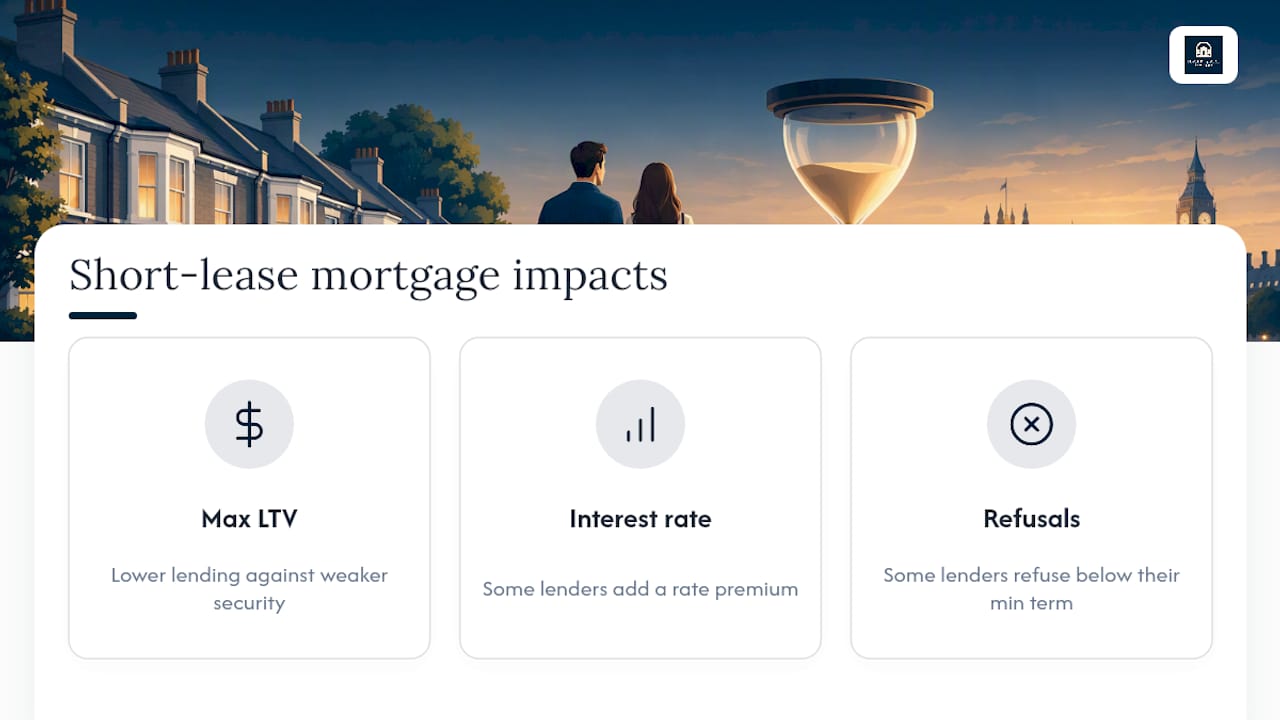
The practical consequences show up in three ways. First, maximum loan-to-value often drops on shorter leases, since lenders reduce their exposure against weaker security. Second, some lenders load the interest rate to reflect the added risk, though this isn't universal and depends entirely on the individual lender's risk appetite. Third, and most bluntly, some lenders decline the application altogether once the remaining term falls below their stated minimum. None of this is guaranteed either way. It depends on the specific lender, the specific property, and the specific mortgage term requested.
Practical routes: mainstream, specialist and short-term lending options
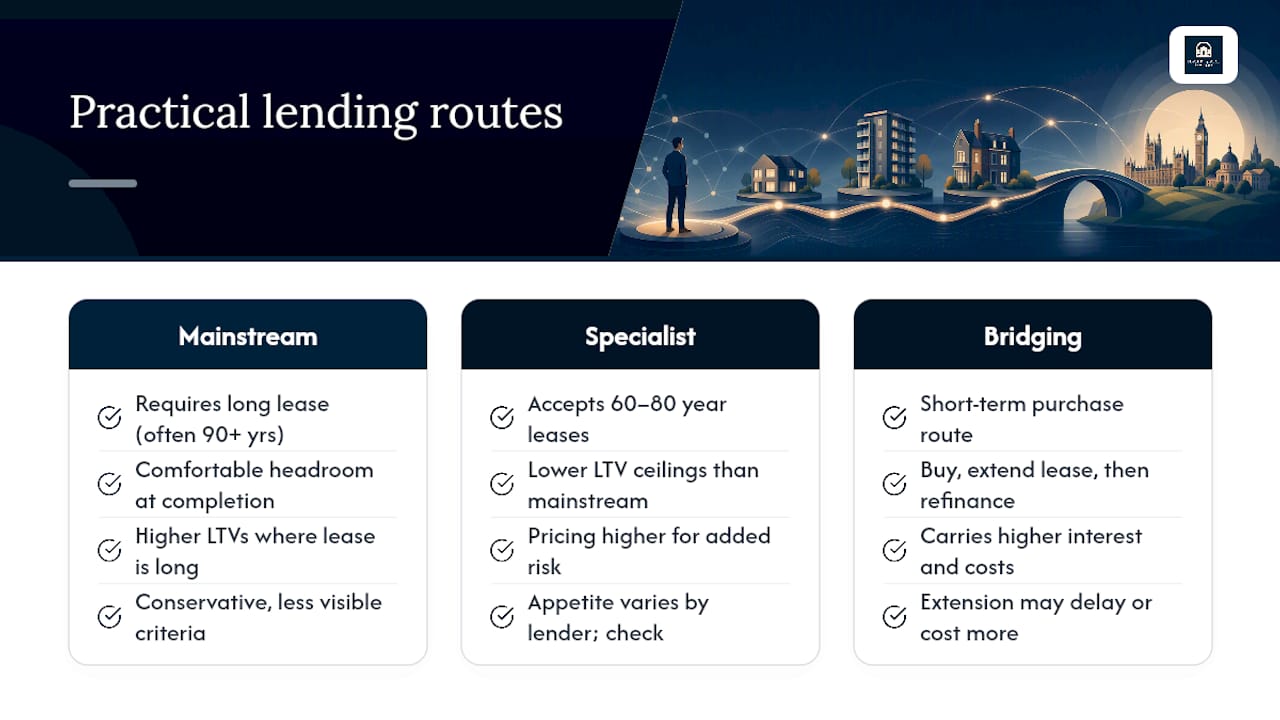
Mainstream high-street lenders tend to set the most conservative minimum unexpired-term requirements, often wanting comfortable headroom at both completion and mortgage-end. That works well for buyers with leases still safely above 90 years, but it rules out a chunk of the market on shorter leases.
Specialist lenders fill much of that gap. They're generally more willing to consider leases in the 60 to 80 year range, though loan-to-value ceilings on these cases are typically lower than on longer leases, and pricing reflects the additional risk they're taking on. The exact appetite varies lender by lender, and criteria change, so a pre-application check against current published lender criteria is worth doing before you fall in love with a property.
Short-term bridging finance is the third route, used less often but sometimes sensibly. A buyer might use a bridge to purchase a short-lease property in cash terms, complete a statutory lease extension, then refinance onto a standard mortgage once the lease is longer and the property is easier to mortgage conventionally. This route carries its own costs and risks, including bridging interest rates and the possibility that the extension doesn't complete as smoothly or cheaply as hoped.
Pro Tip: If you're considering bridging to buy and extend, get the extension premium estimated by a qualified valuer before you commit to the bridge. Bridging costs accumulate quickly, and an extension that runs long or costs more than expected can erode the financial sense of the whole strategy.
Because criteria differ so much between mainstream and specialist lenders, and because they change without much public notice, matching a specific case to the right lender is rarely a job for guesswork. FCA research on intermediary handling of complex cases points out that lenders' detailed decision criteria aren't always visible before you apply, which is exactly why a pre-application review matters more on leasehold cases than on straightforward freehold purchases. Buyers with complex income, such as contractors or the self-employed, face this compounding problem twice over: a mortgage for the self-employed and business owners already needs careful lender selection, and a short lease adds a second layer of criteria to satisfy simultaneously. The same logic applies to leasehold buy-to-let purchases, where lender appetite for short leases can differ again from owner-occupier criteria.
Lease extension, marriage value and the 2024–2026 reforms
Extending a lease under the statutory process typically adds 90 years to the existing term and reduces the ground rent to a peppercorn, meaning effectively nil. That's a meaningful change to a property's mortgageability and its long-term value, but it comes at a cost, and the size of that cost hinges heavily on marriage value.
Marriage value is the added worth created when a short lease is extended, calculated as the difference between the property's value before and after the extension. LEASE's guidance confirms this only applies once the lease drops below 80 years remaining, which is why that threshold gets mentioned so often in leasehold circles. Below 80 years, half of that marriage value typically gets paid to the freeholder on top of the standard premium, which can turn a moderate extension cost into a substantial one.
The Leasehold and Freehold Reform Act changes the picture for some buyers. Gov sets out reforms intended to make extending a lease cheaper and easier, including the removal of marriage value in many cases and proposals to cap ground rents going forward. Exactly how and when these changes apply to a given lease depends on the detail of the reform's implementation, so checking the current GOV.UK position before assuming a lower cost applies to your case is essential.
Timing the extension against your purchase is a genuinely personal decision rather than a one-size-fits-all rule. LEASE advises that waiting for reform can make sense for some buyers, but it isn't a universal recommendation. If you need to complete a purchase now, waiting isn't always practical, and a seller's informal promise to extend before completion generally isn't something a lender will accept as sufficient security in its own right.
Practical pre-application checklist for a short-lease mortgage
Gathering the right paperwork before you apply saves weeks of delay and avoids a declined application derailing your chain. Work through these steps in order:
- Confirm the unexpired lease term at your expected completion date, then recalculate it at the end of your intended mortgage term.
- Request the ground rent schedule in writing, including any review dates, RPI links, or doubling clauses.
- Obtain recent service charge accounts and check for any pending major works or disputed charges.
- Ask the seller or freeholder directly whether a lease extension has been started, discussed, or promised informally.
- Instruct your conveyancer early to review the lease for onerous clauses, such as high event fees or restrictive alienation terms.
- Check the title at the Land Registry to confirm the registered lease length matches what you've been told.
- Run a pre-application lender criteria review against the unexpired term at both dates, rather than assuming your preferred lender will accept it.
Involving your conveyancer at this stage, rather than after an offer's accepted, means lease problems surface while you can still negotiate the price or walk away. A seller's verbal assurance about a future extension carries no weight with most lenders, who generally want to see a legally completed extension or a clearly binding contractual arrangement before they'll release funds.
Timing and likely costs: valuers, solicitors and extension premiums
A standard purchase runs roughly 8 to 12 weeks from offer to completion, though leasehold cases with lease queries often take longer while the lender's valuer and your conveyancer work through the lease terms. If you're pursuing a statutory lease extension alongside the purchase, add several more months, since the formal notice and negotiation process doesn't move quickly.
The main costs break down as follows:
- Valuation fee, usually paid by the buyer, covering the lender's mortgage valuation
- Solicitor's fees, covering both the purchase conveyancing and any lease extension work
- Landlord's reasonable costs, which the leaseholder typically pays as part of a statutory extension claim
- The extension premium itself, which varies enormously depending on the unexpired term and the property's value
Statistic callout: LEASE's guidance on professional valuation warns that small changes in valuation assumptions, such as the relativity percentage a valuer applies, can shift an extension premium by thousands of pounds. This is why a proper professional valuation, not a rough online estimate, is worth commissioning before you commit to a figure.
If your offer is due to expire before completion finishes, it's worth knowing how to extend a UK mortgage offer without restarting the whole application, since lease queries are a common cause of delay.
How a dedicated mortgage adviser supports short-lease mortgage cases
Short-lease cases rarely fit a single lender's box, which is why Haven Mark Advisers assigns each client one dedicated adviser from first enquiry through to completion. That continuity matters on leasehold cases specifically, where lender criteria, lease documentation, and conveyancer queries all need tracking against the same file rather than passed between different points of contact.
The firm's relevant services for short-lease buyers include purchase mortgage advice, remortgaging on existing leasehold properties, and coordination with conveyancers to keep lease queries from stalling a chain. For professional buyers juggling a leasehold purchase alongside complex income documentation, such as lawyers or finance professionals, having one adviser manage both threads reduces the risk of a lease issue and an income query colliding at the worst possible moment.
[author_bio] [brand_signal]
Get a pre-application criteria review before you offer
If you're weighing up a leasehold flat with a shorter lease, the riskiest moment is putting in an offer before anyone has checked whether a lender will actually accept the security. A paid pre-application review can check lease documentation against current lender criteria, flag likely barriers before they become a declined application, and match cases to lenders whose published minima the property might actually satisfy.

Fee transparency is part of the offer: the purchase mortgage service costs £495 one off, payable on completion, and full details of how fees work are published on the fees page. No review can guarantee acceptance, borrowing, or a specific rate. Lender criteria change, and every lease case has its own set of quirks, so an initial review is a sensible step before you commit to an offer, not a substitute for the lender's own underwriting decision. If joint ownership is part of your plans, it's also worth understanding how ownership splits affect a purchase before you go further.
To get started, contact Haven Mark Advisers about a residential mortgage or remortgage review, and a dedicated adviser will talk you through what documents to gather first.
Sources
- MoneyHelper — First-time home buyer guide
- LEASE — Lease extension and reform guidance
- FCA occasional paper 35 — intermediary research
- Gov
FAQ
Can I get a mortgage with a short lease?
Sometimes, depending on the unexpired term at completion and at the end of your mortgage term, plus the specific lender's minimum requirements. The Mortgage Lenders' Handbook confirms lenders set their own minima rather than following one market-wide rule, so checking criteria before offering matters.
What is the shortest lease for a mortgage?
There's no single figure, since each lender publishes its own minimum unexpired-term requirement rather than following an industry standard. Leases under 80 years attract marriage value on extension according to LEASE's guidance, which tends to make lenders more cautious below that point.
What is the shortest mortgage term you can get in the UK?
This question usually confuses mortgage term length with lease term length, which are different things. Mortgage terms typically run from around 5 years up to 35 or 40 years, while lease length is a separate factor about the property's leasehold security that lenders assess independently.
Can I get a mortgage on a temporary contract in the UK?
Some lenders will consider contract or temporary work, particularly where income history and contract renewal patterns are documented clearly, though criteria vary significantly between lenders. This sits outside the scope of leasehold lending specifically, but the same principle applies: pre-application lender matching improves the odds of finding a lender whose criteria fit an unconventional income profile, which Haven Mark Advisers can help review through its mortgages for day-rate contractors service.
Recommended
- 25% or Less: 2026 FCA and Interest Only Mortgages in England
- Fixed term contract mortgage: what England lenders expect
- 30 Days to Extend a UK Mortgage Offer Without Reapplying
This article provides general information only and does not constitute personalised mortgage advice. Mortgage availability, affordability and lender criteria depend on individual circumstances and may change. Please seek advice tailored to your circumstances before acting on this information.