

IMPORTANT: YOUR HOME MAY BE REPOSSESSED IF YOU DO NOT KEEP UP REPAYMENTS ON YOUR MORTGAGE.
Yes, most umbrella company contractors can secure a mortgage, but lender choice and how you present your income decide how much you can borrow. Some lenders assess payslips alone; others annualise your day rate, which can produce a very different figure. Start by gathering three to six months of payslips, your current assignment schedule, and recent bank statements, or speak to a specialist adviser before applying.
TL;DR:
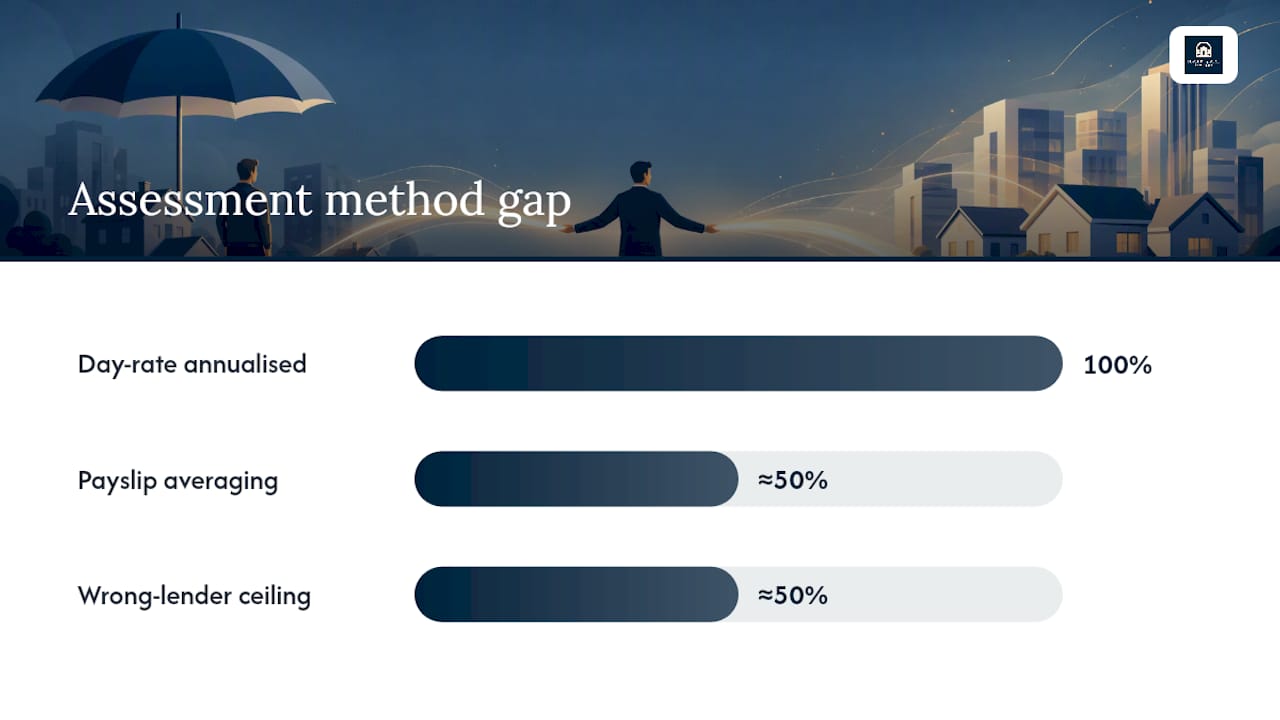
- Lenders’ assessment method, either payslip averaging or day-rate annualisation, can significantly impact borrowing capacity, with some models halving the available loan.
- Providing a clear contract with the actual end client and detailed assignment history boosts the chances of mortgage approval for umbrella contractors.
- Larger deposits of 15% or more improve loan-to-value ratios and access to better rates, especially with stronger contract continuity evidence.
- Avoiding mid-contract changes, unexplained gaps, or submitting incorrect documents with the umbrella provider can prevent application delays or declines.
- Consulting a specialist contractor mortgage adviser can optimize lender choice, improve documentation presentation, and streamline the process from application to offer.
Table of Contents
- Eligibility criteria: what lenders commonly require from umbrella workers
- How lenders assess umbrella income: payslip vs day-rate methods
- Documents lenders want and how to present them
- How much could you borrow: multipliers and worked examples
- How to strengthen your application and when to bring in an adviser
- What to expect from submission to offer
- Impact of umbrella company fees on mortgage affordability
- Common pitfalls and red flags to avoid
- Get specialist support for your umbrella contractor mortgage
- Sources
- FAQ
Eligibility criteria: what lenders commonly require from umbrella workers
Lenders vary, but most look for a similar shape of evidence before approving an umbrella contractor mortgage. Contracting history matters: many lenders want to see a stable work record over several months, though short gaps between contracts may be acceptable if reasonably explained.
- Contract length remaining: often three to six months, with stronger cases showing a renewal history or written confirmation of further work.
- Deposit and loan-to-value: mainstream lenders typically expect at least 5 to 10% deposit, though better rates usually sit at 15% and above.
- Credit standing: a clean credit file with no recent missed payments strengthens every other part of the case.
- Umbrella deductions: employer's National Insurance, apprenticeship levy and margin can all reduce the net figure a lender actually uses.
- IR35 status: inside IR35 assignments are generally treated the same as standard employment income once payslips confirm consistent PAYE pay.
None of this is fixed market-wide. One lender's stance on contract gaps or deposit size is not a rule every other lender follows, so the practical answer is to check current criteria before assuming you qualify.
How lenders assess umbrella income: payslip vs day-rate methods
Lenders use one of two broad approaches, and the difference between them can be substantial.
- Payslip averaging: the lender takes your PAYE payslips, commonly three to six months' worth, and averages the gross or net figure shown. P60s often support this where a full tax year is available.
- Day-rate annualisation: the lender multiplies your day rate by five days and by a set number of working weeks, commonly 46 or 48, to produce an annualised income figure. Where both a payslip and a contract are available, many lenders apply a "lower of" rule and use whichever figure is smaller.
High street lenders tend to default to payslip averaging because it mirrors standard employed underwriting. Specialist and contractor-focused lenders are more likely to offer day-rate annualisation, which usually produces a higher assessed income for contractors on strong day rates.
The gap between methods is not trivial. Guides on contractor mortgage assessment show that a contractor on a solid day rate can see meaningfully lower borrowing when a lender only looks at payslips rather than annualising the contract. One industry guide goes further, warning that picking the wrong lender can roughly halve your assessed income compared with a lender that uses day-rate annualisation. That single choice of lender, more than almost anything else in the application, tends to set the ceiling on what you can borrow.
Documents lenders want and how to present them
Most umbrella contractor mortgage applications need a similar document pack, though individual lenders may ask for extras. Santander's intermediary guidance lists payslips, P60s, and the contract with the firm you actually work for, not the umbrella company itself. That last point trips up more applicants than any other single documentary requirement.
- Three to six months of payslips, matched against bank statements showing the same deposits.
- P60 for the most recent full tax year, where available.
- Current assignment schedule or contract, ideally showing the end client.
- Three to six months of personal bank statements.
- Proof of ID and address, as with any mortgage application.
NatWest's contractor guidance confirms lenders often want contract evidence tied to the end client rather than the umbrella company, to verify the work is genuinely ongoing. Ask your umbrella company for an itemised payslip breakdown if deductions look confusing on the standard version, and annotate any unusual bank statement entries before submission so an underwriter doesn't have to ask.
Pro Tip: If your payslip shows large expense deductions, request a written employment confirmation letter from your umbrella company clarifying which lines are reimbursed expenses rather than reduced pay. It can prevent an underwriter reading your income as lower than it actually is.
How much could you borrow: multipliers and worked examples
Most mainstream lenders apply an income multiple of around four to 4.5 times assessed annual income, though specialist lenders sometimes go higher for strong contracting evidence.
- Payslip-based example: a contractor with average gross payslip income of £45,000 a year, assessed at 4.5 times income, reaches a maximum loan of roughly £202,500.
- Day-rate example: the same contractor on a £350 day rate, annualised at 46 weeks, produces a gross income of £80,500, which at 4.5 times could support borrowing closer to £362,250, subject to the lender's own affordability checks.
- Deposit effect: a larger deposit, say 20% rather than 10%, usually opens access to more competitive rates and sometimes higher multiples from specialist lenders.
These figures are illustrative, not a promise of what any lender will offer. Every case depends on credit history, existing commitments, and the specific lender's affordability model. A mortgage payment calculator is a useful way to sense-check what a given loan amount means in monthly terms before you commit to an application. If your contract history is short or your day rate is high relative to your payslip figure, clearer written evidence of contract renewals tends to matter more than almost anything else in pushing a lender toward the higher multiple.
How to strengthen your application and when to bring in an adviser
A few practical fixes make a genuine difference before you submit anything. Tidy your bank statements so deposits are traceable and consistent. Pause large discretionary expense claims through your umbrella company for a few months if you can, since they can distort your net pay. Gather any renewal paperwork or written confirmation of future assignments, since continuity evidence carries more weight with underwriters than a verbal assurance the contract will continue.
- Correct any payslip anomalies with your umbrella provider before applying, not after.
- Avoid applying mid-contract change; wait until your new assignment is confirmed in writing.
- Keep a folder of assignment schedules going back at least a year, even between different clients.
This is also the point where a specialist adviser earns their fee. A broker who works with contractor mortgages regularly knows which lenders annualise day rates, which want additional evidence, and how to package a case so an underwriter isn't left guessing. Haven Mark Advisers assigns each client a single dedicated adviser throughout the process, which tends to keep queries and paperwork moving faster than a case handled by several different points of contact. That single-adviser model also carries into protection planning, where income protection or life cover can matter more for a contractor without sick pay or employer benefits than for someone in permanent employment.
Pro Tip: If you're inside IR35 and paid via umbrella, treat your application timing carefully. Applying just after a payslip anomaly or during a gap between assignments is the single most common reason otherwise strong cases get delayed.
What to expect from submission to offer
A typical umbrella contractor mortgage takes several weeks from submission to formal offer, though this varies by lender and how complete your paperwork is at the outset.
- Pre-application checks: gathering payslips, contracts and bank statements, ideally before you start looking at properties.
- Submission and initial underwriting: usually the first one to two weeks after a full application goes in.
- Full underwriting and valuation: often the longest stage, particularly if a lender queries payslip deductions or wants further contract evidence.
- Formal offer: issued once underwriting and valuation are both complete.
Fees typically fall into three categories: an adviser or broker fee, often payable on completion; a valuation fee, usually payable upfront or added to the loan; and conveyancing costs, which run separately from the mortgage itself. Haven Mark Advisers' fee structure sets out when its own fee becomes payable so there are no surprises partway through a case.
The most common delay trigger is incomplete documentation submitted at the outset, followed by payslip figures that don't obviously match bank statement deposits. Regulatory direction may ease some of this friction: the FCA's CP26/18 consultation is examining whether lenders should be encouraged to assess self-employed and contract income on a broader, more realistic basis rather than rigid monthly patterns, and industry coverage suggests this could gradually widen access for contract workers. Nothing here is guaranteed, and current lender criteria still apply until any changes take effect.
Impact of umbrella company fees on mortgage affordability
Umbrella company deductions sit at the centre of most affordability disputes, and lenders read them differently depending on their assessment method. Every umbrella payslip includes employer's National Insurance, apprenticeship levy contributions and the umbrella's own margin before you ever see your net pay. A lender using payslip averaging works from the figure left after all of that, which is why two contractors on the identical day rate can show very different mortgage affordability purely because their umbrella providers structure deductions differently.
Broker guidance on umbrella contractor mortgages notes that the main practical advantage of umbrella pay is straightforward, verifiable PAYE payslips, since there's no need to prove dividend income or navigate limited company accounts. The trade off is that deductions reduce the number a payslip-only lender sees, sometimes significantly, compared with the gross contract value.
This is exactly where lender choice becomes a financial decision rather than an administrative one. A day-rate lender looks past the umbrella deductions entirely and works from your contracted rate, which can restore much of the borrowing power a payslip-only assessment would miss. If your umbrella statements show heavy deductions relative to your day rate, it's worth checking whether a lender that annualises contract income would treat your case more favourably before assuming your payslip figure is the ceiling on what you can borrow.
Common pitfalls and red flags to avoid
Certain mistakes come up again and again in umbrella contractor mortgage applications, and most are avoidable with a bit of preparation.
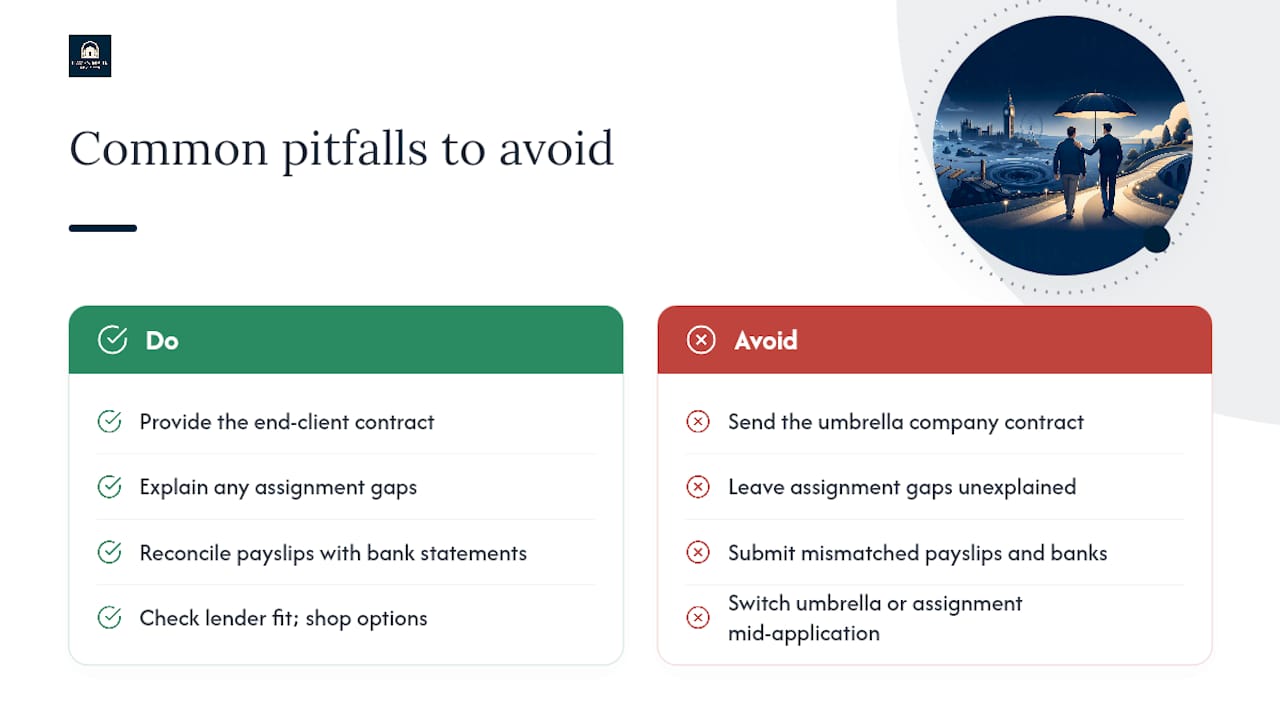
Submitting a contract with the umbrella company instead of the end client is one of the most frequent errors. Lenders like Santander specifically ask for the contract with the firm you actually work for, not the umbrella's own paperwork, and sending the wrong document can stall a case for weeks while it's corrected.
Unexplained gaps between assignments are another common flag. A short gap is often fine if you can show it and explain it, but silence invites an underwriter to assume the worst about ongoing employment stability. Mismatched figures between payslips and bank statements, often caused by expense reimbursements or delayed payments, also trigger extra scrutiny and slow underwriting down considerably.
Applying mid-contract change is a quieter but equally damaging mistake. Switching umbrella providers, changing day rate, or starting a new assignment partway through an application can force a lender to restart affordability checks from scratch. And relying on a single lender's rejection as proof you can't get a mortgage is perhaps the costliest error of all. One lender's payslip-only policy says nothing about how a day-rate specialist lender would view the identical case, which is exactly why lender selection deserves as much attention as the paperwork itself.
Get specialist support for your umbrella contractor mortgage
Some specialist mortgage advisers provide umbrella contractors with a single dedicated adviser who understands the difference between payslip averaging and day-rate annualisation, and who knows which lenders currently favour each. Rather than juggling a call centre queue and re-explaining your contract history to a new person each time, you work with one adviser from first enquiry through to completion.

That matters most for contractors whose day rate tells a stronger story than their payslip does, or whose IR35 status and umbrella deductions have muddied a case a mainstream lender might otherwise decline. Specialist mortgage advisers often work across residential purchases, remortgages and protection planning for contractors and other professionals with complex income, drawing on access to a broader range of UK lenders than most individual applicants could research alone. If you're weighing up whether your current documentation would satisfy a payslip lender or a day-rate lender, a conversation with a specialist contractor mortgage adviser is a sensible next step before you submit anything formally. You can also explore residential mortgage options directly to see how the single-adviser process works from enquiry to offer.
This article is general information, not a substitute for advice from a qualified financial advisor. Consult a qualified financial professional about your own circumstances before acting on anything here.
Sources
- FCA consultation paper CP26/18
- Santander: self-employed income and accountant's certificate guide
- Contractor mortgages: day rate, umbrella & CIS explained (MortgageAffordability)
FAQ
Are umbrella companies legal in the UK?
Yes. Umbrella employment is a recognised way to be paid, though HMRC continues to scrutinise the sector to catch non-compliant schemes, so it's worth checking your umbrella company operates correctly under Gov.
Is HMRC cracking down on umbrella companies?
HMRC maintains ongoing oversight of umbrella arrangements to identify non-compliant tax practices, but this scrutiny targets specific bad actors rather than umbrella employment as a whole, and it shouldn't affect a mortgage application where your payslips and deductions are straightforward.
Why do contractors use umbrella companies?
Umbrella companies handle PAYE tax and National Insurance automatically, which produces the kind of verifiable, standard payslip that many mainstream mortgage lenders are already set up to assess, unlike limited company dividend income.
Which lender is best for an umbrella contractor mortgage?
There's no single best lender, since some favour payslip averaging while others annualise your day rate, and the right choice depends on your contract length, rate and deposit. A specialist adviser can match your specific case to the lenders most likely to assess it favourably.
How many months of payslips do I need for a contractor mortgage?
Most lenders ask for three to six months of recent payslips alongside matching bank statements, though some specialist lenders will consider shorter histories if your contract evidence is strong.
Recommended
- Contractor Mortgage for UK Contractors: How to Qualify
- Mortgages for Day-Rate Contractors
- Contractor Remortgage: A Practical Guide for UK Contractors
- Fixed term contract mortgage: what England lenders expect
This article provides general information only and does not constitute personalised mortgage advice. Mortgage availability, affordability and lender criteria depend on individual circumstances and may change. Please seek advice tailored to your circumstances before acting on this information.