

IMPORTANT: YOUR HOME MAY BE REPOSSESSED IF YOU DO NOT KEEP UP REPAYMENTS ON YOUR MORTGAGE.
Yes, a holiday let mortgage is available in England, but it sits in a specialist corner of the market and usually demands a deposit of at least 25%. Tax rules changed materially after the Furnished Holiday Lettings regime ended, which reshapes how net returns and affordability should be modelled. If your income is complex, whether from self-employment, dividends, or contracting, specialist advice with proactive case management tends to smooth the path to an offer considerably.
TL;DR:
- Most holiday let mortgages in England require a minimum deposit of 25%, with higher loan-to-value options being rare and often limited to favorable circumstances.
- Lenders assess holiday rental income based on seasonal projections and occupancy assumptions, typically around 30 weeks annually, with strict stress testing at above-market interest rates.
- Eligibility generally demands a personal income between £20,000 and £40,000, with self-employed or contractor applicants needing comprehensive income verification and proper documentation.
- Post-2025 tax changes mean owners now face mortgage interest restrictions similar to buy-to-let, making tax planning and ownership structure decisions more critical.
- Interest-only remains common, with higher interest rates than standard buy-to-let loans, and a well-prepared application, including seasonal rental projections, speeds up approval.
Table of Contents
- What is a holiday let mortgage, and how does it differ from buy-to-let?
- How much deposit do you need for a holiday let mortgage?
- How do lenders assess seasonal holiday rental income?
- What are the eligibility rules for a holiday let mortgage?
- How has the end of the Furnished Holiday Lettings regime changed the numbers?
- What are typical holiday let mortgage rates and terms?
- How do I prepare a holiday let mortgage application?
- Why work with a specialist mortgage adviser for a holiday let purchase?
- Further reading and primary sources
- Sources
- FAQ
What is a holiday let mortgage, and how does it differ from buy-to-let?
A holiday let mortgage is a specialist form of property finance for homes let out on a short-term basis to holidaymakers rather than long-term tenants. Lenders assess it against seasonal rental income projections, not standard residential affordability, because the property's earning pattern is fundamentally different to a tenanted buy-to-let.
That distinction matters when you're choosing which product to apply for. A standard buy-to-let mortgage assumes a tenant on an assured shorthold tenancy paying rent monthly, all year round. A second-home mortgage assumes the property is mainly for your own use, with letting either banned outright or heavily restricted. A holiday let mortgage sits between the two: the lender expects the property to generate income from multiple short bookings across the year, often concentrated in peak season, and underwrites accordingly.
- Holiday let mortgage: for a property let commercially on a short-term basis, income assessed via seasonal rental projections.
- Buy-to-let mortgage: for a property let on a standard tenancy, income assessed on monthly rent.
- Second-home mortgage: for a property mainly used by the borrower, letting usually restricted or disallowed.
Not every property qualifies, and lenders publish exclusion lists worth checking before you fall in love with a listing. Holiday parks, caravans and mobile homes are commonly refused outright, and some lenders also decline certain flats, particularly above commercial premises, or properties without formal letting consent from a freeholder or management company. Others set a minimum property value, so a bargain fixer-upper in a remote spot might not clear the bar even if the numbers otherwise work. If you already hold a standard buy-to-let mortgage or are weighing up a second home instead, it's worth comparing all three routes before committing to one, because the wrong product can mean reapplying from scratch later.
How much deposit do you need for a holiday let mortgage?
A handful of lenders will stretch to 80% LTV in favourable circumstances,, but this remains the exception rather than the rule, and it's rarely available to first-time landlords or on lower-value properties.
Deposit size is only part of the cash-to-complete picture. Buying a holiday let in England as an additional property almost always triggers the SDLT surcharge for additional properties, on top of standard stamp duty bands. On a £300,000 property, for example, the surcharge adds several thousand pounds to your completion costs before you've even accounted for the deposit itself, valuation fees, legal fees and any lender arrangement fee.
A few points worth building into your budget:
- Deposit: typically 25% minimum, occasionally lower with a strong case, rarely below that.
- SDLT surcharge: applies to most additional-property purchases in England, calculated on the full price.
- Fees: product fees, valuation fees and legal costs vary by lender and case complexity.
Some lenders also cap the loan amount below the maximum LTV if the projected rental income doesn't stretch far enough to cover the mortgage under their stress test, regardless of how large a deposit you're prepared to put down. Deposit size and income coverage work together, not independently.
How do lenders assess seasonal holiday rental income?
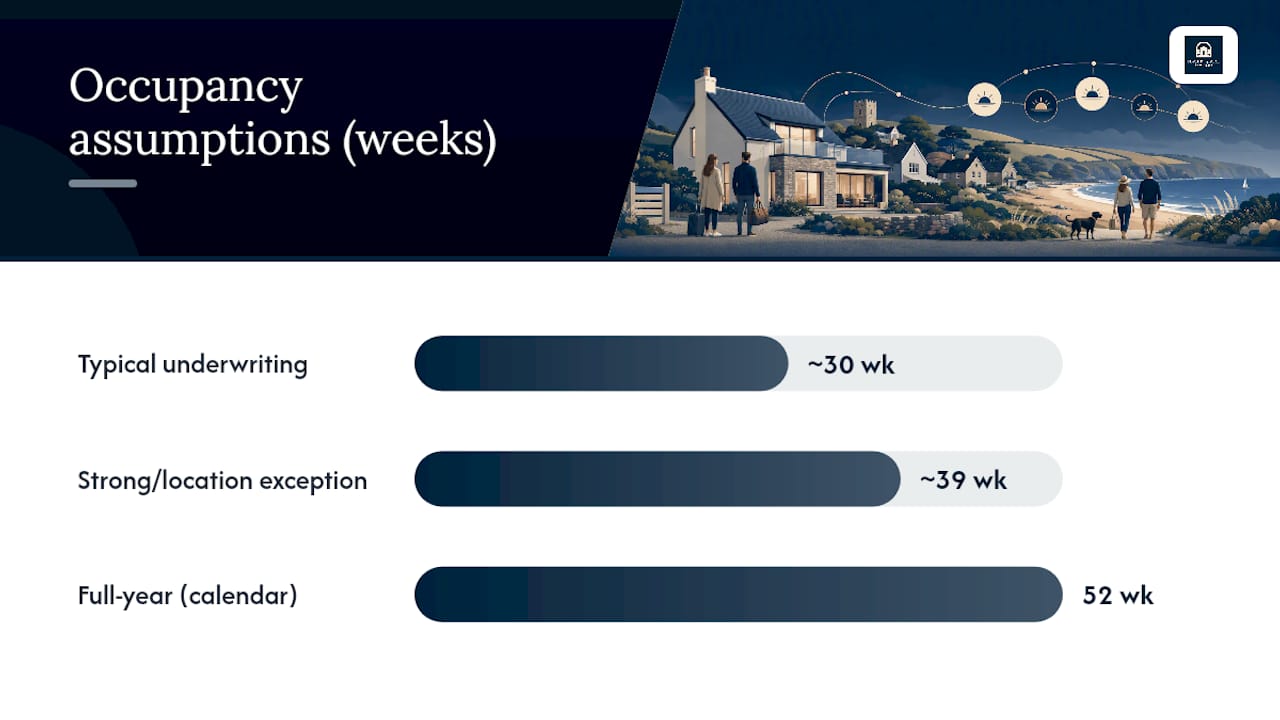
Lenders don't take your best summer week and multiply it by 52. Instead, they typically ask a letting agent to project low, mid and high season weekly rental rates, average those figures, and apply an assumed occupancy level, commonly around 30 weeks a year, to arrive at an annualised rental figure. That figure is then converted to a monthly income and tested against the mortgage payment at a stressed interest rate well above the pay rate, to check the numbers still work if rates rise or bookings dip.
Here's the general workflow most specialist underwriters follow:
- Gather seasonal rate projections from a letting agent covering low, mid and high season.
- Average the weekly rates to smooth out seasonal peaks and troughs.
- Apply an occupancy assumption, often around 30 weeks, though strong locations sometimes see this modelled more generously, up to around 39 weeks in exceptional cases.
- Annualise and convert to a monthly figure to compare against mortgage costs.
- Stress-test against the required coverage ratio, commonly 125% to 145% of the mortgage payment at an inflated stressed rate.
A stressed rate simply means the lender tests affordability at a rate higher than the one you'll actually pay, often several percentage points above, to build in a margin of safety against future rate rises. If the rental income comfortably clears that stressed calculation, the case moves forward more smoothly.
To support this, lenders generally want a written rental projection from a local letting agent, evidence of historical bookings if the property has already been let, and marketing or price lists showing how the property is positioned in the market. A projection pulled from thin air, or one that doesn't match comparable local properties, is a common cause of delay.
Pro Tip: Ask your letting agent for a projection broken down by season, not just an annual average. Underwriters often query flat, unbroken figures because genuine seasonal properties rarely earn evenly across twelve months.
Location genuinely affects your borrowing capacity here. A coastal cottage in a well-established tourist area may support a higher occupancy assumption than a rural property with a shorter season, which directly changes how much you can borrow against the same purchase price.
What are the eligibility rules for a holiday let mortgage?
Specialist lenders typically ask for a minimum personal income, commonly somewhere between £20,000 and £40,000 a year, separate from the rental income the property itself will generate. This background income requirement exists because holiday letting carries void-period risk that standard tenancies don't, and lenders want reassurance you can cover the mortgage even in a quiet season.
Self-employed applicants, contractors and company directors can all access holiday let finance, but the evidence expected differs from a straightforward payslip. Typically that means two to three years of accounts or tax returns for the self-employed, an accountant's reference, or day-rate contracts and bank statements for contractors. If your income structure is unusual, evidencing it properly the first time avoids a referral back and forth that can stretch a case out by weeks.
Beyond income, a few other criteria commonly come into play:
- Residency and age: most lenders require UK residency and set minimum and maximum age limits at application and at the end of the term.
- Portfolio limits: some lenders cap the total number of holiday lets, or the combined mortgaged property value, a single borrower can hold.
- First-time landlords: accepted by some lenders, though often on marginally tighter terms than experienced portfolio owners.
- Limited company or SPV ownership: increasingly common post-tax-changes, and it affects both mortgage rates and the corporation tax treatment of finance costs.
If you're weighing up buying through a limited company, that decision has knock-on effects for both your mortgage options as a director and your annual tax bill, and it's worth thinking through before you exchange contracts, not after.
How has the end of the Furnished Holiday Lettings regime changed the numbers?
Since 6 April 2025, the Furnished Holiday Lettings tax regime has been abolished, and holiday let owners now face the same mortgage interest restriction that standard buy-to-let landlords have dealt with for years. Instead of deducting mortgage interest in full against rental income, owners now receive a 20% basic-rate tax credit on that interest.
It's part of why an increasing number of investors are weighing up limited company or SPV ownership, which allows finance costs to be deducted in full against profits before corporation tax, rather than restricted to a basic-rate credit. That's a capital-structure decision with long-term consequences, not something to decide on a whim, and it's worth taking tax planning advice alongside your mortgage application.
When you model net returns, remember rental income still has to be declared in full through the property pages of your tax return, regardless of ownership structure.
| Cost category | Typical consideration |
|---|---|
| Letting agent fees | Often a percentage of booking income, varies by agent and region |
| Cleaning and turnover costs | Recurs with every booking change, higher than standard tenancies |
| Insurance | Specialist holiday let cover, not standard landlord insurance |
| Local licensing | Required for short-term lets in Scotland; check local rules elsewhere |
| Council tax or business rates | Depends on how the property is classified locally |
If you're preparing for Making Tax Digital reporting requirements as a landlord, factor that administrative shift into your planning too, since it changes how and when income needs to be reported.
What are typical holiday let mortgage rates and terms?
Interest-only remains the most common repayment structure for holiday let mortgages, which keeps monthly payments lower but means you need a credible plan for repaying the capital at the end of the term, whether through sale, remortgage or savings.
Rates on holiday let products generally sit above vanilla buy-to-let pricing, often by around one to one and a half percentage points, reflecting the higher perceived risk of seasonal, void-prone income. Most of these products are distributed through brokers rather than sold directly on the high street, which is one reason the market can feel harder to navigate without help.
Beyond the headline rate, expect these common features:
- Product and arrangement fees, sometimes added to the loan or payable upfront.
- Valuation fees, often higher than for standard residential property given the specialist nature of the assessment.
- Maximum personal use covenants, restricting how many weeks a year you can occupy the property yourself.
- Minimum letting requirements, obliging you to actively market and let the property rather than leave it empty.
- Local licensing conditions, particularly relevant if the property is in Scotland or another area with short-term let registration rules.
Read the offer document covenants carefully. Breaching a personal-use limit or letting requirement can technically put you in breach of your mortgage terms, even if the payments themselves are up-to-date.
How do I prepare a holiday let mortgage application?
A well-packaged application moves faster, and specialist lenders reward preparation. Follow this sequence before you approach a lender:
- Confirm your budget and deposit, factoring in the SDLT surcharge and fees, not just the headline deposit percentage.
- Obtain a written rental projection from a local letting agent, broken down by season rather than averaged flat.
- Gather income and identity evidence, including accounts or tax returns if self-employed, plus standard ID and proof of address.
- Instruct a valuer and solicitor early, since specialist valuations can take longer than standard residential ones.
- Submit the application and track it closely, responding quickly to any underwriter queries to avoid drift on your completion date.
When you speak to a letting agent for the rental projection, ask specifically for seasonal weekly rates, a realistic occupancy expectation for the property's location, and a written document you can hand straight to a lender. A verbal estimate carries far less weight than a formatted letter on agency letterhead.
Pro Tip: Chase your solicitor and valuer proactively rather than waiting for updates. Holiday let cases often stall not because a lender declines them, but because paperwork sits unchased between third parties for weeks.
This is exactly where a dedicated adviser earns their fee. One person tracking your case end to end, rather than being passed between departments, tends to catch documentation gaps before they cause a delay rather than after. If your income is layered, such as self-employed earnings alongside a professional salary, that single point of contact matters even more.
Why work with a specialist mortgage adviser for a holiday let purchase?
If your income is complex, if you're managing an existing portfolio, or if you're buying your first holiday let and feel uncertain about lender criteria, specialist advice tends to pay for itself in time saved and application stress avoided. Cross-border tax questions, dividend income, or a mix of contracting and salaried work all add friction that a generalist high-street process isn't built to absorb.
A dedicated adviser managing your case from application through to completion can help ensure continuity and reduce the need to re-explain your circumstances during the process. The case manager may proactively coordinate valuers, solicitors and lenders, and maintain transparency around fees so you understand what is payable and when. For professionals with self-employed income, dividends or day-rate contracts, this kind of continuity often matters more than the headline rate on offer.
If you're ready to explore your options, Haven Mark Advisers' mortgage support for self-employed business owners is a sensible starting point for complex-income holiday let purchases, and the team can also advise on protection cover such as income protection or life insurance alongside the mortgage itself.
Further reading and primary sources
For the underlying rules behind everything in this guide, these primary sources are worth bookmarking:
- Gov
- SDLT rules for buying an additional residential property
- HMRC UK property notes for reporting rental income correctly
- Short-term let licensing guidance for Scotland, relevant if your property falls under Scottish rules
This article is general information, not a substitute for advice from a qualified financial advisor. Consult a qualified financial professional about your own circumstances before acting on anything here.
Sources
- Clarification on abolition of the furnished holiday lettings tax regime
- UK property notes (HMRC)
- Gov
FAQ
What is the 10-year rule for holiday lets?
There isn't a universal rule that applies to holiday let mortgages or tax; requirements vary by lender and by the specific tax or planning question being asked, so it's best to check the specific rule you've encountered against the relevant lender's criteria or GOV.UK guidance directly.
Can I get an Airbnb mortgage in the UK?
There's no separate "Airbnb mortgage" product; a holiday let mortgage covers short-term letting through platforms like Airbnb, provided the property meets the lender's criteria and any local short-term let licensing rules are followed.
Recommended
- 25% Deposit on New Build Buy to Let: Worth It for England Landlords?
- UK practitioner led: pre settled status mortgages from 5% deposit
- Avoid Completion Delays: 6 Step Gifted Deposit Rules for England Buyers
- Large loan mortgage advice: your route to a large residential loan
This article provides general information only and does not constitute personalised mortgage advice. Mortgage availability, affordability and lender criteria depend on individual circumstances and may change. Please seek advice tailored to your circumstances before acting on this information.