

IMPORTANT: YOUR HOME MAY BE REPOSSESSED IF YOU DO NOT KEEP UP REPAYMENTS ON YOUR MORTGAGE.
Yes, most mainstream lenders will approve a mortgage while you're on maternity leave, provided you can show a confirmed return-to-work salary rather than your current pay. When that evidence is accepted, borrowing of around 4 to 4.5 times your annual salary is common. A minority of lenders still underwrite against your current Statutory Maternity Pay, which sharply reduces what you can borrow, so getting matched to the right lender matters more than almost anything else in this process.
TL;DR:
- Most lenders will approve a mortgage based on your confirmed return-to-work salary, supporting borrowing of about 4 to 4.5 times that amount.
- Providing a signed employer return-to-work letter, payslips, P60, and bank statements early improves chances, especially if the letter specifies a firm date and salary.
- Borrowing limits drop significantly if lenders only assess your current Statutory Maternity Pay instead of your normal salary, reducing borrowing potential.
- Timing your application before leave or immediately after returning to work can make a big difference in eligibility and loan size.
- Using a specialist adviser can help match you with lenders that accept your return-to-work salary and navigate complex income situations.
Table of Contents
- Quick checklist: exact documents and employer evidence to prepare
- How lenders assess maternity income and what it means for how much you can borrow
- Practical application strategy: timing, joint applications and how to present your case
- Managing mortgage payments during maternity leave: budgeting and lender options
- Remortgaging and product transfers while on maternity leave
- If your application is declined: lawful remedies and practical next steps
- When a specialist mortgage adviser helps
- Effects of parental leave combined with other leave types on mortgage applications
- Proving future income continuity when you're self-employed with irregular income
- A short, compliant invitation to contact Haven Mark Advisers
- Sources
- FAQ
Quick checklist: exact documents and employer evidence to prepare
Lenders need paperwork that proves your salary will return to normal, not just a promise that it will. Get these ready before you apply:
- Employer return-to-work letter, on company letterhead, signed by HR or your line manager, stating your confirmed return date, contracted hours and salary on return
- Payslips covering the three months before your leave started
- P60 for the most recent tax year
- Bank statements, usually the last three months
- Details of any occupational maternity pay top-up your employer offers
- For joint applications, matching documents for your partner, including proof of income continuity
Childcare cost estimates are not always required, but some lenders ask for them if your outgoings look tight against your new borrowing.
Pro Tip: Request your employer letter 1 to 3 months before applying, and keep dated copies of everything. Letters that name a specific return date and salary figure are treated far more favourably than vague statements about "returning eventually."
How lenders assess maternity income and what it means for how much you can borrow
There are two underwriting paths, and which one you land on changes your borrowing power dramatically.
Approach A, used by most mainstream lenders, assesses affordability on your confirmed return-to-work salary once you supply a signed employer letter and a firm return date. This is the path that unlocks standard multiples.
Approach B, used by a minority of lenders, assesses affordability only on your current SMP or occupational maternity pay while you remain on leave. Because SMP is typically far lower than your normal salary, this route usually cuts what you can borrow substantially.
Borrowing multiples commonly run to 4 to 4.5 times annual salary. A £30,000 salary can support borrowing up to roughly £135,000, and a £40,000 salary up to roughly £180,000, when a lender accepts your return-to-work figure.
Some lenders will manually underwrite part-time or pro-rata returns, particularly where hours are reduced after leave. Declaring reduced hours honestly is essential: understating or misrepresenting contracted hours can trigger a decline at the underwriting stage, even where the headline salary looks strong.
- Full-time return on full salary: usually the most straightforward case for underwriters
- Part-time or reduced-hours return: often needs manual underwriting and a pro-rata calculation
- No confirmed return date yet: expect a lender to fall back on current SMP, or to decline
Practical application strategy: timing, joint applications and how to present your case
Timing changes your options considerably, and the order you take steps in can be the difference between a smooth approval and a frustrating refusal.
- Apply before your leave starts, if you can. Payslips still show full salary, which removes the maternity question from the equation entirely.
- If you're already on leave, get the employer letter first. Nothing else in your application matters as much as a correctly worded, signed return-to-work letter.
- Consider a joint application. Adding a partner's income can offset a temporary dip and gives the lender a second income stream to lean on, though it also means doubling the paperwork.
- Package the case cleanly. Make sure dates, contracted hours and signatures on the employer letter match your payslips and contract exactly. Underwriters flag inconsistencies quickly.
- Do your credit housekeeping. Reduce revolving debt where possible, check your credit file for errors, and run your numbers through an affordability calculator before you commit to an offer.
If you've recently changed employer, the timing considerations around applying with a new job can compound with maternity leave, so plan the sequence of major life events where you have any control over it.
Managing mortgage payments during maternity leave: budgeting and lender options
Statutory Maternity Pay drops well below your normal salary, so the practical challenge often isn't approval, it's cash flow once you're on leave. Run your numbers through a take-home pay calculator before your leave starts, and aim to build a 3 to 6 month buffer of mortgage payments in savings.
Several lender options can ease the squeeze, though each carries a trade-off:
- Overpaying before leave begins, which reduces your balance while you still have full salary coming in
- A temporary switch to interest-only, which lowers monthly outgoings but means interest keeps accruing on the full balance
- A payment holiday, where available, though this also adds to the total interest owed over the life of the loan
Check what you're entitled to outside the mortgage itself: Child Benefit, expanded funded childcare hours, and Universal Credit where your household qualifies can all ease pressure on the same budget.
Pro Tip: If a payment feels at risk, contact your lender before you miss it, not after. Lenders have far more flexibility to offer when you flag a problem early, and missed payments without warning are what damages your credit file and, ultimately, puts your home at risk.
Remortgaging and product transfers while on maternity leave
The distinction here matters more than most borrowers realise. A product transfer with your existing lender, moving to a new deal on the same mortgage, usually skips a full affordability check, so maternity leave rarely affects the outcome. A remortgage to a new lender is a different matter entirely: it re-runs affordability from scratch, exactly as a fresh purchase would, and needs the same return-to-work evidence.
The real risk is timing. If your fixed deal expires while you're on leave and you do nothing, you can slip onto your lender's standard variable rate by default, often at a noticeably higher cost. Speak to your current lender about a remortgage or product transfer well ahead of your renewal date, so you're not choosing under pressure.
If your application is declined: lawful remedies and practical next steps
A refusal isn't necessarily the end of the road. It's worth understanding why it happened before you try again elsewhere.
- Ask for the reason in writing. Check whether the lender assessed you on current SMP rather than your return-to-work salary.
- Use the lender's complaints procedure if you believe the decision was unreasonable, and escalate to the Financial Ombudsman Service if unresolved.
- Refusal based solely on maternity leave itself, rather than genuine affordability, may raise questions under the Equality Act 2010, though every case turns on its own facts.
- Try a different lender that's known to accept return-to-work evidence, or wait until you have post-return payslips if timing allows.
- Keep every letter, email and application note. If you do need to complain, a clear paper trail matters far more than memory.
When a specialist mortgage adviser helps
Matching to a lender that accepts your return-to-work salary is usually more productive than compiling extra paperwork for one that defaults to SMP-only underwriting. That matching work is exactly where a specialist adviser earns their fee, particularly for borrowers whose income doesn't fit a standard payslip pattern.
Limited company directors, contractors, day-rate workers and clients with foreign income all face an added layer of complexity on top of the maternity leave question. For professionals in these categories, correctly presenting accounts and pay evidence often makes the difference between an acceptance and a decline. Haven Mark Advisers assigns one dedicated adviser through the full process and specialises in lender-matching for professional and complex-income clients, rather than passing a case between different contacts at each stage.
A regulated, fee-based adviser should set out fees clearly, handle document collection and submission, and give a realistic view of likely outcomes. No adviser can guarantee acceptance, borrowing amount, or rate.
Effects of parental leave combined with other leave types on mortgage applications
Households increasingly combine maternity leave with paternity leave or Shared Parental Leave, and lenders need to see the full picture, not just one partner's situation.
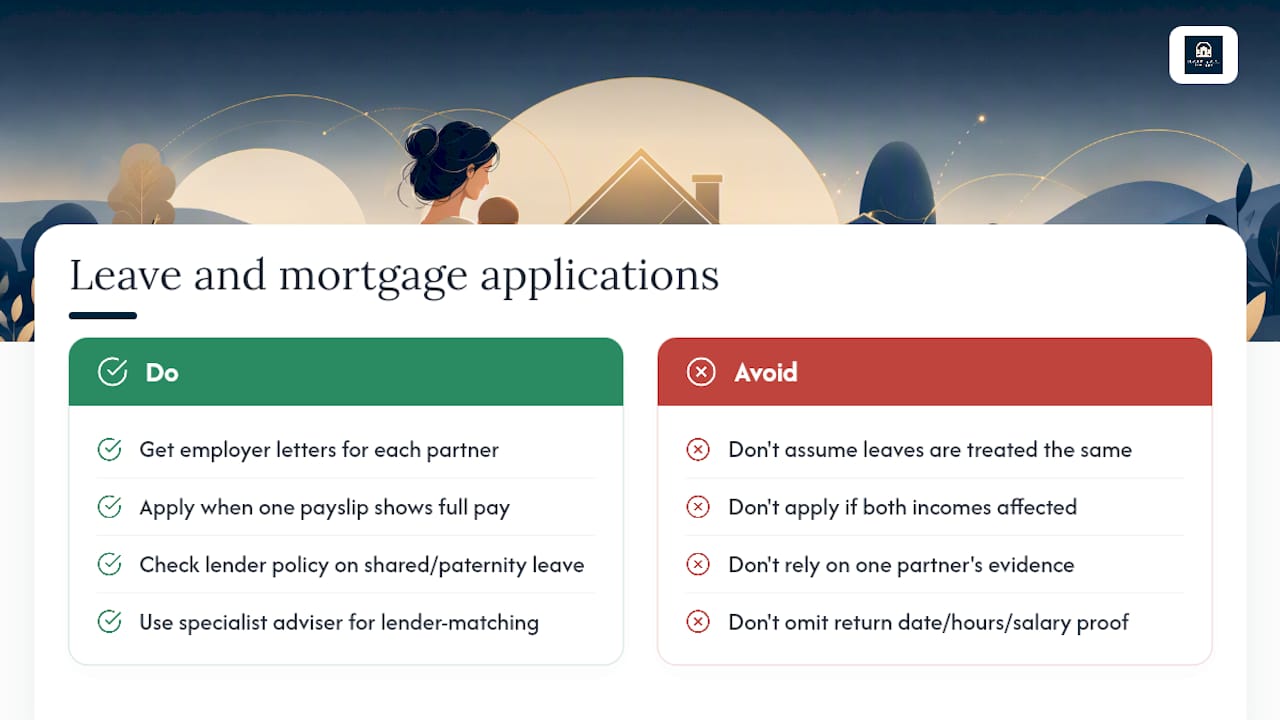
Where one partner is on maternity leave and the other is taking paternity leave or a period of Shared Parental Leave, a lender assessing a joint application will typically want return-to-work evidence for both incomes, not just one. If both partners are off work simultaneously, even briefly, that overlap can affect the current-income snapshot a lender sees at the point of application, even where both salaries are confirmed to return in full.
Shared Parental Leave adds a further wrinkle because pay during that period often mirrors statutory maternity pay rates, and some lenders haven't fully standardised how they treat it compared with traditional maternity leave. Practically, this means the same principle applies twice over: get a signed employer letter for each partner confirming return date, hours and salary, and don't assume a lender will treat paternity or shared leave identically to maternity leave without checking their specific policy first.
For joint applicants, timing the application to when at least one partner's payslips still show full, unaffected salary can simplify underwriting considerably, particularly if the other partner's leave arrangements are more complicated to document. Where both incomes are affected at once, a specialist adviser's lender-matching becomes more valuable, since fewer lenders have a clear, consistent policy for handling two simultaneous leave periods within the same household.
Proving future income continuity when you're self-employed with irregular income
Self-employed applicants face a different challenge on maternity leave, because there's no employer letter to fall back on. Lenders instead look at your trading history and try to judge whether your business income will continue at a similar level once you return to working full hours.
Typically, this means providing two to three years of accounts or self-assessment tax returns, alongside evidence of ongoing contracts, retained clients or recurring bookings that demonstrate the business hasn't stopped simply because you've stepped back temporarily. If you've maintained some client work through your maternity leave, invoices and bank statements showing that continued activity can support your case. If you've stopped trading entirely for the period, a clear, dated plan for resuming, ideally backed by signed contracts or a return date agreed with key clients, carries more weight than a verbal assurance.
Limited company directors face a related issue: lenders often average dividends and salary across recent years rather than taking the most recent, potentially lower, year in isolation. If your last set of accounts reflects reduced trading due to maternity leave, an accountant's letter explaining the dip and confirming projected income on return can support the application, alongside guidance on how lenders assess director income more broadly.
Contractors and day-rate workers should gather signed contract extensions or new contract offers wherever possible, since a rate card alone rarely satisfies an underwriter. The challenges facing IR35 contractors around income proof compound further when maternity leave is added to the mix, which is another reason lender-matching matters so much for this group.
A short, compliant invitation to contact Haven Mark Advisers
Most maternity leave mortgage cases don't fail because the borrower is unaffordable. They fail because the application landed with a lender that defaults to SMP-only underwriting instead of one that accepts a confirmed return-to-work salary. Specialist mortgage advisers exist to help prevent that mismatch happening.

Some mortgage advice firms give clients one dedicated adviser throughout the process, handling document checks, lender-matching and case management from first call to completion, rather than passing cases between different contacts as complications arise. This matters most for clients whose income doesn't fit a standard payslip: lawyers and legal professionals, banking and finance professionals, and self-employed business owners all face underwriting quirks that a generalist broker may not anticipate.
A first call typically covers a review of your documents, an honest assessment of which lender routes are realistic given your maternity leave and income type, and next steps for your residential mortgage in London. Fees are set out transparently on the fees and how we're paid page before you commit to anything. Advice is regulated and fee-based, and no outcome, borrowing amount, or rate can ever be guaranteed.
Sources
- MoneySuperMarket — Getting a mortgage on maternity leave
- Maternity Pay Calculator — Getting a mortgage on maternity leave
- MortgageAffordability — Getting a mortgage on maternity leave
This article is general information, not a substitute for advice from a qualified financial advisor. Consult a qualified financial professional about your own circumstances before acting on anything here.
FAQ
Can I get a mortgage while on maternity leave?
Yes, most mainstream lenders will assess affordability using your confirmed return-to-work salary rather than your current maternity pay, provided you supply the right employer evidence.
How much can I borrow on maternity leave?
Borrowing is commonly 4 to 4.5 times your annual salary once a lender accepts your return-to-work figure; it falls considerably if a lender assesses you on current SMP only.
What does the employer letter need to include?
It should confirm your return date, contracted hours, salary on return, and that your role is being held open, ideally on company letterhead and signed by HR or your line manager.
Does a remortgage work differently to a product transfer while I'm on leave?
Yes. A product transfer usually skips a full affordability check, while a remortgage to a new lender re-runs affordability and needs the same evidence as a purchase.
What can I do if my mortgage application is refused because of maternity leave?
Ask the lender for the reason in writing, check whether it assessed you on SMP alone, and use the lender's complaints process or the Financial Ombudsman Service if you believe the refusal was unreasonable.
Is it worth using a specialist mortgage adviser during maternity leave?
For borrowers with complex income, such as company directors, contractors or those combining maternity leave with paternity or shared parental leave, a dedicated adviser like those at Haven Mark Advisers can match you to lenders more likely to accept return-to-work evidence.
Recommended
- Fixed term contract mortgage: what England lenders expect
- New job mortgage: your guide to buying with recent employment
- Mortgage for Professionals: What Lawyers, Doctors and Self-Employed Need to Know
- Skilled worker visa mortgage: can you get one in the UK?
This article provides general information only and does not constitute personalised mortgage advice. Mortgage availability, affordability and lender criteria depend on individual circumstances and may change. Please seek advice tailored to your circumstances before acting on this information.