

IMPORTANT: YOUR HOME MAY BE REPOSSESSED IF YOU DO NOT KEEP UP REPAYMENTS ON YOUR MORTGAGE.
Mortgage underwriting is the lender's verification stage after your Agreement in Principle: it checks your documents, values the property and decides whether to issue a formal mortgage offer. The outcome is binary, an offer (often with conditions attached) or a decline. For most mainstream applications in England, expect the underwriting stage itself to run 1 to 4 weeks; complex or specialist cases regularly take longer.
TL;DR:
- Mortgage underwriting typically takes between 1 to 4 weeks for mainstream lenders, with delays caused by missing documents, down-valuations, or slow responses to queries.
- Self-employed, contractor, and foreign national applicants often face longer manual underwriting processes, requiring additional documentation and specialist checks.
- Responding promptly to underwriter queries and preparing all necessary paperwork before application can significantly reduce delays.
- Declines are usually due to affordability issues, credit problems, or property valuation shortfalls, but some cases can be improved by adjusting deposit size or switching lenders.
- Having a dedicated adviser to manage the application process helps prevent delays, especially for complex income sources or non-standard property types.
Table of Contents
- Where underwriting sits in the mortgage timeline
- What lenders check during underwriting
- How long does underwriting take and what causes delays?
- Special-case underwriting: self-employed, contractors, buy-to-let and foreign nationals
- How to prepare and behave during underwriting to avoid delays
- When underwriting raises queries or declines your application
- Haven Mark Advisers can manage the process for you
- Sources
- FAQ
Where underwriting sits in the mortgage timeline
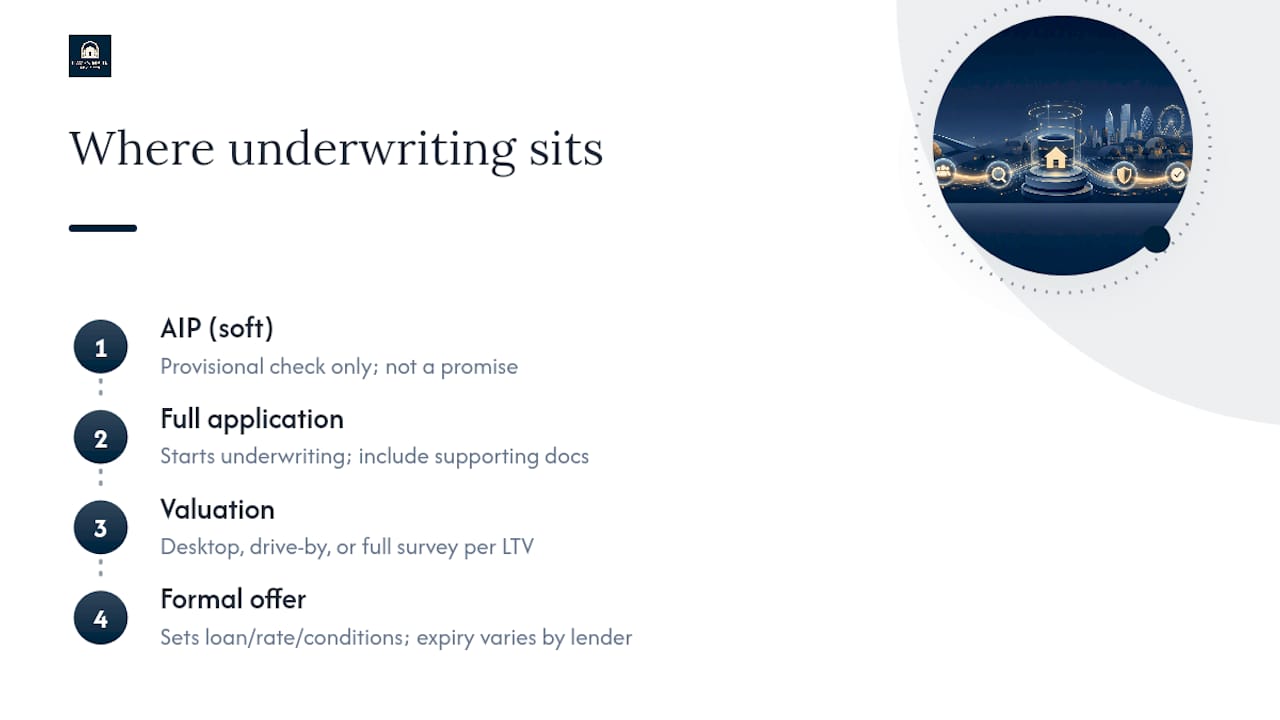
An Agreement in Principle (AIP) is a soft, provisional indicator built on limited information, not a promise. Full underwriting only starts once you submit a complete application with supporting documents, and lenders can still decline at that stage even after issuing an Agreement in Principle. Many first-time buyers treat the AIP as a done deal, which sets up unnecessary disappointment later.
Once the underwriter has your file, the valuation is instructed. Lenders choose between a desktop valuation (an automated estimate using comparable sales data), a drive-by inspection, or a full physical survey, depending on the loan-to-value ratio and the property type. Lower-risk, standard properties at modest LTVs often qualify for the faster desktop route, while unusual or higher-value properties tend to get a full inspection.
A formal offer, once issued, sets out the loan amount, rate, and any conditions still to be satisfied. Offers typically remain valid for a set period, which varies by lender, so check the expiry date on your own offer letter rather than assuming a standard figure. Understanding this sequence matters if you are weighing up a Decision in Principle against a full application.
What lenders check during underwriting
Underwriters work through five core areas on every file: affordability and income, credit history, deposit and source of funds, property valuation, and overall risk exposure, including loan-to-value and age at the end of the mortgage term.
- Income and affordability: PAYE applicants supply payslips and P60s; self-employed applicants need SA302s or accountant references. Lenders stress-test affordability against a higher notional rate, and treatment of bonuses or commission varies between lenders.
- Credit history: a full credit file review looks for patterns rather than isolated events. Recent late payments carry more weight than older, settled defaults, and an active payment arrangement is viewed differently to one that has been cleared.
- Deposit and source of funds: gifted deposits, sale proceeds, and savings all need a paper trail to satisfy anti-money-laundering checks.
- Property valuation and suitability: LTV, construction type, remaining lease length, EPC rating, and flood or subsidence flags can all affect the decision or attach conditions.
- Other checks: identity verification, your age at the end of the mortgage term, and existing financial commitments all feed into the final risk assessment.
Pro Tip: Pull your credit report before you apply, not after a query lands. Spotting and explaining an old default yourself looks far better to an underwriter than having them ask about it cold.
How long does underwriting take and what causes delays?
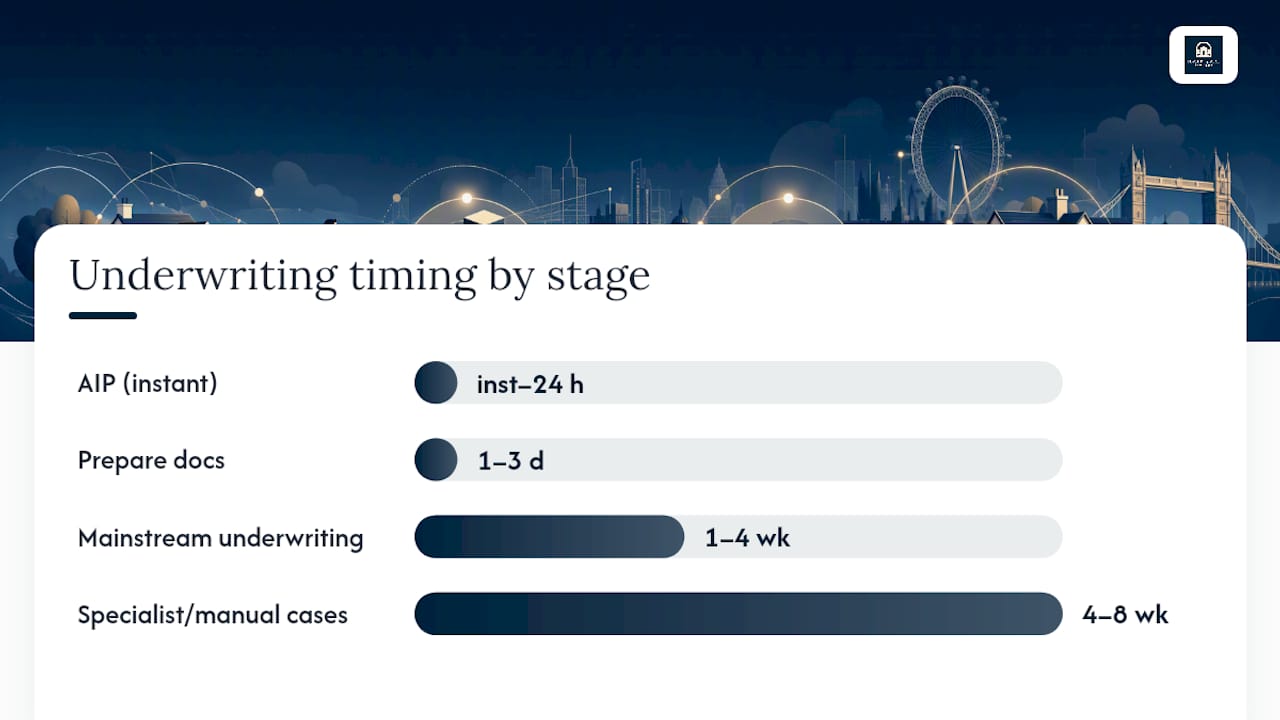
Timing varies more by lender type than most applicants expect. An AIP can be instant or take up to 24 hours, and pulling your documents together for a full application often takes a further 1 to 3 days if you are organised. From there, underwriting and valuation commonly take 1 to 4 weeks at mainstream lenders, while specialist or manual-underwriting cases often run 4 to 8 weeks. Some high-street lenders with automated systems can turn round straightforward cases within days of the valuation, since many now run hybrid automated and manual underwriting models.
Four things routinely add weeks to the process:
- Down-valuations, where the surveyor values the property below the agreed price, often forcing a bigger deposit, a renegotiated price, or revised loan terms, and are a leading cause of underwriting delay.
- Missing or incomplete documents, which send the file back to you rather than forward to a decision.
- Solicitor delays, particularly around searches and title queries.
- Slow responses to underwriter queries, which stall the file at the back of a queue rather than moving it along.
Responding to queries on the same day they arrive, rather than the same week, can shave one to four weeks off the overall timeline, according to research on how long a mortgage application takes.
Special-case underwriting: self-employed, contractors, buy-to-let and foreign nationals
Self-employed applicants and contractors usually go through manual underwriting rather than an automated system, because their income does not fit a standard payslip template. Expect to provide two to three years of SA302s or full accounts, plus an accountant's reference confirming your figures. A free checklist such as TradeTally's sole trader tax and CIS checklist can help you gather the right paperwork before you apply, and our contractor mortgage guide covers what different lenders typically expect from day-rate income.
Buy-to-let underwriting shifts the focus away from your personal salary and onto the property itself. Lenders stress-test the rental income against the mortgage payment and want evidence of your track record as a landlord where you have one.
Foreign nationals and those with pre-settled status face extra scrutiny of residency documentation, visa status, and time remaining in the UK. Acceptance criteria differ significantly between lenders, so it pays to understand what evidence each one actually wants before applying, covered in more detail in our foreign national mortgage guide. Non-standard properties, short leases, or unusual construction methods, often attract additional conditions or a specialist valuation before an offer is issued.
How to prepare and behave during underwriting to avoid delays
Most delays are avoidable. Gather your documents before you submit, not after an underwriter asks for them:
- Three months of payslips and your most recent P60
- Three months of bank statements across your main accounts
- Valid photo ID (passport or driving licence)
- Proof of deposit, including a gifted deposit letter where a family member is contributing
- SA302s or full accounts for the last two to three years if you are self-employed
If your bank statements show an unusual transaction, a large one-off transfer or an irregular payment, explain it in writing before the underwriter asks. It reads as transparency rather than something to hide.
Once your file is with the underwriter, avoid changing jobs, applying for new credit, or moving large unexplained sums of money. Any of these can trigger fresh checks and reset the clock. Pro Tip: Instruct your solicitor the same week you submit your mortgage application, not after you get your offer. Conveyancing searches take time regardless of how fast underwriting moves, and running them in parallel is where real time gets saved.
When underwriting raises queries or declines your application
A query is not a red flag, most files get at least one. Typical requests cover missing documents, a clarification from your solicitor, or a specialist report on the property. Answer promptly and in full; a partial response usually generates a second query rather than closing the first.
If the application is declined, you have options. Sometimes it is as simple as correcting an error in the paperwork and reapplying. Other times, a different lender with different criteria for your circumstances is the better route, or increasing your deposit changes the loan-to-value enough to shift the outcome. For adverse credit, complex income, or a foreign-national case, this is exactly when a specialist mortgage adviser earns their fee, matching you to a lender whose criteria actually fit your situation rather than guessing.
Haven Mark Advisers can manage the process for you
Chasing paperwork, decoding a lender's query, and second-guessing which provider will actually accept your income structure is where most applicants lose weeks. Haven Mark Advisers is built around one dedicated adviser handling your case from first conversation to completion, so you are never explaining your situation to a new person halfway through.

That single point of contact matters most for professionals with complex income, lawyers, banking and finance workers, self-employed business owners, and contractors, whose files often need manual underwriting and a lender genuinely comfortable with non-standard evidence. Haven Mark Advisers manages queries proactively rather than waiting for them to stall your file, and has access to a broad range of UK lenders to match your circumstances rather than forcing you into a one-size-fits-all product. Fees are agreed upfront: the purchase mortgage service is £495, paid on completion.
If you want to see how a dedicated adviser prepares a file before it reaches underwriting, read how we get you ready to offer, or head straight to the main mortgages page to start a conversation about your own application.
Sources
For further reading beyond this guide, Barclays covers AIP mechanics, Bright Box explains the underwriter's role, and MoneyHelper offers independent guidance on the wider mortgage process.
This article is general information, not a substitute for advice from a qualified financial advisor. Consult a qualified financial professional about your own circumstances before acting on anything here.
- Agreement in Principle (Barclays)
- How long does a UK mortgage application take in 2026? (MortgageNotes)
- What is a mortgage underwriter? (Bright Box)
- How long from valuation to mortgage offer (Propelr)
FAQ
How long do mortgage underwriters take in the UK?
Underwriting and valuation commonly take 1 to 4 weeks at mainstream lenders, and 4 to 8 weeks for specialist or manually underwritten cases. Straightforward, automated cases at some high-street lenders can move faster than that once the valuation is back.
How long does it take for a mortgage to go through underwriting?
It depends heavily on how complete your documentation is when you submit. Complete files with prompt responses to queries move through underwriting notably faster than files that need repeated chasing, and using an adviser to manage that process typically helps.
How often do mortgages get denied in underwriting?
There is no single reliable figure for decline rates across the UK market, since criteria and risk appetite vary between lenders. The most common triggers are affordability shortfalls, credit issues uncovered during full checks, and down-valuations that change the deal's economics.
What are the stages of a mortgage process in the UK?
The sequence runs from Agreement in Principle, through a full application and valuation, to underwriter review, and finally a formal mortgage offer. Each stage depends on the one before it, which is why an AIP is never a guarantee of the final offer.
Recommended
- 4–8-week remortgage timeline in England: why one adviser speeds complex cases
- 30 Days to Extend a UK Mortgage Offer Without Reapplying
- Foreign National Mortgage in the UK: A Complete Guide
- Keep mortgage power on maternity leave in the UK with lender matching
This article provides general information only and does not constitute personalised mortgage advice. Mortgage availability, affordability and lender criteria depend on individual circumstances and may change. Please seek advice tailored to your circumstances before acting on this information.